Lithium Sulphur Battery Additives Using Incineration Ash
Synopsis
This technology uses incineration ashes for battery cell manufacturing to potentially address disposal and recycling issues. By incorporating incineration ash into lithium-sulphur (Li-S) batteries, this approach offers a cost-effective solution to enhance cycle life and reduce overall battery cost, contributing to the advancement of next-generation battery technology.
Opportunity
This invention explores a new application of incineration ashes, offering a potential solution to disposal and recycle problems stemming from them. The concept involves repurposing these incineration ashes to form battery cells. Lithium-sulphur (Li-S) batteries represent a promising advancement in next-generation battery technology owing to their utilisation of more readily available earth-abundant materials. However, the commercialisation of Li-S batteries has encountered significant challenges primarily attributed to their suboptimal cycle life.
Consequently, conventional Li-S battery methodologies incorporate active additives designed to adsorb polysulphides within the cathode, thereby improving cycling performance. Notably, many of these active additives are cost-prohibitive. Hence, the integration of incineration ashes as a substitute for a portion of these active materials presents a strategic approach to substantially mitigate the cost associated with Li-S batteries.
Technology
The invention relates to an electrode material comprising incineration bottom ash (IBA) in Li-S battery. By partially replacing the active materials, this integration serves a dual purpose: reducing the cost of Li-S batteries while also facilitating the recycling of IBA.
In Li-S batteries, capacity decay primarily arises from the "shuttle effect," wherein sulphur (S) in the cathode forms polysulphides during the charging/discharging process. These polysulphides are highly soluble in the electrolyte and tend to migrate from the cathode to the anode, where they deposit and struggle to return to the cathode. This phenomenon results in the gradual loss of active materials in the cathode and a subsequent decrease in capacity over time.
The inclusion of Fe2O3, Fe3O4, and potentially Al2O3 and TiO2, enhances cycling performance. These active materials can adsorb polysulphides and suppress the shuttle effect of the polysulphides. Some of them, like of Fe2 and TiO2, can catalyse electrochemical reactions and decrease the existence of polysulphides. Consequently, the loss of sulphur is significantly alleviated, leading to improved cycling capacity in Li-S batteries.
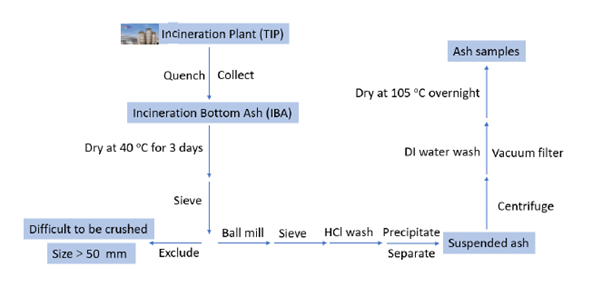
Figure 1: Steps to yield incinerated ash from an incineration plant.
Applications & Advantages
- First reported technique for utilising incineration ashes as active additives in Li-S batteries.
- Offers an eco-friendly solution for incineration ash disposal, reducing landfill needs, especially beneficial for clean energy Li-S batteries.
- Recyclable and environmentally friendly.
- No quantity restrictions; aligns with the demand for mobile energy devices.
- Active materials in incineration ashes boost battery cycling capacity by up to 50-100 mAh/g.
- Substitutes costly additives, reducing Li-S battery costs with minimal value ash and no need for expensive recycling chemicals or equipment.
- Lowers landfilling costs and conserves land resources.
- Converts worthless incineration ashes into high-value products, reducing disposal costs.

.tmb-listing.jpg?sfvrsn=ecbd1c2d_1)

-cropped.tmb-listing.jpg?sfvrsn=4ef22100_2)
.tmb-listing.jpg?sfvrsn=43b583b8_2)