Tokyo Alumni Dialogue Explores the Transformative Role of AI in Healthcare
Building on the momentum of last year’s Alumni Leaders Dialogue, which focused on Artificial Intelligence (AI), this year’s gathering took a deeper dive into AI’s transformative impact on the healthcare sector.
He was joined by Prof Goh Kim Huat, Associate Dean, Graduate Studies & Professor of Information Systems, Information Technology, and Operations Management, who moderated the session.
The event was hosted by Assistant Dean for NBS Alumni Relations, Assoc Prof Chung Lai Hong, who highlighted the Nanyang MBA’s rising global rankings, and growing international recognition. She attributed these achievements to the alumni who continue to embody the NBS’ values and uphold its reputation worldwide.
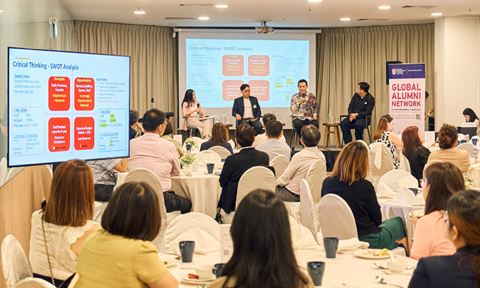
The dialogue and Q&A session served as a dynamic knowledge-sharing platform for more than 70 alumni and guests who converged in Tokyo to explore the practical applications, limitations, and implications of AI in healthcare.
The following is an edited transcript:
A common challenge that many developed countries face is the rapidly aging population. AI offers promising solutions to ease this growing burden by enhancing the efficiency of healthcare delivery and optimising resource allocation.
Dr Peng shared several real-world examples of how AI is making an impact:
Reducing missed appointments
In the United States (US), patient no-shows cost the healthcare system up to an estimated $150 billion annually. AI-powered smart reminder systems help mitigate these losses by prompting patients to confirm, cancel or reschedule their appointments, significantly reducing absenteeism.
Maximising consultation time
In Japan, where doctor visits are often less than 15 minutes, AI tools can help improve the quality of these interactions. By using AI to prepare patients in advance before the appointment, doctors can ensure that the limited consultation time is used effectively to focus on critical concerns.
Additionally, AI can generate post-visit summaries for patients to reinforce key takeaways.
Leveraging predictive AI
Coaching and knowledge retention
Alignment of business objectives
For AI to deliver real value, organisations need a clear understanding of the problems they are trying to solve.
Organisations must invest in internal capabilities, promote cross-functional collaboration, as well as cultivate a culture of curiosity, continuous learning, and disciplined execution.
Drawing from his experience in Japan, Dr Peng noted that when there is transparency and teams understand that the AI initiatives are designed to enhance their capabilities, they are more likely to embrace it.
Limitations
As organisations strive to align AI with strategic goals, it is important to recognise its limitations. While AI can significantly amplify human capabilities, it cannot replicate empathy, compassion, or the human touch. These are qualities that are indispensable in delivering effective and ethical care.
Governance
To ensure the safe and responsible use of AI, clear governance frameworks are essential. This includes ethical safeguards, robust data privacy protections, and measures to mitigate bias.
Approaches to AI governance vary globally, with the U.S. leaning toward market-driven models. The European Union prioritises individual rights and data privacy, while Japan is adopting a more balanced stance and has plans to introduce a nationwide healthcare data platform by 2030.
Q & A Segment
Accountability
-(1).tmb-listing.png?sfvrsn=58da16d6_1)