NBS Knowledge Lab Webinar: Cultural Intelligence and the Future of Work: Building Inclusive Teams Across Borders
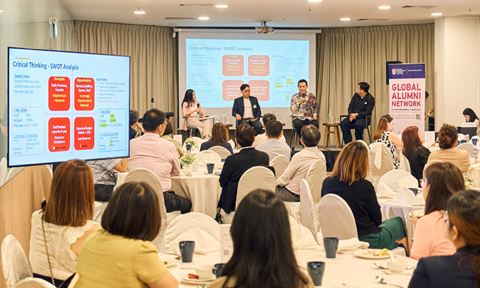
On 6 November 2025, the NBS Knowledge Lab hosted a webinar on Cultural Intelligence (CQ) and the Future of Work. Moderated by Professor Kok Yee Ng, Director of Research at the Centre for Leadership and Cultural Intelligence (CLCI), with Associate Professor Thomas Rockstuhl, Director of Psychometrics, the session featured Mr Tatsuo Hidaka of Rakuten Group and Dr Stefan Seiler of UBS Group - two senior leaders who have actively collaborated with CLCI on CQ research and practice.
Key Takeaways for Leaders
- Cultural Intelligence (CQ) enables individuals and organisations to bridge cultural differences and turn diversity into performance.
- Shared language, feedback loops, and inclusive practices build alignment and cohesion across borders.
- As AI reshapes work, CQ remains essential for empathy, fairness, and collaboration.
Understanding Cultural Intelligence
Prof Ng began by defining culture as “a set of shared rules of a group of people”. Diversity, she noted, extends far beyond nationality - it encompasses organisational, professional and disciplinary differences. Citing a meta-analysis of more than 100 studies involving 10,000 teams, she observed that diversity alone does not improve performance. The missing capability is the ability to work effectively across differences - cultural intelligence.
Assoc Prof Rockstuhl elaborated that CQ is the capability of individuals, teams or organisations to function effectively in culturally diverse environments. CQ comprises four key factors:
- Drive – one’s energy to work across cultures.
- Knowledge – understanding similarities and differences across cultures.
- Strategy – planning for, monitoring, and learning from intercultural interactions.
- Action – flexing verbal and non-verbal behaviour across cultures.
Research shows CQ predicts adaptability, decision-making, and performance in cross-cultural contexts, not just for individuals but also for teams and organisations.
Practice in Action: Insights from UBS and Rakuten
UBS – Integrating Cultures after a Historic Merger
Dr Seiler described how CQ guided UBS’s integration of Credit Suisse, the largest merger in banking history. The challenge was to blend two corporate cultures while maintaining engagement across 51 countries and more than 100 nationalities.
UBS launched a structured culture-integration programme anchored in empathy and leadership commitment. The programme comprised four key components:
- Over several months, more than 80% (18,000) of all leaders participated in a shared leadership experience to strengthen relationships and build common understanding.
- Each workshop, led personally by members of the Group Executive Board, centred on developing a shared language and unified identity.
- Continuous feedback mechanisms reinforce these efforts. Every manager - including the CEO - receives annual feedback from their teams through a 15-item Line Manager Effectiveness survey.
- UBS also evaluates staff using two performance dimensions: contribution and behaviour, ensuring that cultural values influence promotions and rewards.
Within two years, employee sentiment between the two organisations had nearly equalised - evidence of a successful cultural integration. “Culture,” Dr Seiler observed, “should have global standards and regional practices.”
Rakuten – Building Cultural Bridges through Language and Technology
Mr Hidaka outlined how Rakuten’s Englishisation policy, introduced in 2012, transformed the Japanese technology conglomerate into a global ecosystem. With more than 20 per cent of employees at its Tokyo headquarters now non-Japanese, language and cultural integration remain central to its strategy.
The Rakuten People and Culture Lab developed a distinctive approach to CQ in 2021, anchored on three key practices within Rakuten Mobile, Inc., one of its group companies:
- Managers at Rakuten Mobile are trained to embrace differences, observe objectively, and act strategically to close cultural gaps.
- The company uses virtual-reality simulations that place staff in another person’s perspective - Japanese employees experience foreign colleagues’ viewpoints and vice versa - followed by group reflection.
- Training participants co-create lists of inclusive language: for instance, using “group company” rather than “subsidiary” when referring to newly acquired firms.
Such practices, Mr Hidaka explained, help employees shift from an individual to a team-based mindset and ensure that Rakuten’s values are lived across geographies.
The Human Connection in a Hybrid World
Both speakers highlighted that culture develops through human interaction. Dr Seiler shared that UBS now expects employees to be in the office at least three days a week, describing the policy as “office-centric with flexibility.” Physical proximity, he said, enables informal conversations and observation, which are vital for learning and cultural cohesion. Mr Hidaka agreed, highlighting the need for “breathing space” in conversations, where colleagues can exchange views beyond meeting agendas to understand one another’s backgrounds.
Managing Difference and Fairness
Addressing questions on team dynamics, Prof Ng noted that cultural diversity differs from personality differences because cultural “rules” are often implicit, and when violated, they can evoke perceptions of unfairness. Both panellists underscored the importance of structured feedback in creating shared understanding.
At UBS, systematic feedback through surveys and performance reviews reinforces expectations and accountability. At Rakuten, hiring managers consider candidates’ backgrounds, including industry, company size and growth stage, to anticipate differing work norms and facilitate smoother integration.
When Leadership Commitment Matters
Asked what happens when senior management does not take CQ seriously, Dr Seiler reflected that effective leaders want to succeed, and feedback systems help them see how culture shapes performance. He likened leadership to driving a train: “You may be the engine, but if the wagons are not connected, the train will not move.” Leaders, he said, must ensure alignment between their direction and the organisation’s culture, or risk derailment.
The Future of CQ in the Age of AI
The discussion ended with reflections on Artificial Intelligence (AI). Dr Seiler described AI as “a new player in the team” and urged leaders to learn how to work effectively with machines that influence decisions and processes. Mr Hidaka cautioned that many AI systems are trained on culturally narrow data, resulting in biased outcomes. He called for efforts to “educate AI” with more balanced, diverse information.
Assoc Prof Rockstuhl added that while AI tools focus largely on text, much of cultural intelligence lies in non-verbal communication - tone, gesture and timing - areas where technology still struggles to replicate human understanding.
Conclusion
As Prof Ng concluded, diversity alone does not guarantee success; what matters is the ability to detect and create shared rules. From mergers to virtual teams, and from VR empathy training to AI collaboration, CQ offers a roadmap for inclusive, high-performing organisations. In the evolving world of work, it is not only a leadership skill - it is a strategic necessity.
Watch the webinar here:
-(1).tmb-listing.png?sfvrsn=58da16d6_1)