NBS Knowledge Lab Webinar: GenAI and Digital Transformation: Competing in the Next Wave
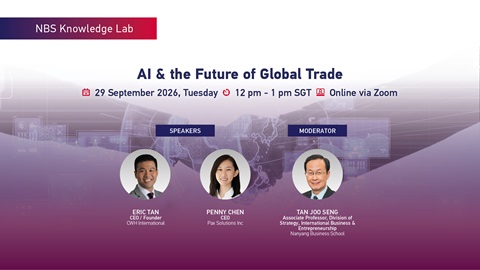
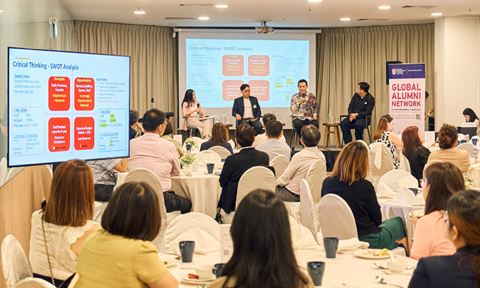
On 25 September 2025, the NBS Knowledge Lab hosted an engaging webinar on how Generative AI (GenAI) is transforming industries through digitalisation. Moderated by A/P John Dong from Nanyang Business School (NBS), the session featured distinguished speakers sharing real-world perspectives: Mr Lawrence Wu, Dr Elva Zou, and Dr Koh Hau Tek.
Key Takeaways for Leaders
- Start small with secure pilots and scale as you learn.
- Use GenAI to augment human expertise, not just automate tasks.
- Governance, data security, and training are critical for trust and adoption.
The Strategic Role of GenAI in Digital Transformation
GenAI is rapidly moving from headlines to practice, driving the next wave of digital transformation. In the technology sector, Dr Zou emphasised that AI has become part of core infrastructure. “It’s no longer an optional tool — it should be considered part of the basic infrastructure,” she said, referencing a McKinsey study that found 80% of companies already use AI in their daily operations.
She highlighted how GenAI is already solving everyday challenges. During COVID-19, many F&B merchants lacked professional images for online menus, which frustrated customers and reduced sales. By using text-to-image AI, restaurants could instantly create appetising visuals, overcome language barriers, and improve user experience while keeping costs low.
Mr Wu described how renewable energy players like EDPR are embedding GenAI across three areas. First, internal productivity: a secure AI assistant now supports presentations, proposals, and research while protecting sensitive data. Second, operational efficiency: predictive maintenance has reduced downtime by up to 50% and cut maintenance costs by up to 40%. Third, forecasting and simulation: AI aligns demand with intermittent renewable supply by integrating weather data and batteries to ensure reliability.
Dr Koh offered a healthcare perspective, noting that GenAI is poised to transform both shared services and clinical practice. In China, Tsinghua University has piloted an “AI hospital” able to handle 10,000 patients a day — three times more than a conventional hospital. While AI is not yet replacing procedural medicine, it is beginning to manage non-procedural consultations such as internal medicine and family practice under doctor oversight. “This is a big change,” he remarked, signalling a shift in medical education, workforce planning, and research.
Balancing Technology with Ethics and the Human Touch
Despite its promise, the panel warned of significant challenges. Dr Zou cautioned about AI “hallucinations,” data bias, and the need for explainable models in sensitive areas like HR screening and financial services. Mr Wu emphasised the importance of governance frameworks, secure closed-loop systems, and staff training, noting, “Policies and training are as strategic as the models themselves.”
Dr Koh spoke about the issue of data sovereignty, particularly in countries like Indonesia where infrastructure for AI adoption remains limited. He contrasted this with China, where abundant data and scale allow rapid in-country innovation. Privacy, regulation, and geopolitical factors all shape how quickly healthcare can adopt AI globally.
The panellists also stressed the human dimension. In energy and tech, GenAI supports more personalised customer experiences. In healthcare, it enhances but does not replace empathy and accountability. As Dr Zou observed, “AI allows humans to focus on complex issues, relationship- building, and empathy.”
The Future of AI in Industry
Looking ahead, the speakers agreed that most jobs will change rather than disappear. Repetitive and rules-based roles may be automated, but humans will remain essential for judgment, creativity, and care. In healthcare, radiology and chronic disease management are likely to see deep AI integration, while procedural medicine will evolve as GenAI converges with robotics and remote capabilities. In energy, precision forecasting, asset optimisation, and hyper-automation will widen the gap between leaders and laggards.
The panel emphasised that organisations should begin now, starting small but deliberate. “Don’t wait for the perfect tech stack,” Dr Zou advised. “Get your hands dirty and learn by doing.”
Leaders to Learn From
When asked about role models, Mr Wu pointed to holistic organisations that combine governance, innovation, and staff-driven ideas to scale AI responsibly. Dr Koh highlighted Professor Wang Tianyin of Tsinghua University, who spearheaded the AI hospital initiative. Dr Zou cited Jensen Huang of NVIDIA for pushing the compute frontier and also praised her own students for developing AI tools that help seniors navigate the digital world safely.
As Prof Dong reflected, GenAI is not only a lever for efficiency but also a driver of strategic transformation. By pairing technological advances with ethical safeguards and human insight, organisations can harness AI to compete more effectively. The future of digital transformation will be defined by ambition balanced with responsibility, and innovation guided by empathy.
Watch the webinar here:
-(1).tmb-listing.png?sfvrsn=58da16d6_1)