
From Artificial Enzymes to Ultrasensitive, or Even Single Molecule Biosensors That Operate in Complex Biological Fluids by Professor J. Justin Gooding
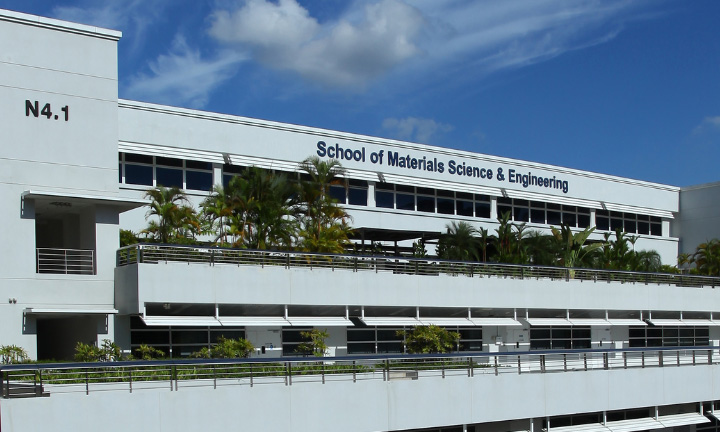
NTU MSE Seminar Hosted by Dr Rui Goncalves
Abstract
This presentation will cover recent advances in three major directions in sensing in complex biological fluids. Firstly, the concept of nanozymes, nanoparticles that serve as artificial enzymes by performing reactions that enzymes also perform. As attractive as this concept is, nanozymes have been challenged by poor selectivity in complex biological fluids. Herein, we will show how nanoparticles that are designed with similar three-dimensional geometry to enzymes, with active centres down nanoconfined substrate channels can be used to develop biosensors that can detect glucose in whole blood [1].
Next we turn our attention to the liquid biopsy and the monitoring of microRNA released from single 3D printed spheroids [2] to begin to understand what information from the liquid biopsy could mean in terms of drug treatments. To achieve this we require ultrasensitive sensors that allow us to detect tiny amounts of biomarkers released from the spheroids. For our proof of concept work we use gold coated magnetic nanoparticles (Au@MNPs) as dispersible electrodes which allow the development of ultrasensitive sensors for proteins and microRNA, even down to just a few thousand molecules [3].
Finally, the presentation pivots to single molecule sensors and how we can detect single molecules, and single molecule binding events, by viewing a biosensing surface in a wide field format and imaging individual molecules. We show how super-resolution fluorescence microscopes, specifically stochastic optical reconstruction microscopy (STORM) allows widefield imaging with single molecule resolution can be turned into a single molecule counting approach as well using electrochemistry; an approach we developed call electrochemical or EC-STORM. We have shown that electrochemistry can be used to do this fluorescence switching without photobleaching of molecules such that molecular counting seems possible [4]. The talk discusses how this is done before demonstrating the molecular counting approach.
Biography
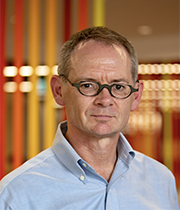
Professor J. Justin Gooding
University of New South Wales
J. Justin Gooding graduated with a B.Sc. (Hons.) from Melbourne University, a D.Phil. at the University of Oxford, and postdoctoral training at Cambridge University. He is currently a Professor in Chemistry at the University of New South Wales. He leads a research team interested in surface modification and nanotechnology for biosensors, biomaterials, electrocatalysis, and 3D bioprinting. He has been invoveld in the commercialisation of a glucose meter that interfaces with an iPhone, a 3D bioprinter for making artificial cancers for drug testing and now a smart patch that monitors drugs in the body in real time.