
Colloidal Semiconductor Quantum Dots: From Artificial Atoms to Designer Molecules by Professor Uri Banin

04 Feb 2026
11.00 AM - 12.00 PM
Harvard Room, Research Techno Plaza Level 1
Alumni, Current Students
NTU MSE Seminar Hosted by Professor Cho Nam-Joon
Abstract
Colloidal semiconductor quantum dots (QDs), often regarded as artificial atoms, have reached an exceptional level of synthetic control and fundamental understanding—particularly regarding their size, composition, and surface-dependent properties. Their tunable characteristics, scalable bottom-up synthesis, and compatibility with solution-based processing have enabled widespread applications in displays, lasers, light-emitting diodes, single-photon sources, photodetectors, photocatalysis and beyond.
For the next step towards enhancing their functionalities, we take inspiration from molecular chemistry and present a strategy for the controlled linking and fusion of two core/shell QDs, creating artificial molecules with two coupled emissive centers.1 These coupled colloidal quantum dot molecules (CQDMs) exhibit electronic level hybridization and optoelectronic behaviors that are fundamentally distinct from their individual QD constituents.2 Notably, CQDMs enable a novel electric-field-induced instantaneous color-switching effect—allowing for color tuning without loss of intensity—a feature unattainable with single QDs.3 These dual-emission quantum dot molecules can be engineered to emit distinct colors, offering new opportunities for electric field sensing and the development of color-switchable devices, such as innovative pixel architectures for next-generation displays or tunable photon sources.
References
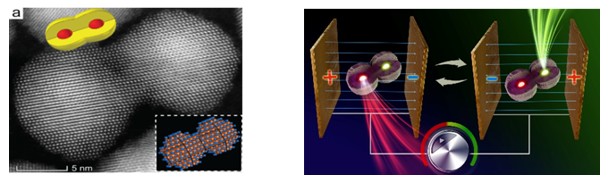 Fig. 1: Coupled homodimer molecule formed by fusing two core/shell colloidal quantum dots. Left: A high resolution electron microscopy image. Right: illustration of the color switching effect |
References
[1] J. Cui, Y.E. Panfil, S. Koley, D. Shamalia, N. Waiskopf, S. Remennik, I. Popov, M. Oded, U. Banin, “Colloidal Quantum Dot Molecules Manifesting Quantum Coupling at Room Temperature” Nature Comm. 10, 5401 (2019).
[2] S. Koley, J. Cui, Y. E. Panfil, Y. Ossia, A. Levi, E. Scharf, L. Verbitsky, U. Banin, “Photon Correlations in Colloidal Quantum Dot Molecules Controlled by the Neck Barrier” Matter 5, 3997-4014 (2022).
[3] Y. Ossia, A. Levi, Y.E. Panfil, S. Koley, E, Scharf, N. Chefetz, S. Remennik, A. Vakahi, U. Banin, “Electric field induced color switching in colloidal quantum dot molecules at room temperature” Nature Materials 22, 1210-1217 (2023).
Biography
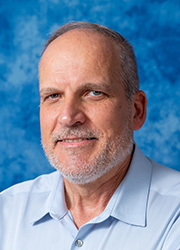
Professor Uri Banin
Institute of Chemistry and the Center for Nanoscience and Nanotechnology
The Hebrew University of Jerusalem
Uri Banin received his B.Sc. degree summa cum laude (1989) and Ph.D. in Physical Chemistry summa cum laude (1994), all from the Hebrew University of Jerusalem. After his postdoc as a Fullbright and Rothschild fellow (UC Berkeley, 1994-1997) he joined the Hebrew University of Jerusalem (1997) where he is a Full Professor since 2004, holding the Alfred and Erica Larisch Memorial Chair. He was the founding director of the Hebrew University Center for Nanoscience and Nanotechnology (2001-2010), served on the scientific advisory board of Nanosys Inc. (2002-2007), was the founder (2009) of Qlight Nanotech that developed the use of nanocrystals in displays – and that was acquired by Merck in 2015. He served as an Associate Editor of the ACS journal Nano Letters (2013-2021). Banin is studying the chemistry and physics of nanocrystals and is best known for inventing new types of semiconductor quantum dots and hybrid semiconductor-metal nanocrystals, and for his studies on their unique chemical and physical properties with relevance for applications in nanotechnology in the fields of displays, alternative energy especially photocatalysis, materials science and quantum technologies. Recently he introduced “Nanocrystals Chemistry” to create coupled molecules from colloidal quantum dots serving as artificial atoms. He published over 250 papers that have been widely cited and is an inventor of over 30 patents in nanotechnology. He received numerous awards including the Israel Chemical Society Prize for Outstanding Young Scientist (2001), the Michael Bruno memorial award (2007-2010), the Landau prize in Nanotechnology (2015), the Israel Chemical Society Prize of Excellence (2018) a Miller fellowship at UC Berkeley (2019), and the Rothschild prize in chemical sciences (2024). He received the ERC advanced investigator grant twice (Project DCENSY 2010-2015; Project CoupledNC 2017-2023), and also an ERC-POC grant.