NTU researchers have created a colour-changing sensor that signals when a structure is under stress, offering a potentially simpler and intuitive way to monitor the health of bridges, buildings and other critical infrastructure.
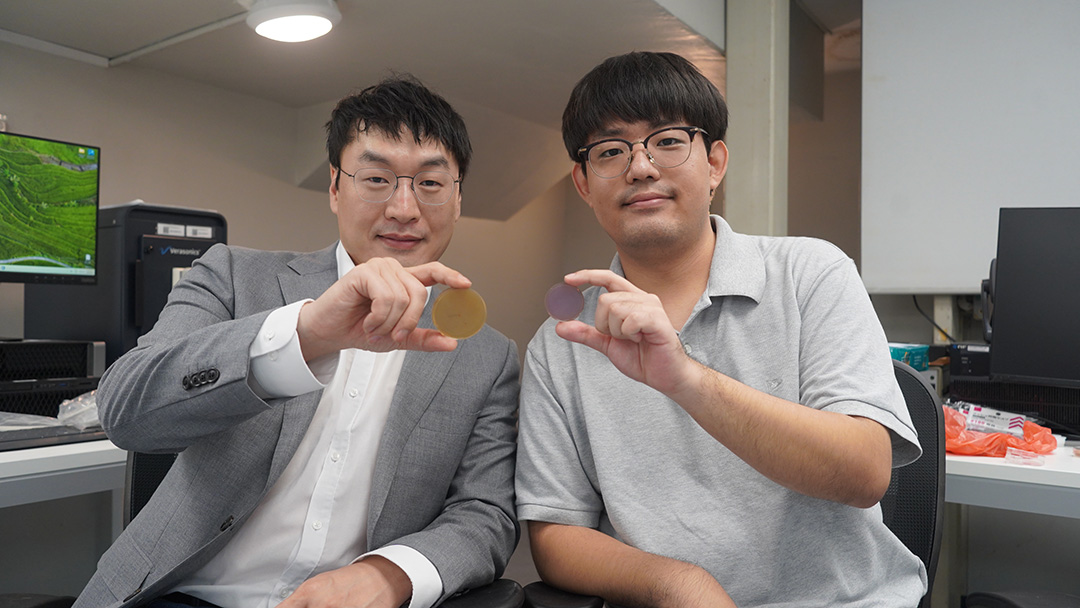
Tan Swan Beng Assistant Professor Gun Kim (left) and his PhD student Seungo Baek (right) with a sample of the colour-changing sensor. Photo credit: NTU College of Engineering (CoE).
Developed by Tan Swan Beng Assistant Professor Gun Kim and his PhD student Seungo Baek from the Cross-Ultrasound Research (CURE) Lab in NTU's School of Civil and Environmental Engineering (CEE), the smart polymer sensor displays multiple colours in response to different levels of stress, providing an immediate visual warning without the use of batteries, wiring or complex monitoring systems required by conventional sensing technologies.
The sensor provides a visible indication of where the stress is concentrated and how severely it is developing, enabling engineers to quantify the condition of a structure promptly. The research was recently published in Advanced Science.
"In civil engineering, many sensors are designed to measure either strain or stress. Ours can measure both, while also functioning as a structural component," said Baek, first author of the paper.
Making infrastructure sensing systems more intuitive
The sensor communicates stress through colour, much like a traffic light. As stress increases, it shifts from cooler tones to warning red, allowing engineers to gauge a structure’s condition without analysing complex graphs or data streams. Different colours correspond to different stress levels, making it easier to identify areas that require closer inspection or immediate attention.
The polymer sensor shows multiple colour changes under low and high stress conditions. Video credit: Assistant Professor Gun Kim.
"You do not need any training to read colour. As stress increases, the colour shifts distinctly, allowing engineers to know right away what needs attention," said Kim.
Tackling real-world challenges
Deploying conventional sensors requires costly interventions, such as power supplies, batteries and wiring, while ongoing maintenance adds to the overall expense over time. Reducing these costs has been a longstanding challenge in civil engineering.
By embedding sensing capabilities directly into entangled polymer networks, the team has developed a simpler alternative that operates as both a sensor and a structural component.
The technology could potentially be applied to bridges, cables and other critical infrastructure where early detection of excessive stress matters most. A visible colour change could help engineers catch problems early, before they require major repairs or escalate into safety risks. The team is now working to transform this from single test samples into scaled-up structural components.
Inspired by interdisciplinary research
The work reflects Kim's interdisciplinary approach to research. During his postdoctoral research in the Carle Illinois College of Medicine at the University of Illinois, he immersed himself in bioacoustics, polymer mechanics, and therapeutic ultrasound imaging. That foundation continues to shape his approach to addressing complex challenges in civil engineering.
“What if a bridge could automatically tell us, 'I'm sick'? What if it could identify where it hurts by itself?” said Kim. “That curiosity has sparked new research ideas and taught me the importance of interdisciplinary research.”
Driven by this idea, the colour-changing sensor was developed by combining knowledge from structural health monitoring, polymer mechanochemistry, and focused ultrasound.
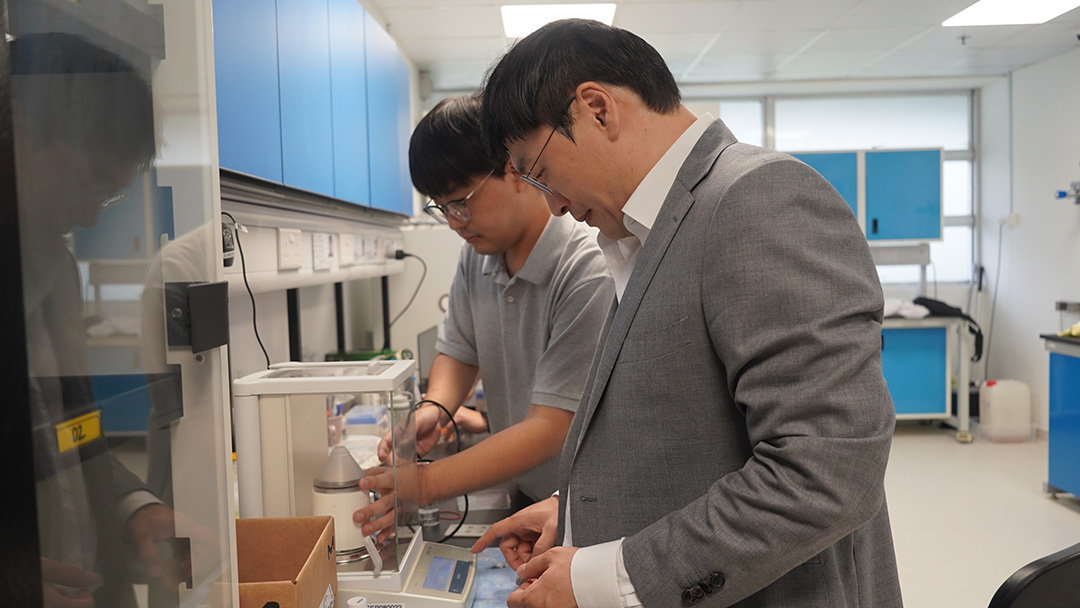
Kim and Baek in the laboratory where they conduct research on smart polymer sensors for infrastructure monitoring. Photo credit: NTU CoE.
“It goes both ways now,” said Kim. “The techniques we developed for civil engineering can also be translated back, and we are now using ideas gained from civil engineering to design new platforms for super-resolution scanning of the human body and targeted triggering of drugs and particles.”