
About CTPE Lab:

Construction Technology Laboratory

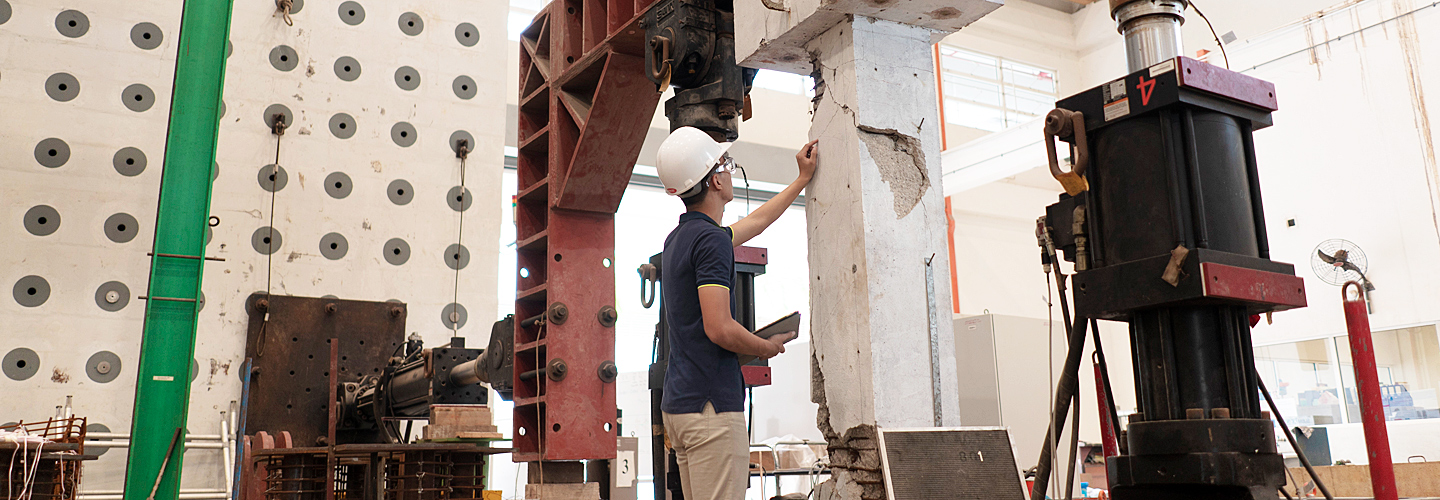
The Construction Technology Laboratory supports teaching, research, and industry collaboration in construction materials, structural systems, and construction technologies. Equipped with specialised facilities for material characterisation, non-destructive evaluation, and full-scale structural testing, the laboratory enables both fundamental investigations and applied engineering studies.

Its facilities include a large strong floor testing area designed for full-scale structural experiments, a dedicated construction annex, materials testing facilities, and workshop support. The laboratory is capable of conducting a comprehensive range of tests on construction materials and building components, providing students and researchers with hands-on experience in the assessment of structural performance and construction practices.

The laboratory facilities are categorised into 4 sub-categories:

200-Tonne Dynamic Testing Frame
This system is a 2000kN servo-controlled hydraulic actuator unit that is capable of conducting 2000kN compression and 1500kN tension loading test. It is driven by a controller that is linked to a computer. The software is capable of controlling and monitoring load and the external sensors.


500-Tonne Dynamic Universal Testing Frame
A hydraulic powered facility which comprises a frame and a control panel with measuring and control instruments. For a higher requirement in the lateral stiffness, this frame is designed in four columns instead of two-columns.

Capability: Compression (5000 kN), Tension (2000 kN)

Stroke: 500 mm

Control/Measurement Mode: Load, Position and Strain

500-Tonne High-Stiffness Servo Controlled Compression Testing Frame
This system is a servo-controlled hydraulic actuator unit that is capable of conducting 5000kN compression test. It is driven by a controller that is linked a computer. The software is capable of controlling and monitoring load and external sensors connected.

500-Tonne Servo Controlled Horizontal Actuator Test Rig Enhanced with Heating Furnace
This horizontal test rig houses a 500 Tonne servo-hydraulic actuator unit that is capable conducting 5000kN compression and tension on specimen connected horizontally. It is driven by a controller that is linked to a computer. The software is capable of controlling and monitoring load and external sensors.

Hopkinson Bar Testing Machine

Rebound Hammer
The instrument, also named as Rebound Hammer is used for quick measurement of the quality and compressive strength of concrete. It meets the testing standard BS1881; ASTMC805.

Ultrasonic Pulse Velocity Tester
An Ultrasonic device commonly used for crack & void detection, measurement of layer thickness and elastic modulus, uniformity & deterioration of concrete. Low frequency pulses are passed between the two transducers placed at the end of the specimen being tested and time taken measured to determine the velocity of the pulses through the specimen. The strength of the specimen is then read off from a chart.

Crack Measuring Microscope
Crack measuring microscope is specially designed for measuring crack width in concrete. This high definition microscope operates via adjustable light source provided by high-power batteries.

Rebar Locator, Profometer & Covermeter
These instruments consist of electromagnetic cover devices used for determining the position and direction of reinforcement bars. These instruments give precise measurements of the concrete cover and estimation of the rebar size.

150-Tonne Dynamic Testing Machine
This system is a 2000kN servo-controlled hydraulic actuator unit that is capable of conducting 2000kN compression and 1500kN tension loading test. It is driven by a controller that is linked to a computer. The software is capable of controlling and monitoring load and the external sensors.


15-Tonne UTM with 3-zone heating furnace

Concrete Water Penetration Apparatus
This apparatus is used for determining the depth of penetration of water under pressure. The water under controlled pressure is applied to the surface of the concrete specimen and the readings obtain through the graduated glass burettes mounted on the front panel after the test.

Compression Machine
The Laboratory houses 2 unit of Compression machine, 2000kN and 3000kN respectively. These digital controlled machines allow the user to set the rate of loading according to the loading requirements. It is commonly used for testing cubes and cylinders.

Corrosion Testing Equipment

  • Concrete Coring Machine
  • Concrete and Steel Grinders
  • Concrete Cutting Machine
  • Wood Cutting Machine
  • Sand Blaster
  • Bar cutter
  • Lathe Machine
  • Milling Machine
  • Drilling Machine
  • Metal Shear Machine
  • Welding Machine
  • Miscellaneous

The laboratory has a workshop that is fully equipped with the above-mentioned facilities to aid in the fabrication of jigs, specimens, modifications or even repair work. Staff and students alike would consult our technicians for advice regarding the work that would be required.

Protective Engineering Laboratory

Established in late 2003, Protective Engineering Laboratory is located at block N1.1, level B5. The laboratory carries out activities ranging from conducting research projects, teaching laboratory experiments for common engineering subjects, guiding students with final year projects to events such as consultancy projects and forums.

The strong floor and the strong reaction wall have over 2000 anchor holes placed at a uniform spacing of 600mm in two orthogonal directions. Therefore, the test-rigs (8 sets with 2000kN capacity) can be placed and oriented in almost any direction to suit a particular test. The laboratory has the capability to perform 18 simultaneous tests of specimens with 9m length each.

The L-shaped reaction wall is 6m/8m high. It can carry more than 100 tons of lateral load per square metre of wall area. With the size and strength of the reaction wall, the PE lab can easily perform a complete test of a full-scale 3-D building of 3-storey high. The strong floor is strong enough for testing an 800mm-thick concrete flat plate slab under punching load.

  • 2 sets of Hydraulic Power Packs are connected in series
  • Total flow rate up to 1000 liter/min
  • Operating pressure of 21 MPa (3000 psi)
  • 8 sets of hydraulic manifolds with 22 outlets
  • 10 units of dynamic / pseudo dynamic actuators
  • Capacity: 500-1000KN
  • Displacement: 250-1000mm
  • Control system can support up to eight control channels
  • 2 sets of MTS Flex Test GT Controller
    • 1 set with 4 channel output
    • 1 set with 6 channel output
  • Creation of complex test procedures that include command, data acquisition, event detection, and external control instructions
  • Uni-axis Horizontal Shake Table
  • 30-ton Servo-Hydraulic Actuator
  • 3m x 3m Steel Table Top
  • +/- 200mm Maximum Dynamic Displacement
  • Performance with 10Ton Max Nominal Payload:
  • 1.3g Max Acceleration
  • 0.8m/s Max Velocity
  • 4.0g Acceleration with No Payload
  • Frequency Range: 0-50Hz to Over 100Hz
  • Sine, Random, Impulse, Arbitrary Waveform

The Shake Table can be used to test large-scale structural components and reduced-scale model structures under simulated earthquake ground motions as well as blast-induced ground shocks.