From A Cappella to Academia: NTU CCEB Graduate Named Global Winner in Chemical & Pharmaceutical Sciences
Lau Chung Hean’s award-winning undergraduate research on surface organometallic chemistry paves the way for more efficient industrial catalysts.
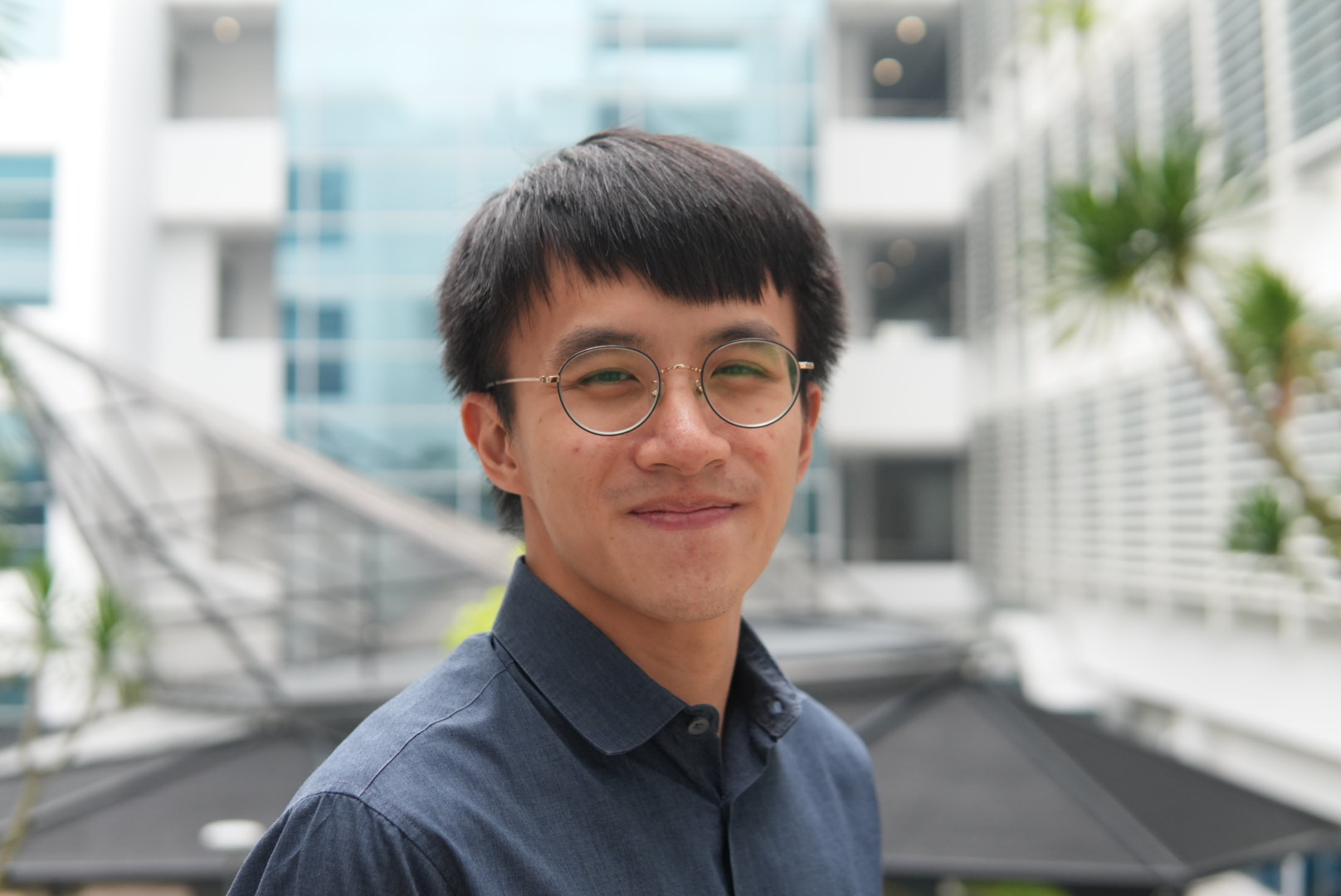 Lau Chung Hean
2026 Global Winner for Chemical & Pharmaceutical Sciences, Global Undergraduate Awards
Chemistry and Biomolecular Chemistry Alumnus, NTU School of Chemistry, Chemical Engineering and Biotechnology (CCEB)
We are thrilled to feature Lau Chung Hean, who was crowned the 2026 Global Winner in Chemical & Pharmaceutical Sciences at the Global Undergraduate Awards. Chosen from hundreds of top international submissions, his award-winning work underscores the exceptional research standards and interdisciplinary thinking driving the future of the field.
The Global Undergraduate Awards are often described as the 'Junior Nobel Prize' of academia, evaluating thousands of entries worldwide. When you received the news that you were selected as the Global Winner in the Chemical & Pharmaceutical Sciences category, what was your initial reaction—and what does this honour mean to you and those who supported you through your undergraduate journey at CCEB?
When I first received the news, I was stunned and it felt like time stood still, which wasn’t ideal for the column chromatography I was running. Jokes aside, I took some time to process it all – the award, the summit, the opportunity. I shared the good news with Prof. Christophe Copéret and Kazutaka Sakamoto, who were my supervisor and mentor respectively at ETH Zurich, and I thanked them for providing me with the opportunity, resources and guidance which made receiving this award possible. Besides being a significant milestone in my research journey, this award is also a testament to the quality of education, opportunities and resources to perform research that NTU CCEB has provided me with during my undergraduate journey. In particular, I’m especially grateful to Ex-Assoc. Prof. Leong Weng Kee and Wong Zhen Xuan, who helped me build a strong foundation in organometallic chemistry research during my second-year research attachment. I would also like to thank the CN Yang Scholars Programme (CNYSP) and CCEB faculty and staff for their support over the past four years. All these culminated in a successful overseas final year project and the honour of receiving this award.
Your award-winning submission in Chemical & Pharmaceutical Sciences triumphed over competitive entries from other universities. Can you briefly explain the core focus of the research you submitted, and what real-world challenge your work aims to address?
Propene is the second most important petrochemical building block, and propane dehydrogenation (PDH) plays a major role in its production with the help of catalysts. While the industry relies on these catalysts every day, we still lack a complete understanding of their structure, which makes improving them difficult. Our research aims to close this gap by using surface organometallic chemistry (SOMC) to systematically construct a model Pt-Sn catalyst with well-defined surface sites. By performing rigorous spectroscopy and microscopy characterization, we were able to gain new insights about the tin (Sn) species present during each step of catalyst development. Our catalytic tests also affirmed the promoter effect of tin in PDH catalysis. All in all, this project refreshes our understanding of these complex catalytic systems and highlights SOMC as a powerful methodology to accurately understand and then improve catalytic systems relevant to the global industry.
As a CN Yang Scholar, you have engaged in hands-on, interdisciplinary tinkering and research since your first year. How did CCEB’s collaborative ecosystem—especially after the merger of chemistry and engineering—help shape your scientific perspective and encourage you to push the boundaries of conventional chemistry?
As I completed my final year project overseas, I missed out on CCEB’s collaborative ecosystem and its merger between science and engineering. However, during my early undergraduate years, NTU instilled in me an interdisciplinary and collaborative mindset through various modules such as Making and Tinkering. The module is taken by CN Yang Scholars Programme (CNYSP) students at the end of their first semester, bringing together diverse talents from various majors to engineer creative solutions to real-world problems. In my project, I collaborated with peers from physics, materials science, and computing to design a smart fish tank that automatically tops up its own clean water to maintain optimal pH and TDS levels—a process that taught us invaluable, multidisciplinary skills like prototyping, 3D-printing, soldering, and circuit board wiring. This experience definitely played a part in motivating me to seek a research project that stepped beyond conventional chemistry and ultimately led me to research in applied catalysis, which bridges molecular chemistry and industrial chemical processes.
Aside from your rigorous lab work, you were a member and vocal percussionist of NTU CAC Harmonix, the a cappella club. Were there any lessons from a cappella that you were able to apply to your academic work?
A big part of this would be resilience. The preparation for an a cappella concert is such a lengthy process, and just like in academic research, things take a ton of creative but logical trial and error to get right. Through perseverance, we sometimes make serendipitous discoveries, which can be the key turning point in performance preparation and in research. Another similarity I got to appreciate was the beauty of collaboration – in a cappella that manifests in the chords, dynamics and “colour” of music, in research that manifests in the integration of ideas and insights.
As you look back on your undergraduate journey at CCEB, what is the most valuable life lesson or scientific mindset you have developed that you would most like to pass down to your juniors?
If there’s one thing I want to share, it would be to do everything with love. When our experiments fail to work, it’s our love for learning that keeps us going. Research can sometimes get overly competitive and stressful, and it’s so important for us to treat each other with care and kindness. And when we fail to meet our own expectations, it’s a good reminder to be gracious to ourselves too, and to be happy. So that’s it – love – to the science, to the people around us and to ourselves.
Winning a global award at the undergraduate level is an incredible launchpad into your research career. As you look beyond this milestone, what are your ultimate aspirations, and how do you hope your PhD at CCEB will help you achieve these?
I’m grateful that this award is not only an acknowledgement of my undergraduate research work, but also a springboard into my future career in academia and research. Through my PhD at CCEB under the supervision of Asst. Prof. Zhong Hongyu, I aim to make use of the opportunities ahead to develop the necessary knowledge and proficiencies to do well in a career in research. For my PhD, my focus will be back in molecular organometallic chemistry, specifically looking at asymmetric catalysis.
🎓 Find out more about CCEB's undergraduate programmes here.
💬 Stay connected! Follow CCEB on LinkedIn, Instagram, and Facebook to keep up with our latest research highlights, student stories, and campus happenings.
Story by Sumita Thiagarajan, NTU CCEB