Programme Overview
The MSc Finance programme at Nanyang Business School is a one-year, full-time programme that equips students with a strong foundation in financial concepts, theories, and analytical techniques essential for success across a diverse finance ecosystem.
Programme Calendar
The MSc Finance is a one-year full-time programme across three trimesters. Classes commence in August and will be completed in May the following year.
.png?sfvrsn=67bc6abb_2 "MSc Finance Programme Structure (as of Jun 2026)")
Curriculum
The MSc Finance programme can be completed in one year on a full-time basis. Students will select between two elective tracks – Fintech and Sustainability – in Trimester 3.
Pre-Trimester
In today’s world, basic technological proficiency is a must. Consistent feedback from the industry has indicated that Microsoft Excel skills are critical to be effective in the workplace.
This is an online, self-paced eLearning course designed for students with little or no experience in Excel to equip them with essential Excel skills through hands-on practice.
In the financial industry, programming is becoming an essential and fundamental skill nowadays. Among all different programming languages, Python is probably the most widely used one to deal with financial data analysis and decision making.
The purpose of this preparatory online course is to prepare students with zero knowledge of Python to get familiar with the Python environment so that they can catch the basics of Python under the context of financial problems and be prepared for the subsequent advanced data analysis courses using Python.
This is a pre-course to prepare students for the Financial Accounting and Analysis course. In this pre-course, students learn the foundation of financial accounting. This includes understanding the accounting cycle, elements of financial statements and basic structure of financial statements.
Trimester 1
This course aims to provide students with a broad understanding of important financial principles, concepts, and analytical tools for practical applications. It is the first finance course for this program and the materials that you learn here will serve as the foundation to study other finance courses (such as Investments, Equity Securities, and Advanced Corporate Finance, among others). It is therefore important for you to build a strong financial foundation from this class. The main topics include capital budgeting, asset valuation, financing and investing decisions, and most importantly, the time value of money.
The course aims to equip students with accounting skills and knowledge essential for understanding and analysing financial statements for business decisions. Students will learn the concepts and applications of financial accounting standards on key economic transactions of the reporting entity so that they can interpret and analyse financial statements. These transactions include complex scenarios that involve financial instruments, impairment, leases, and business combinations.
This course provides a rigorous introduction to the fundamentals of modern finance and their applications to business challenges in investment. Models of investment are at the heart of every investment decision, whether that decision is to buy, sell, or hold. Due to the globalization process and ever-changing dynamics of the modern financial markets, the pricing of any financial asset has become a more complex task. This course endeavors to provide the basic understanding and tools to conduct portfolio analysis, make investment decisions, and manage portfolios. By the end of this course, students should have a broad understanding of investments and portfolio management. This course covers the analysis of various investment vehicles (stocks, bonds, and options), allocation of assets, and modern portfolio theory. Students will learn valuation, portfolio construction and evaluation techniques, and apply investment techniques using Excel.
The main topics are: (A) an introduction to asset classes and financial instruments, and how to trade financial securities; (B) fixed income securities; (C) risk and return, capital allocation decisions; (D) modern portfolio theory, the Capital Asset Pricing Model (CAPM), Arbitrage Pricing Theory (APT), and Multi-factor models; (E) performance evaluation of mutual funds and other portfolios.
This course introduces students to the basic statistical and decision analysis tools for making informed management decisions. Statistics is the science of learning from data and includes everything from collecting and organizing to analysing and presenting data. It is concerned with probabilistic models, specifically inference, using data. It focuses on understanding the principles and developing problem-solving skills. The use of computer-based solution tools will be emphasized throughout the course. This course also presents the fundamental concepts of linear regression model and with an emphasis on applications, real data, and the use of statistical software. Emphasized are understanding the assumptions of the statistical techniques and knowing when and how the techniques might be useful in a business setting. Students should develop abilities to identify, analyse and solve financial problems.
The Communication course will enhance participants’ ability to design and deliver presentations that influence an audience, change their mindset and inspire them to take actions that are to the presenter’s advantage. Participants will learn to make the right initial impact, gain the attention and respect of the audience, and establish on-going rapport with them. These skills can be applied in any business or workplace scenario with any corporate audience including potential employers, customers, investors, senior management and internal staff, and government officials or agencies.
The course aims to equip students with essential knowledge and practical tools to enhance their effectiveness at the workplace. Students will explore concepts of workplace conflict, team decision making and the influence of individual differences on work behaviour. They will learn to apply this knowledge to better understand their own and others’ actions, navigate conflict at work, and contribute to more effective team decisions.
Trimester 2
This course is to provide an in-depth understanding of theoretical foundations of fixed income securities, markets and their analyses. These financial securities include treasury debt, corporate bonds and asset-backed products. Their risk-return characteristics will be explained in terms of price-yield relationship, yield and return measures, and price volatility measures. Various techniques for the valuation, trading, and risk control of these securities will be illustrated in details in association with yield curve analysis.
The objective of this course is to provide students with comprehensive coverage of the principles and techniques in equity securities analysis, especially asset valuation. Valuation is at the heart of every investment decision, whether that decision is to buy, sell, or hold. This course will guide you through the theory and application of various valuation models (such as DCF, APV, VC, Option Pricing, and Relative Valuation) and highlights their strengths and weaknesses. It will cover the valuation of conventional going concern firms, financial service firms, start-ups and early-stage firms, private companies, IPOs, distressed firms, biotechnology, natural resources firms, and cryptocurrencies.
The main aim of this course is to understand the factors affecting the global economy. We will first trace through how we arrived at the current global economic situation. Students are then required to provide an analysis of potential future path for the global economy. This is followed by an analysis of the sources of economic growth and policies that drive it. An important policy tool to help calibrate growth is monetary policy. In this course, we will analyse monetary policy under inflationary and deflationary expectations. However, not all central bank implements monetary policy through the same means. We will of study how monetary policy is carried out in major central banks around the world. Finally, students will learn how to read economic indicators and financial market signals in order to make sense of dynamics of the global financial market.
This course aims to provide students with an understanding of various Derivatives & Structured Products – forward, futures, swaps, and option with different underlying assets, such as shares, stock indices, and foreign exchange. You will learn how these contracts work, how they are used and how they are priced. This course is quantitative in nature and intense. To gain the most mileage from the course, you are encouraged to read the required text, do the assignments, read financial newspapers and actively participate in class.
Trimester 3
Sustainable finance integrates environmental, social and governance (ESG) criteria into business and investment decisions for sustainable outcomes, which include reducing inequality, improving inclusiveness, reducing pollution, and mitigating and adapting to the adverse effects of climate change, among others.
This course is the study of finance and sustainability as an integrated subject beginning with an introduction of financial and investment principles and moving towards financial analysis, financing, valuation, responsible investment and impact investing. The course covers diverse aspects of sustainable investments and offers tools for effective financial valuation and effective risk assessment. The perspective proposed by this course is motivated by the desire of corporations for continued prosperity, expansion and in some cases even to promote their own survival.
The course introduces you to the world of mergers and acquisitions (M&A), emphasizing the use of real-world business cases. It covers fundamental techniques and principles associated with successful M&A and addresses how acquisitions can form a crucial and valuable part of a company’s growth strategy.
The main purpose of this course is to guide the student to acquire solid knowledge about the functions and operations as well as risk management practices of financial institutions from a global perspective. This course is particularly valuable to those who will pursue a career in financial industry. Understanding how financial institutions operate in increasingly competitive international financial markets and under treacherous global macroeconomic environment is critical for those who would like to pursue a successful career in financial industry.
This course will outline and analyse China's financial situation, financial policies, financial markets and financial institutions from the macro and micro levels. The course will briefly review the development history of China's financial market and then focus on the current situation of China's financial market and major ongoing financial reforms. The course covers monetary policy, financial regulation, stock market, bond market, derivatives market, financial innovation and so on.
- Corporate Strategy and Risk Management
While organizations primarily focus on improving economic performance, it is equally important to address the associated environmental and social risks. The course will focus on embedding sustainability into corporate strategies while providing foundational knowledge of risk management theory and equipping participants with tools and financial models to evaluate and integrate climate risks into strategic and investment decisions.
- Sustainability Reporting
This course provides a comprehensive exploration of sustainability reporting, designed to equip students with the principles and practices essential for navigating the corporate landscape. Students will learn to prepare and critically analyse sustainability reports by studying key frameworks, standards, and materiality assessment methodologies. The course emphasizes practical application, covering topics such as stakeholder engagement, data management, and quality assurance. It also delves into critical contemporary issues, including greenwashing, carbon offset controversies, and ESG rating discrepancies, preparing students to handle the complexities of modern sustainability disclosure.
- Machine Learning in Finance
This course covers essential machine-learning techniques in finance. The emphasis is placed on financial applications and how can they transform the finance industry. This course will go into detail about some selected topics such as artificial neural networks and decision trees, and support vector machines. This course will also train the students’ soft skills through the group project on realistic data analysis problems.
- Blockchain Systems: Concepts & Principles
This is an introductory course to equip students with basic knowledge of blockchain. Students will study the basic building blocks of a blockchain network. From a financial perspective, students will also study how to evaluate cryptocurrency as a new alternative asset class. We will study how applied cryptography techniques are crucial to the operation of a blockchain. Two example blockchains are explored in more depth: Bitcoin and Ethereum. For Ethereum, we will also look at Smart Contracts. From an enterprise perspective, we will study how blockchains can be engineered for enterprise adoption.
Optional
The six-month internship opportunity equips students to transit from the classroom to work with ease. It also helps to increase the likelihood of our students securing employment after graduation.
Leading People Globally
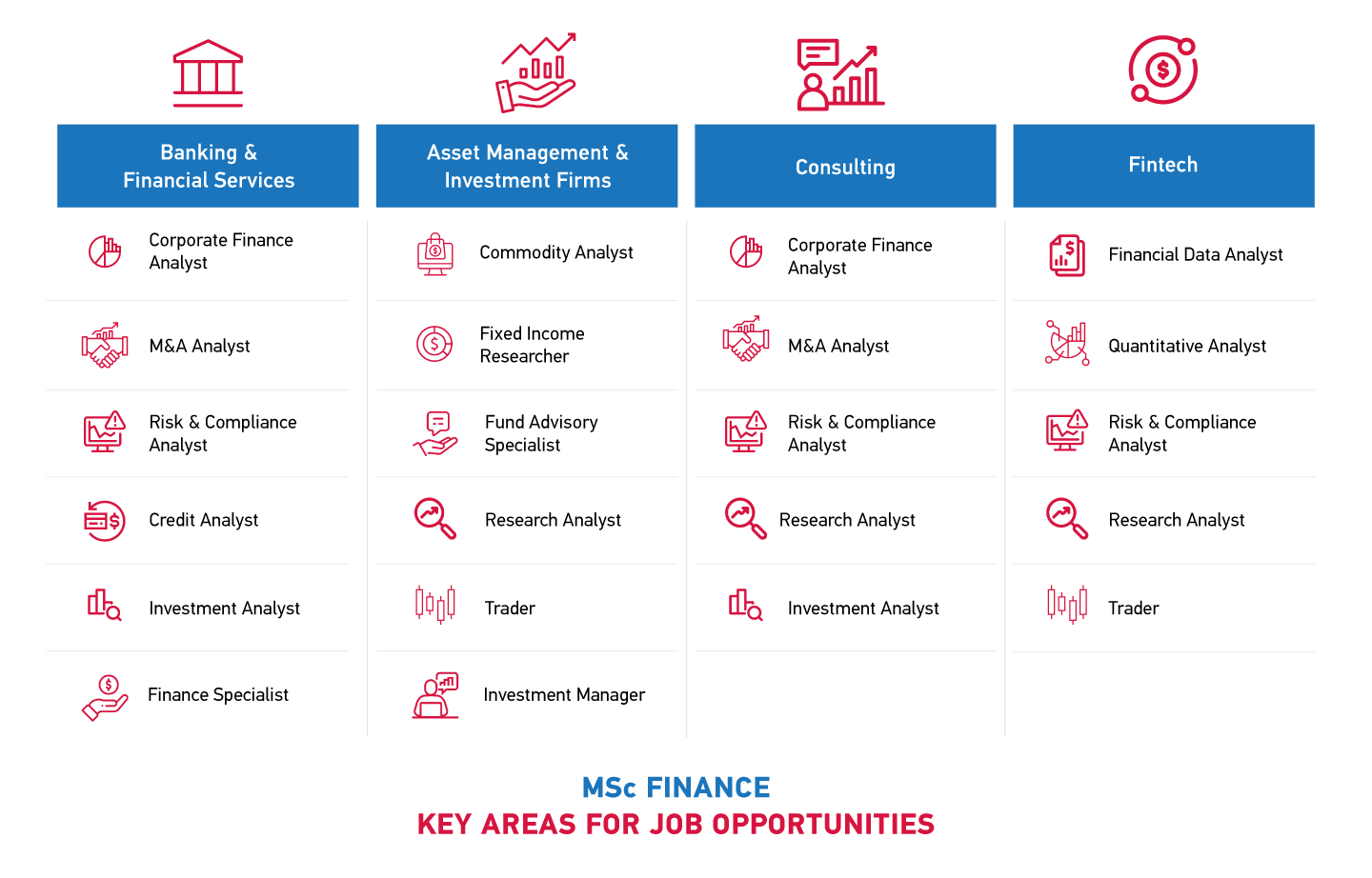
The MSc Finance programme prepares our students for the deep and diverse global economy. Discover the key areas for job opportunities that awaits our candidates after graduation.