Prof Tan Ming Jen Receives 2026 ASTM International Additive Manufacturing Award of Excellence in Education
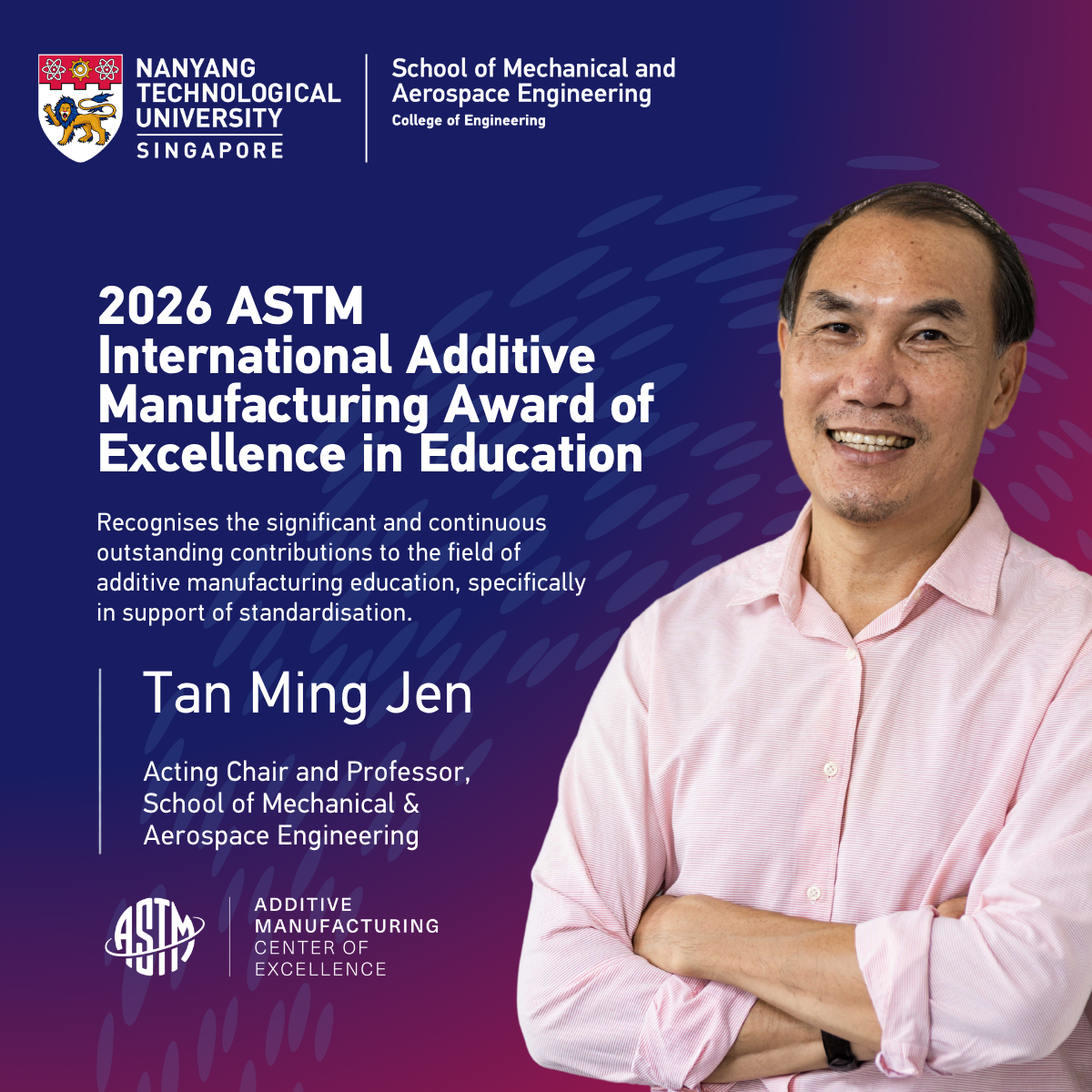
NTU MAE congratulates Professor Tan Ming Jen on receiving the 2026 ASTM International Additive Manufacturing Award of Excellence in Education.
The award is given by the ASTM Additive Manufacturing Center of Excellence. It recognises his significant and continuous contributions to additive manufacturing education, specifically in support of standardisation. Dr Mohsen Seifi and Professor Nima Shamsaei presented it to him at the 11th ASTM International Conference on Advanced Manufacturing (ICAM 2026) in Orlando, USA.
Since 2019, the award has been presented to one individual each year.
Prof Tan began his academic career studying the formability of light alloys such as aluminium, magnesium and titanium. In 2013, he became the founding Programme Director (Building & Construction) at the Singapore Centre of 3D Printing (SC3DP). At that time, 3D printing at construction scale was still largely unexplored. He was given the opportunity to lead the programme by the then Director and Deputy Director of SC3DP, Prof Chua Chee Kai and Prof Leong Kah Fai.
According to the United Nations Environment Programme (UNEP), the buildings and construction sector accounts for around 37% of global carbon dioxide emissions. Cement production alone makes up around 8%, according to the Global Carbon Project.
Working with industry partners, Prof Tan has pursued greener construction in two ways. The first is upcycling waste into building material. The second is making the manufacturing process itself cleaner.
Upcycling waste into building material
Fly ash is left over when rubbish is incinerated. Prof Tan's team used it in the concrete mix for their first 3D-printed bathroom units, made in 2019 with Sembcorp Design and Construction. The units were a world first, and up to 30% lighter than conventional ones.
"My researchers integrated the printing robot, mixer and pump themselves. Our first print went swimmingly running without a single stop until the job finished at midnight, almost nine hours later," said Prof Tan.
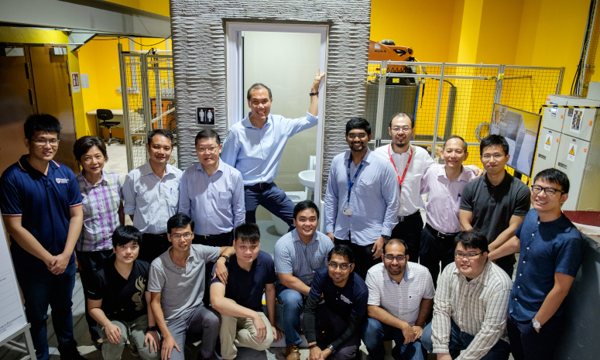
Prof Tan and the research team with a 3D-printed prefabricated bathroom unit.
Recycled glass is the team's second upcycled material. Glass is one of the least recycled waste materials in Singapore, even though it can be recycled without any loss in quality. It is also about 70% silica, the main component of sand.
Prof Tan's team developed a concrete mix that uses recycled glass in place of sand. Their study, "Extrudable region parametrical study of 3D printable concrete using recycled glass concrete," published in the Journal of Building Engineering, used the mix to 3D print a 40cm-tall L-shaped bench.
"What our research does is to essentially return the silica found in glass to be reused again as sand in our 3D printing concrete mixture," Prof Tan said in 2022.
.jpg?sfvrsn=ea078333_1 "3D_printed_benches (L-shaped bench)")
The L-shaped bench, 3D printed with a concrete mix that uses recycled glass in place of sand.
The team has also worked with Australian partner Mineraltec and the National Additive Manufacturing Innovation Cluster (NAMIC) to develop recycled glass as a substitute for sand in 3D-printable concrete.
Capturing carbon in the printing process
With Saudi Aramco Ltd, the team developed a 3D concrete printing method that captures carbon dioxide. As each structure is printed, the system pumps CO2 into the concrete mix and sprays steam to help it absorb, locking the CO2 inside.
Cement production releases large amounts of carbon, and Prof Tan sees the method as a way to put some of it back into the material. Their study, "Carbon capture and sequestration with in-situ CO2 and steam integrated 3D concrete printing," published in Carbon Capture Science & Technology, found the printed concrete was up to 36.8% stronger in compression and 45.3% stronger in bending than regular 3D-printed concrete.
NTU and Aramco have jointly filed a US patent application for the method.
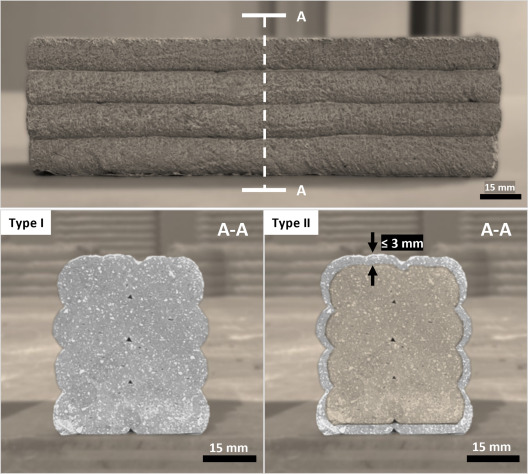
Cross-sections of 3D-printed concrete, sampled to measure how much carbon dioxide the structure absorbed.
About Prof Tan
Prof Tan is Acting Chair of the School of Mechanical and Aerospace Engineering and holds the President's Chair in Mechanical Engineering. He received his BSc (Eng) and PhD from the Royal School of Mines, Imperial College London. He was later a JSPS Fellow at Kyoto University and a Fulbright Scholar at UCLA and Northwestern University.
He was Director of the HP-NTU Digital Manufacturing Corporate Lab from 2018 to 2025. He serves on the World Economic Forum's Global Future Council on Advanced Manufacturing and Value Chains. He also serves on the Task Force on National Greenhouse Gas Inventories of the Intergovernmental Panel on Climate Change (IPCC), which was established by UNEP and the World Meteorological Organization (WMO).
He also sits on the editorial boards of the Journal of Magnesium and Alloys and Metals.
At MAE, we carry his spirit forward by pushing the frontiers of 3D printing in construction and developing greener solutions for the built environment.
Congratulations, Prof Tan!
This article draws on the following sources:
SC3DP Newsletter, May–Aug 2025, Singapore Centre for 3D Printing
Global Status Report for Buildings and Construction 2024/2025, UNEP
Cement sector CO2 emissions double in 20 years, Global Cement
NTU Singapore develops technology that can 3D print a bathroom unit within a day, SC3DP news release, May 2019
NTU Team Creates World's First 3D Printed Bathrooms, NTU MAE
NTU Singapore scientists use recycled glass waste as sand replacement in 3D printing, NTU news release, April 2022
NTU Singapore scientists develop 3D concrete printing method that captures carbon dioxide, NTU news release, December 2024