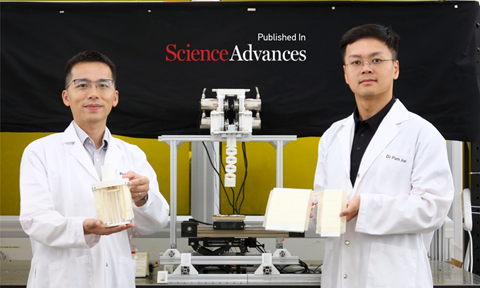
Artificial Intelligence Keeps Planes Safe in Bad Weather
NTU researchers have built an AI system that helps multiple aircraft navigate around thunderstorms while maintaining safe distances from storm cells and nearby aircraft.
Climate change brings about increased frequency of severe weather, particularly thunderstorms, posing significant safety and efficiency concerns for air travel.
These highly disruptive events can force aircraft off planned routes, cause severe turbulence and flight delays, result in passenger injury, and in extreme cases, contribute to air accidents and crashes.
When Weather Turns Bad
The Air Traffic Control (ATC) system currently adopts a dual-pronged strategy to address these challenges.
On one hand, Air Navigation Service Providers (ANSPs) manage air traffic flow by regulating the number of flights entering weather-affected airspace in advance.
On the other, Air Traffic Control Officers (ATCOs) monitor air traffic flow and evolving weather conditions in real time, coordinating among multiple aircraft to maintain safe separation distance from one another and thunderstorm cells.
However, the current strategy poses significant strategic and operational challenges. Accurate and timely prediction of thunderstorms is difficult to achieve with precision, as thunderstorms can develop rapidly to obstruct nominal flight paths, demanding real-time adjustments to flight trajectories.
Multiple aircraft also increase the complexity and workload for ATCOs, who must ensure efficient traffic flow amid high-density air traffic interactions and rerouted trajectories while maintaining safe separation distances between aircraft and evolving thunderstorm cells.
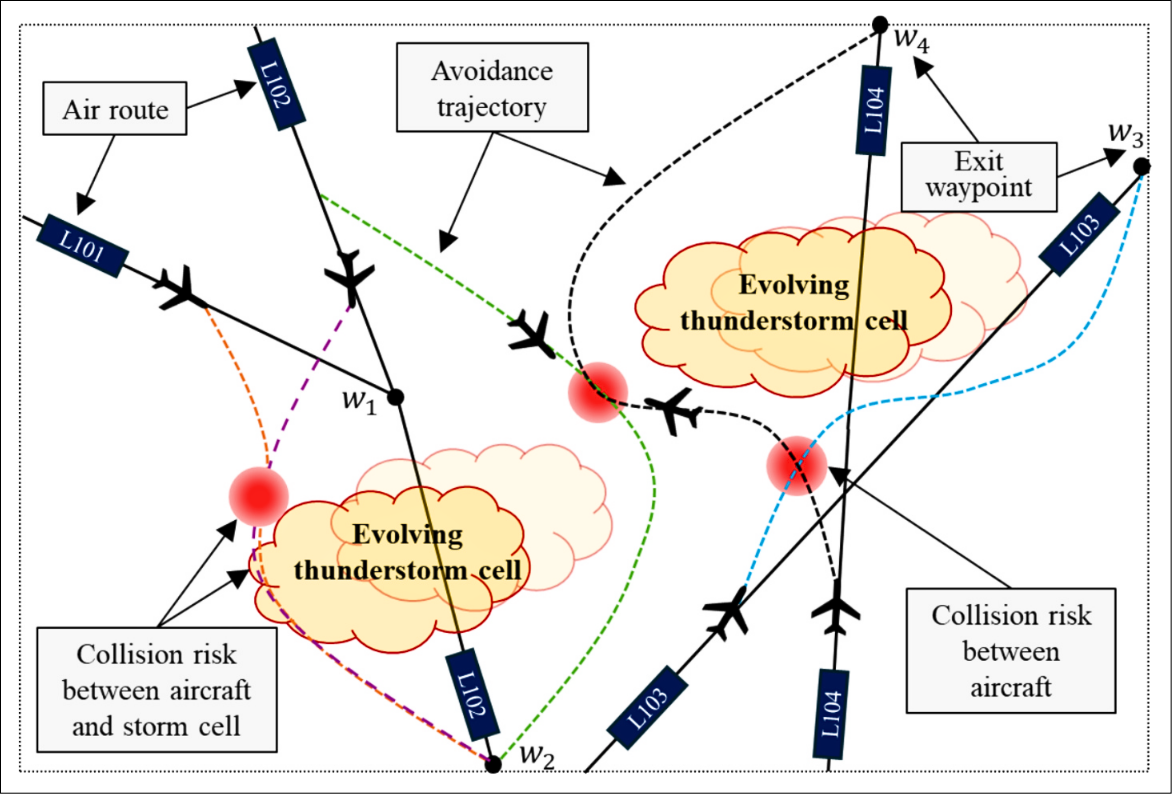 Figure 1: Illustration of multi-aircraft trajectory planning under dynamic thunderstorm cells.
Although automation tools are available to assist pilots and ATCOs with conflict resolution and flight rerouting, most are not scalable and computationally efficient enough to handle dynamic and unpredictable environments.
Their single-agent approach also limits cooperative decision-making across multiple aircraft, compromising overall safety, efficiency and fairness.
Meet the Weatherproof AI Model
Motivated to make air travel safe in adverse weather, A/Prof Sameer Alam and his team at the Air Traffic Management Research Institute developed a cooperative, robust and scalable multi-agent framework for autonomous multi-aircraft trajectory planning under dynamic traffic and weather conditions.
“Our aim is to find an optimal solution to ensure safe separation distance among multiple aircraft and thunderstorm cells while minimising overall flight distance,” said A/Prof Alam.
The team trained their Independent Deep Deterministic Policy Gradient (IDDPG) framework using scenarios simulating complex interactions between airspace structures, aircraft and thunderstorm cells.
They then validated the model by randomly introducing four aircraft from three entry waypoints within a 200 x 200 nautical miles (nm) area, where two dynamic thunderstorm cells with varying speed, size and shape moved across the region from northwest to southeast, over a 30-minute interval.
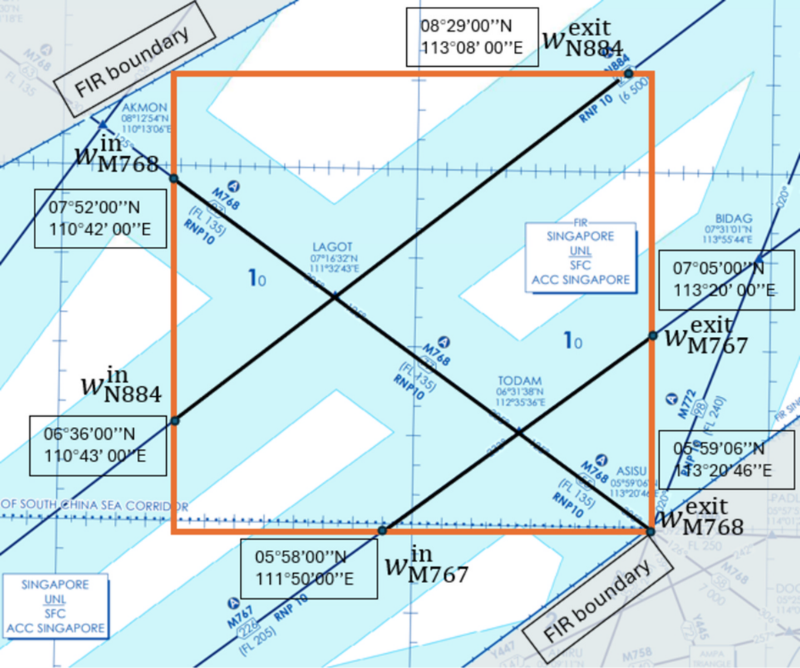 Figure 2: A real-world en route airspace area selected from Singapore FIR for model testing.
The results: All aircraft successfully navigated around the thunderstorm cells while maintaining safe separation distances from both the storms and other aircraft.
Onboard sensors fed real-time data into the system, allowing the aircraft to perceive the evolving environment and make informed trajectory decisions.
“The aircraft initially follow their predetermined air routes,” explained A/Prof Alam. “But as the thunderstorm cells move and change shape, the aircraft reroute around these cells to reach their respective exit waypoints.”
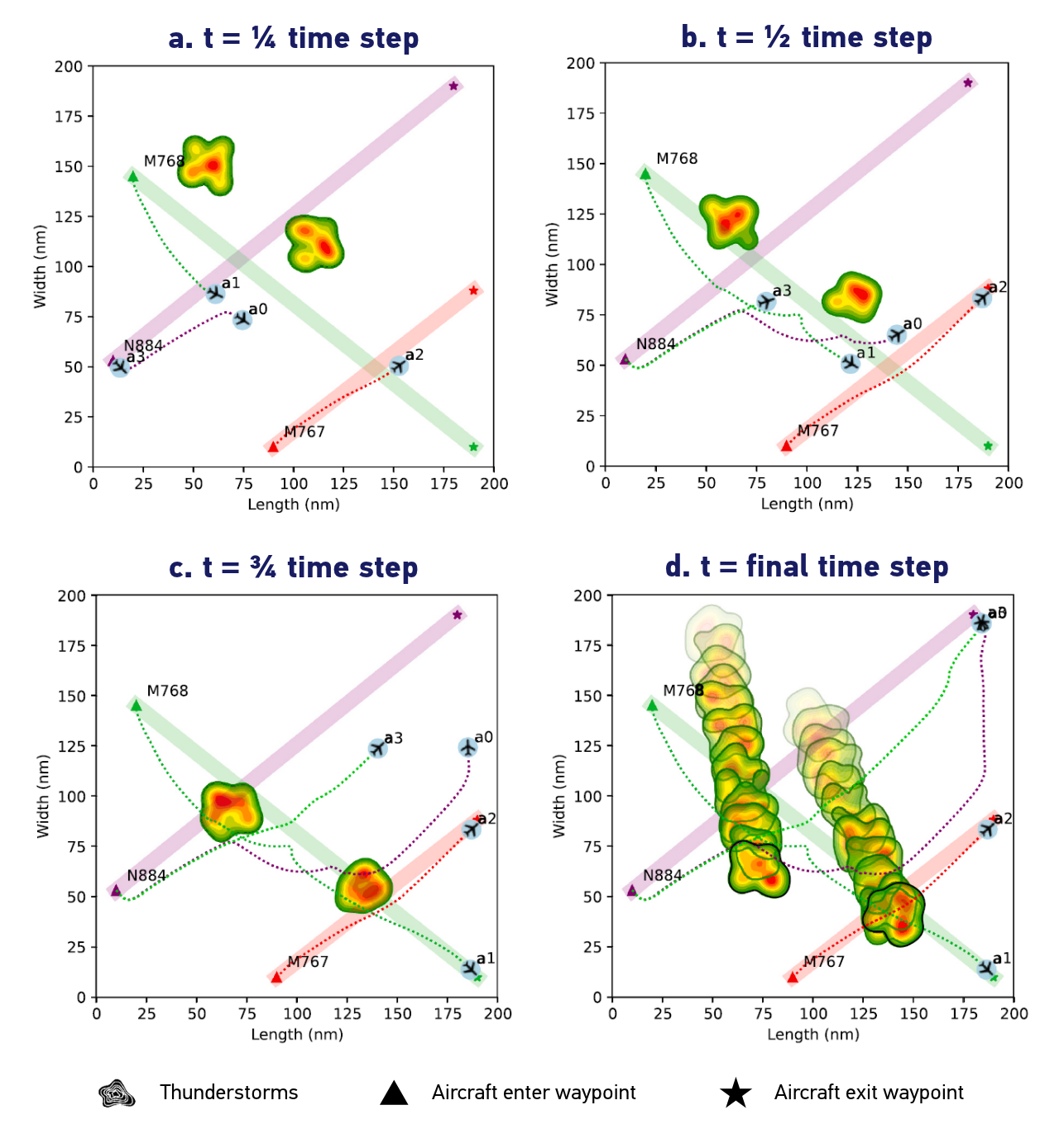 Figure 3: Conflict-free trajectories of 4 aircraft and 2 moving thunderstorm cells at different time steps. The dynamics of the thunderstorm cells are depicted using evolving contours, with decreasing transparency to represent their progression over different time steps.
Strong Performance in Scalability and Adaptability
Next, the team doubled the aircraft from four to eight while keeping the same weather conditions to test the model’s scalability.
A slight decrease in the goal reach rate from 100% to 95% was observed, reflecting the increased challenge of safe navigation in more crowded airspace.
Flight distances also increased slightly, but remained within an efficient range, demonstrating the model’s ability to reroute efficiently without compromising safety, even under denser air traffic conditions.
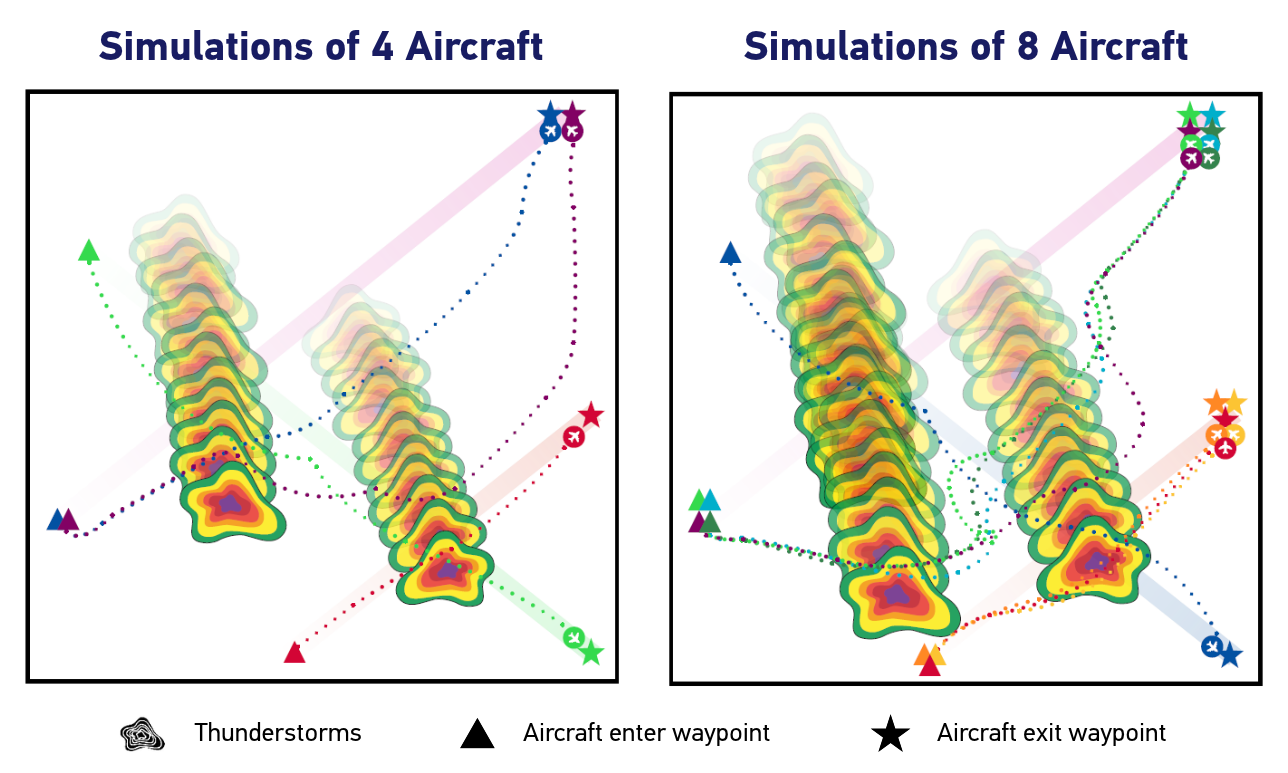 Figure 4: Conflict-free trajectories comparing simulations of 4 aircraft and 8 aircraft under moving thunderstorm cells.
Building on these scalability tests, the team asked a more demanding question: how would the model perform in more complex airspace structures and under more erratic weather conditions?
To find out, they subjected the model to varying traffic densities and larger, more unpredictable thunderstorm cells.
The model proved resilient, maintaining safe separation between aircraft with a zero loss-of-separation rate, and a high goal reach rate of 98–99% in the most crowded scenarios.
The results affirmed the Deep Reinforcement Learning model’s ability to adapt to complex air route structures and its potential for deployment across diverse airspace environments without redevelopment or retraining.
Future Enhancements
While the results are encouraging, the team sought to test the model’s robustness under increasingly complex and fast-changing weather conditions. “We wanted to push the model to its limits,” shared A/Prof Alam.
To do so, the researchers simulated six scenarios ranging from a single small thunderstorm cell to three large, dynamic cells.
The findings showed that while safe separation between aircraft remained stable, separation from thunderstorm cells and the goal reach rate declined as environmental complexity increased, highlighting the model’s sensitivity to highly dynamic weather.
Notably, performance improved when thunderstorm trajectories were known in advance, pointing to the value of integrating more advanced weather prediction capabilities.
Beyond weather uncertainty, the team also examined the impact of estimated time of arrival (ETA) uncertainty.
Simulations across four levels: "negligible" to "high", revealed that high ETA uncertainty significantly degrades performance, largely because the current framework optimises within-sector dynamics without coordinating across sectors.
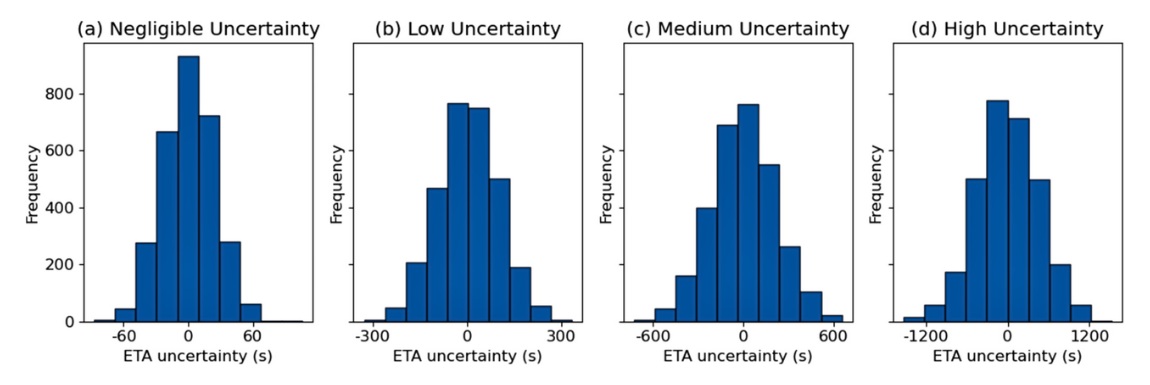 Figure 5: Distributions of simulated ETA uncertainty at various uncertainty levels.
As adverse weather can cause aircraft to reroute and enter airspace from non-designated points, future enhancements that incorporate multi-sector coordination and optimise demand–capacity balancing across wider airspace could pave the way for safer, more cooperative and weather-resilient skies.
“This is an important step,” A/Prof Alam noted. “With further advances in prediction and cross-sector coordination, cooperative AI has the potential to fundamentally reshape how air traffic is managed in challenging weather.”
About the researcher
| Associate Professor Sameer Alam
A/Prof Sameer Alam is the Director of the Air Traffic Management Research Institute and leads his research lab in developing the next generation of intelligent Air Traffic Management (ATM) systems for efficient airport operations using AI and machine learning. He also serves as Associate Editor for the IEEE Transactions on Artificial Intelligence since 2023. He has received the Best Paper Award at the 44th Digital Avionics Systems Conference in Canada in 2025, Best Paper Award at the 1st FAA & Eurocontrol Air Transportation Research and Development Symposium in Czech Republic in 2025, and Best Paper Award at the 25th Integrated Communications, Navigation and Surveillance Conference in Belgium in 2025. |  |
This story first appeared in the MAE Collective 2026, AI edition.
References
[1] Pang B, Hu X, Zhang M, Alam S, Lulli G. A multi-aircraft co-operative trajectory planning model under dynamic thunderstorm cells using decentralized deep reinforcement learning. Adv Eng Inform. 2025;65:103157. https://doi.org/10.1016/j.aei.2025.103157.
[2] Pang B, Zhang M, Hu X, Pham T, Alam S, Lulli G. Constrained multi-agent reinforcement learning with MAF-Net for safe trajectory planning. In: Proc 25th Int Conf Autonomous Agents Multiagent Syst (AAMAS 2026); 2026; Paphos, Cyprus. IFAAMAS. https://doi.org/10.65109/MQDV9851.
[3] Civil Aviation Authority of Singapore. Aeronautical Information Publication. 2026. https://aim-sg.caas.gov.sg/aim-content/uploads/aip/28-MAY-2026/AIP/2026-05-14-000000/html/index-en-GB.html.
[4] Lowe R, Wu YI, Tamar A, Harb J, Abbeel P, Mordatch I. Multi-agent actor-critic for mixed cooperative-competitive environments. In: Advances in Neural Information Processing Systems. 2017;30. https://doi.org/10.48550/arXiv.1706.02275.
[5] EuroControl, Eurocontrol Manual for Airspace Planning-Common Guidelines, 2003. www.eurocontrol.int.