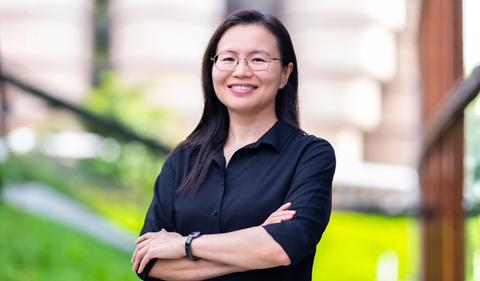
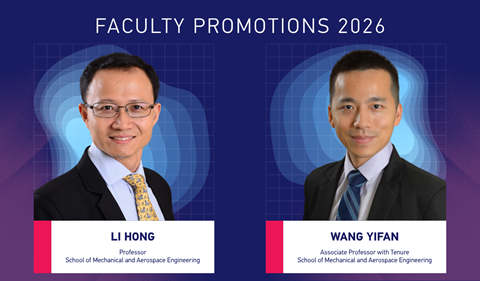
Associate Professor Wang Yifan Receives Nanyang Research Award (Young Investigator) 2026
NTU MAE congratulates Associate Professor Wang Yifan on receiving the Nanyang Research Award (Young Investigator) 2026.
The Nanyang Research Award recognises NTU faculty members for outstanding research achievements. The Young Investigator category honours early-career researchers.
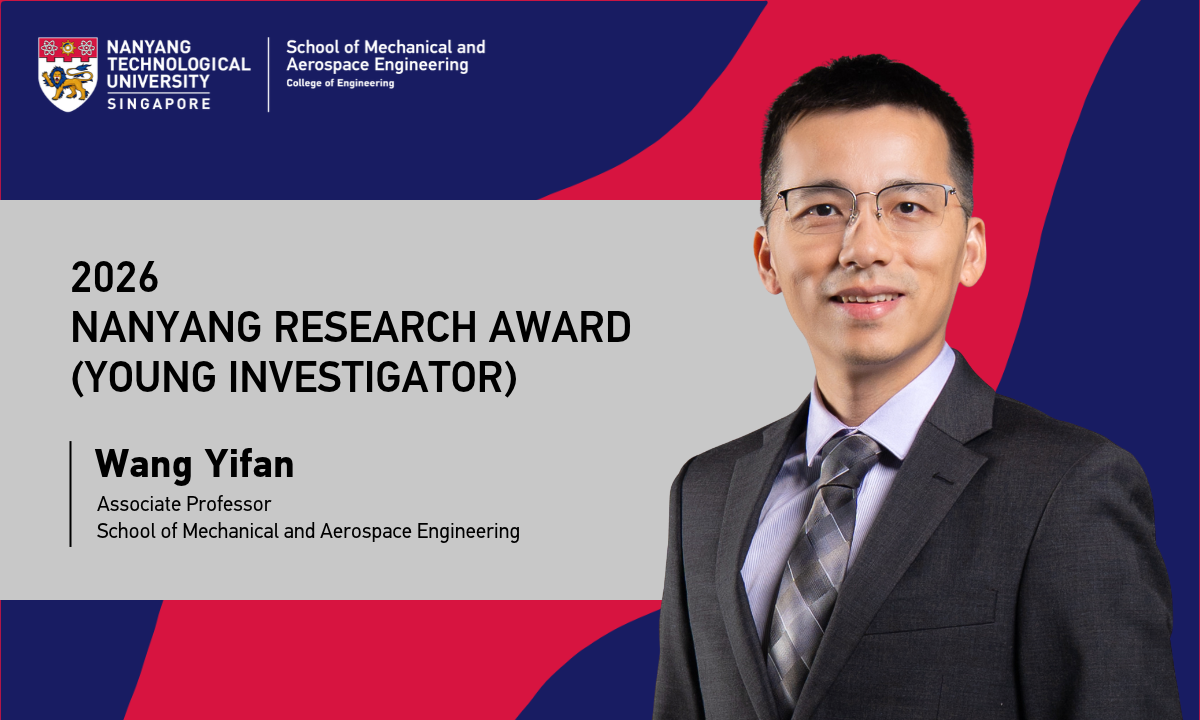
Award citation
Associate Professor Wang Yifan is recognised for pioneering research in robotic materials that brings intelligence into the structures of materials themselves. His work advances how robots adapt to the human body, creating new possibilities for wearable healthcare and safer industrial work.
By designing material architectures that can change stiffness and shape, Professor Wang has addressed a central challenge in robotics: combining flexibility for safe human interaction with the strength needed to provide support. His structured fabrics and programmable robotic materials connect fundamental discoveries in mechanics with advanced manufacturing, enabling lightweight, adaptable assistive devices. These contributions have appeared in leading journals, including Nature, Science Robotics and Science Advances.
His research translates scientific advances into measurable human benefits. His team has demonstrated wearable devices that reduce tremor amplitude by approximately 80 per cent in human subjects, alongside industrial assistive systems that reduce muscle load by approximately 40 per cent. Collaborations with Tan Tock Seng Hospital and Imperial College London support clinical translation, while partnerships with Hyundai Motor Group and Schaeffler advance industrial applications.
Through scientific originality and close engagement with clinical and industrial partners, Professor Wang is advancing human-centred robotics and strengthening NTU’s contributions to technologies that improve lives and work.
About Prof Wang’s work
Imagine a sleeve that stiffens to support you as you lift a heavy box, then softens as you reach for a cup of coffee. This vision of adaptable wearable robotics guides the research of Prof Wang Yifan.
At NTU, Prof Wang leads the Robotic Materials Group, which develops robots that adapt to their users and surroundings. The team brings together sensing, learning, control and physical design to create systems that respond to human needs.
For a robot to work effectively with a person, it needs to understand their intentions. Prof Wang's team develops wearable sensors that detect muscle activity, enabling robots to recognise gestures and estimate the force a person applies.
Combined with machine learning and touch-based interfaces, these signals can guide a robotic partner, control an assistive device or move a virtual hand. The team's flexible muscle impedance sensors were featured in Science Advances in 2025.
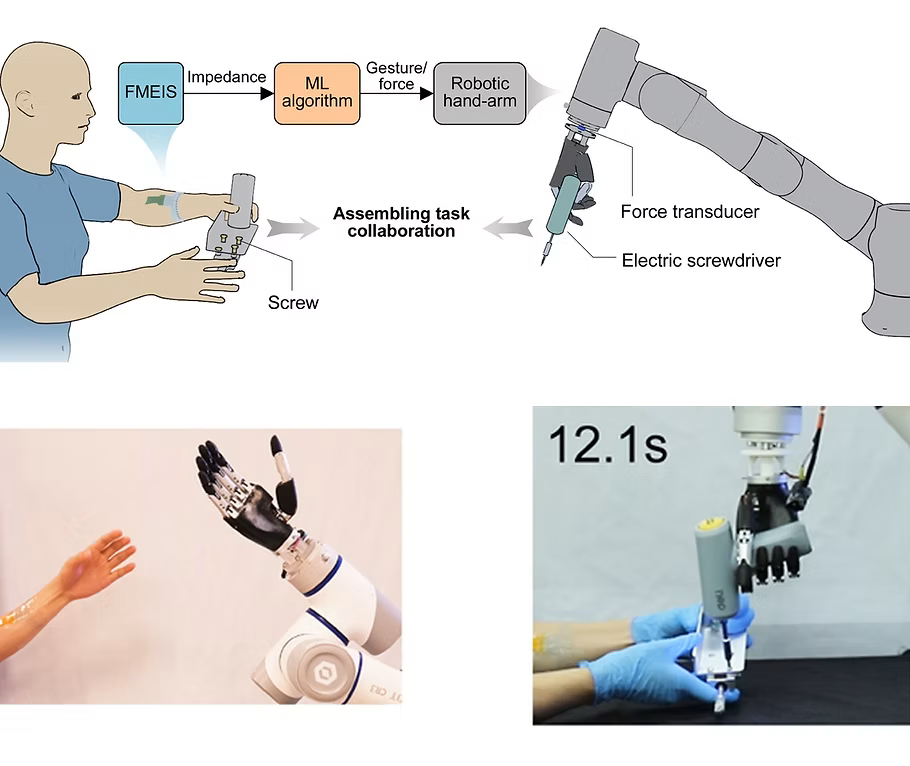 A forearm-worn sensor detects the user's gestures and muscle force. A machine-learning model translates these signals into commands for a robotic arm during a shared assembly task. Image: Li, J., et al. (2025). Science Advances. DOI: 10.1126/sciadv.adv3359
Wearable robots have long faced a trade-off between support and comfort. Rigid frames can provide strong support but are heavy to wear, while soft garments are comfortable but offer limited assistance.
Prof Wang's soft exoskeletons, exosuits and active fabrics aim to combine comfort with support. Their programmable stiffness allows them to remain flexible during free movement and stiffen when support is needed, with applications in lifting, movement assistance and tremor suppression.
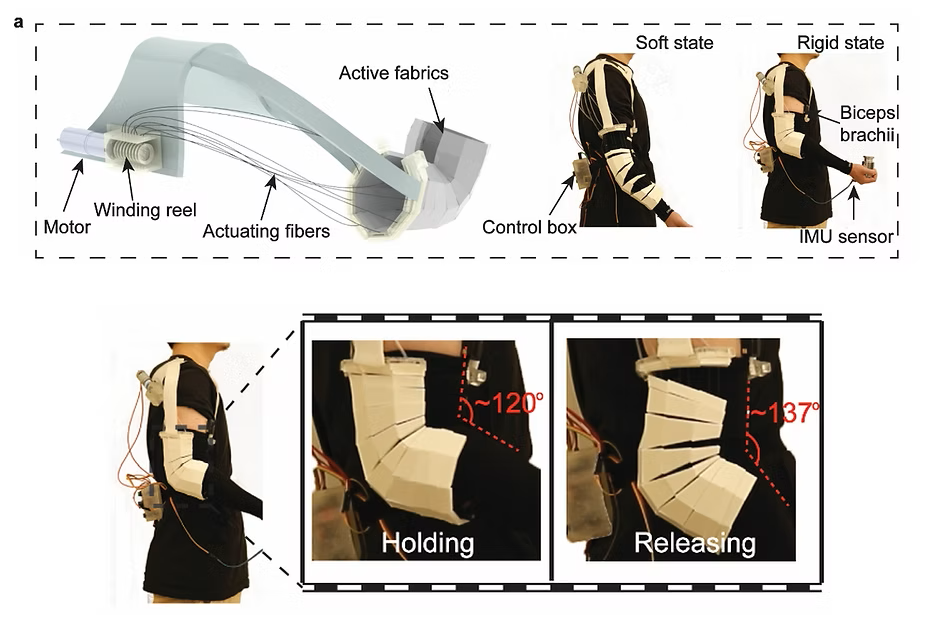 An elbow support made from active fabrics switches between a soft state that allows free movement and a rigid state that holds the arm steady.
Image: Yang, Y., et al. (2024). Advanced Materials, 36(28), 2404502.
The active fabric research was published in Advanced Materials in 2024. Related work on a wrist exoskeleton with adjustable stiffness appeared in IEEE Robotics and Automation Letters in 2023.
Prof Wang also builds adaptability into the robot's body. Inspired by structures found in nature, his group develops materials that change shape, adjust their stiffness and sense their surroundings.
This research has led to grippers that adapt to the objects they hold, reconfigurable systems and new wearable platforms. Publications in this area include scale-inspired robotic structures in Science Robotics (2024) and structured fabrics in Nature (2021).
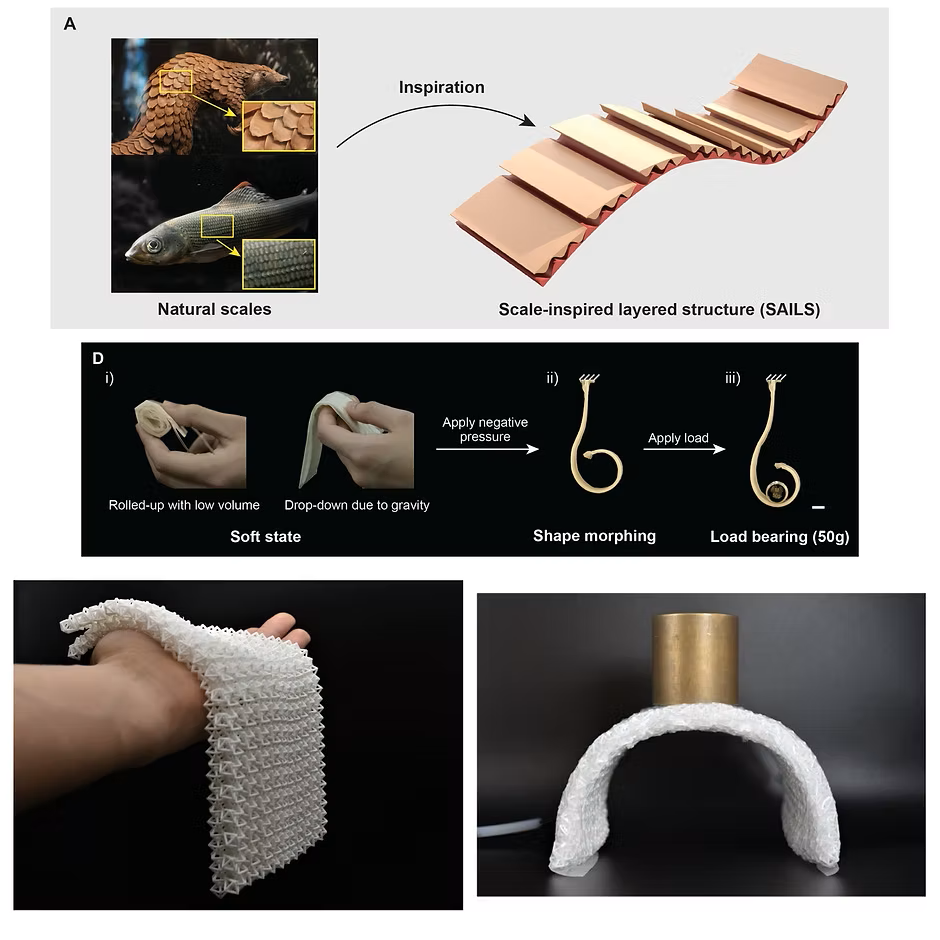 Inspired by the overlapping scales of pangolins and fish, these layered structures can roll up in a soft state, change shape and support loads. Image: Wang, Y., et al. (2024). Science Robotics.
"This award recognises the dedication of my team and collaborators. Together, we are developing robots that adapt to people and support everyday movement." said Prof Wang.
Congratulations once again, Prof Wang!
Learn more about the Robotic Materials Group.