Ahead of the Competition: Inside NVF-3’s Upgrades
The NTU Formula Racing team has built its latest race car, NVF-3, with more power, less weight and quicker acceleration. The car is set to compete in Formula Student Electric China this November.
On paper, NVF-3 should be the slower car. Its top speed of 105 km/h falls short of the 120 km/h reached by its predecessor, NVF-2.
Its acceleration, however, tells a different story. NVF-3 goes from 0 to 100 km/h in 4.35 seconds, more than two seconds faster than NVF-2.
That trade-off was deliberate, with the team building the car to accelerate out of every corner.
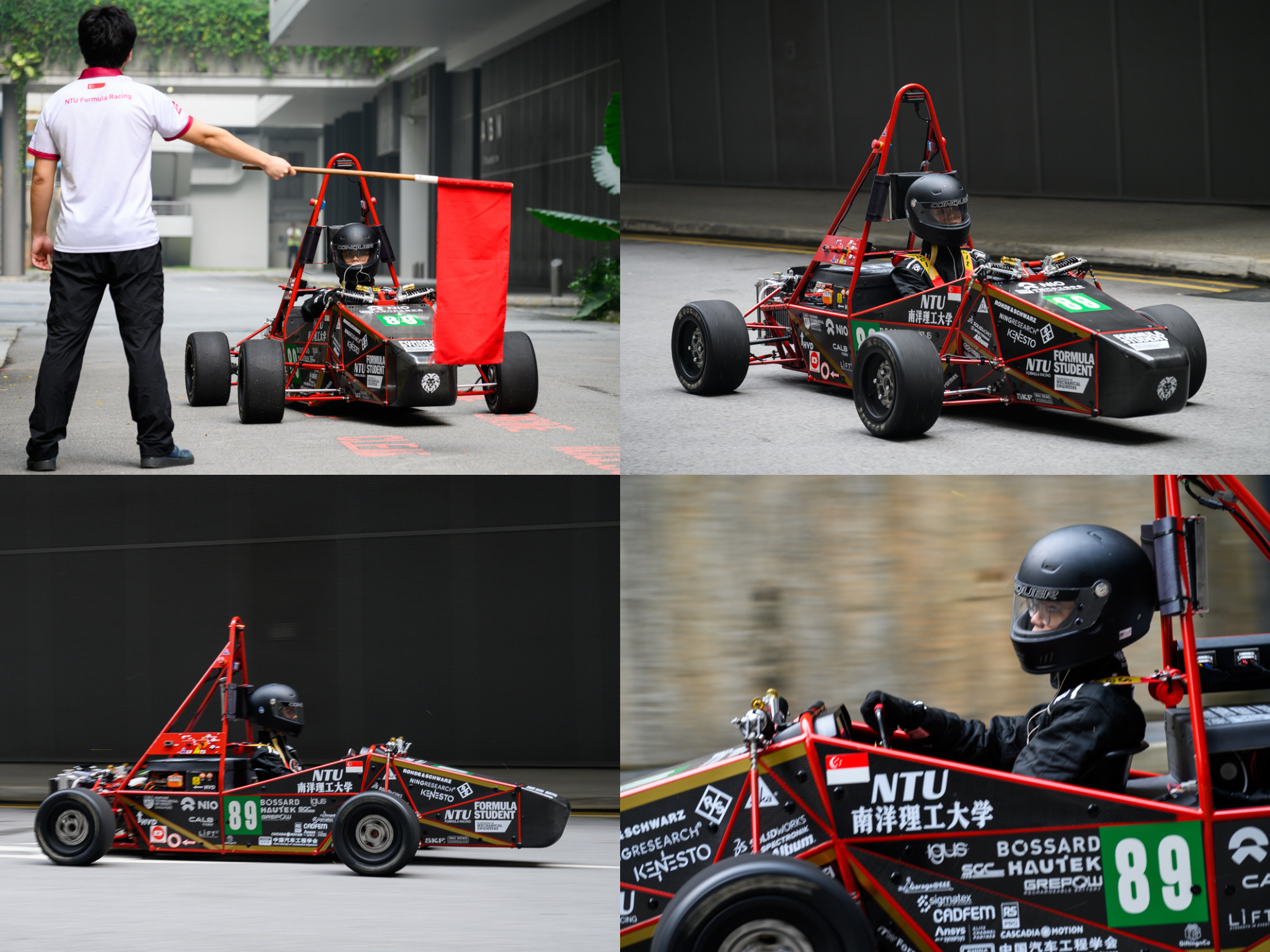 The NVF-3 car in a test race.
Why Acceleration Wins
Formula Student competitions are run differently from races such as Formula One.
Rather than a single race to the finish line, cars take part in a series of events, each testing a specific aspect of performance.
Among the dynamic events held on track, the acceleration event tests how quickly cars can cover a straight 75 m distance.
Another event, the skidpad, tests how well a car maintains grip and stability through corners while navigating a figure-of-eight track.
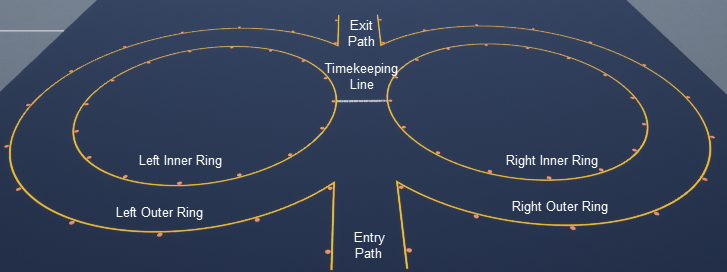 An example of a Formula Student skidpad track.
Source: https://www.mathworks.com/help/vdynblks/ug/place-cones-skipad-simulation-3d-animation-functions.html
Formula Student tracks typically feature short straights and frequent tight corners, meaning cars rarely reach speeds of over 80 km/h. This led the team to prioritise acceleration over top speed.
“A high acceleration allows us to exit corners faster and make better use of the available distance, ultimately reducing lap times and improving overall track performance across the various events at the competition,” said Ivan Foo, a Year 4 Mechanical Engineering student and senior member of NTU Formula Racing.
How quickly a car accelerates also depends on its weight. Compared with NVF-2, the new car is 45 kg lighter at 251.5 kg. With less weight to move, NVF-3 can pick up speed far more quickly.
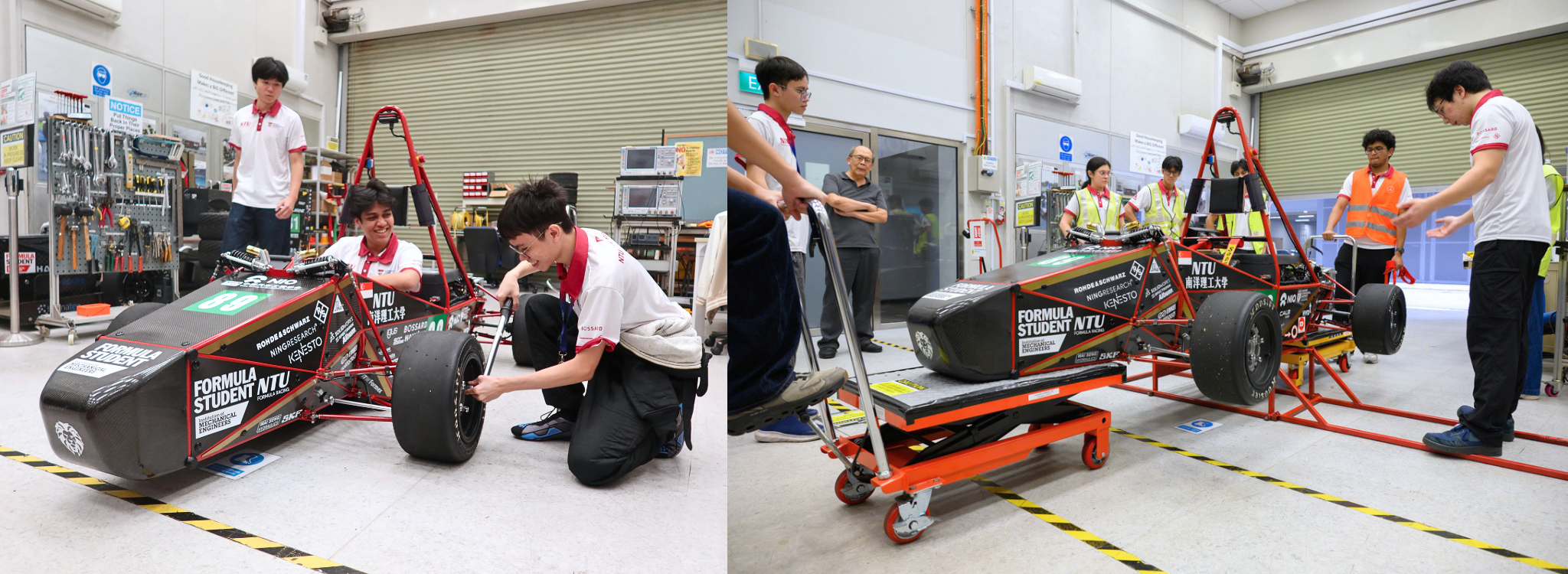 Members of NTU Formula Racing working on NVF-3
Inside the Battery
The biggest leap from NVF-2 to NVF-3 lies in the battery, known in Formula Student as the accumulator.
The battery’s maximum voltage has more than tripled, rising from 138.6 volts to 469.8 volts. This higher voltage allows the battery to deliver more power to the motor, increasing its output from 50 kW to 124 kW, a nearly 150% gain.
The new battery also stores 63% more energy than NVF-2’s, allowing the car to run longer before recharging.
It also makes better use of its weight, with each kilogram of the battery pack storing about 53% more energy than before.
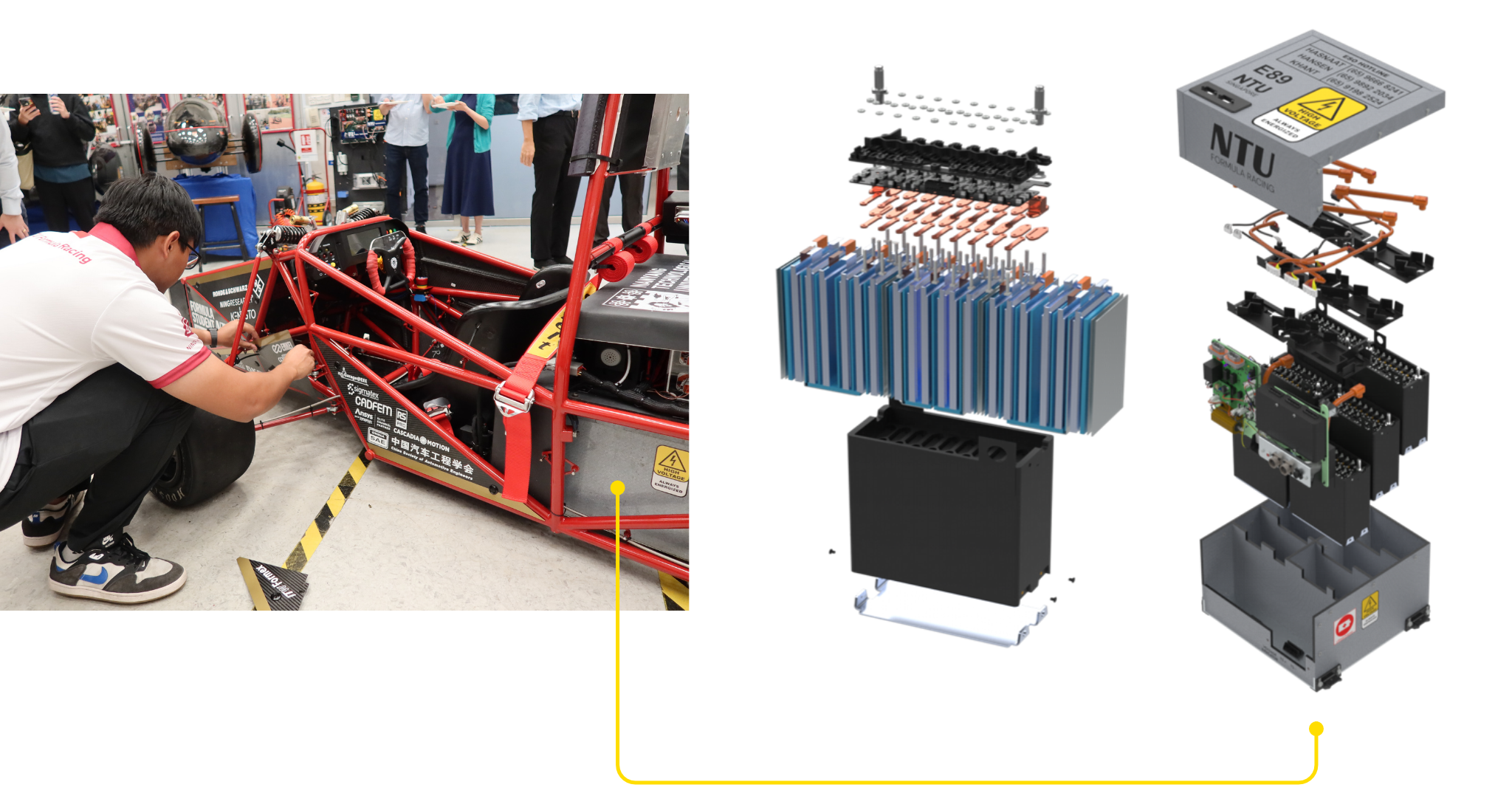 The accumulator component of the NVF-3 car.
Bringing It All Together
One of the biggest challenges in building NVF-3 was getting the car’s subsystems to work together.
Ivan explained, “It’s one thing to design each subsystem individually, but it’s another challenge entirely to bring them all together while ensuring that everything fits, functions properly and communicates with our data acquisition system.”
The team also faced logistical delays, budget limits and issues that only surfaced during assembly, many of which could not be resolved through calculations alone.
“We had to get our hands dirty, troubleshoot as we went and sometimes rethink decisions that looked fine during design,” he recalled.
The battery was one area where the team made assembly quicker and simpler. Building the battery modules for NVF-2 took two people over 18 hours. For NVF-3, the team cut that down to under six hours for one person.
Quicker assembly also gives the team more flexibility as they prepare the car for the competition in Hefei.
Drawing on the experience of seniors who had worked on NVF-1 and NVF-2, the team knew what to look out for, though many problems still had to be worked out on their own.
“I think that’s where we’ve grown the most as a team, learning to make practical engineering decisions under real-world constraints rather than relying solely on what works on paper,” Ivan added.
Next Stop: Hefei
The team will be competing in Formula Student Electric China, held in Hefei from 17 to 22 November 2026.
NTU Formula Racing is no stranger to the competition. At the 2024 edition, NVF-2 went up against around 90 teams from across Asia and won the Pioneer Racing team award, given to the best new team.
Since then, both the car and the team have evolved considerably. Many of this year’s members will be taking part in a Formula Student competition for the first time, and as a senior, Ivan sees mentoring them as a key part of his role.
Before any car can race, it must pass scrutineering, a series of technical and safety inspections.
“One of our key priorities is to pass scrutineering so that the team can see its efforts come to fruition on track,” Ivan shared. “It would be incredibly rewarding to finally see the car compete this year, as getting it on track has been a long-standing goal for the team.”
NTU MAE wishes NTU Formula Racing all the best in Hefei!
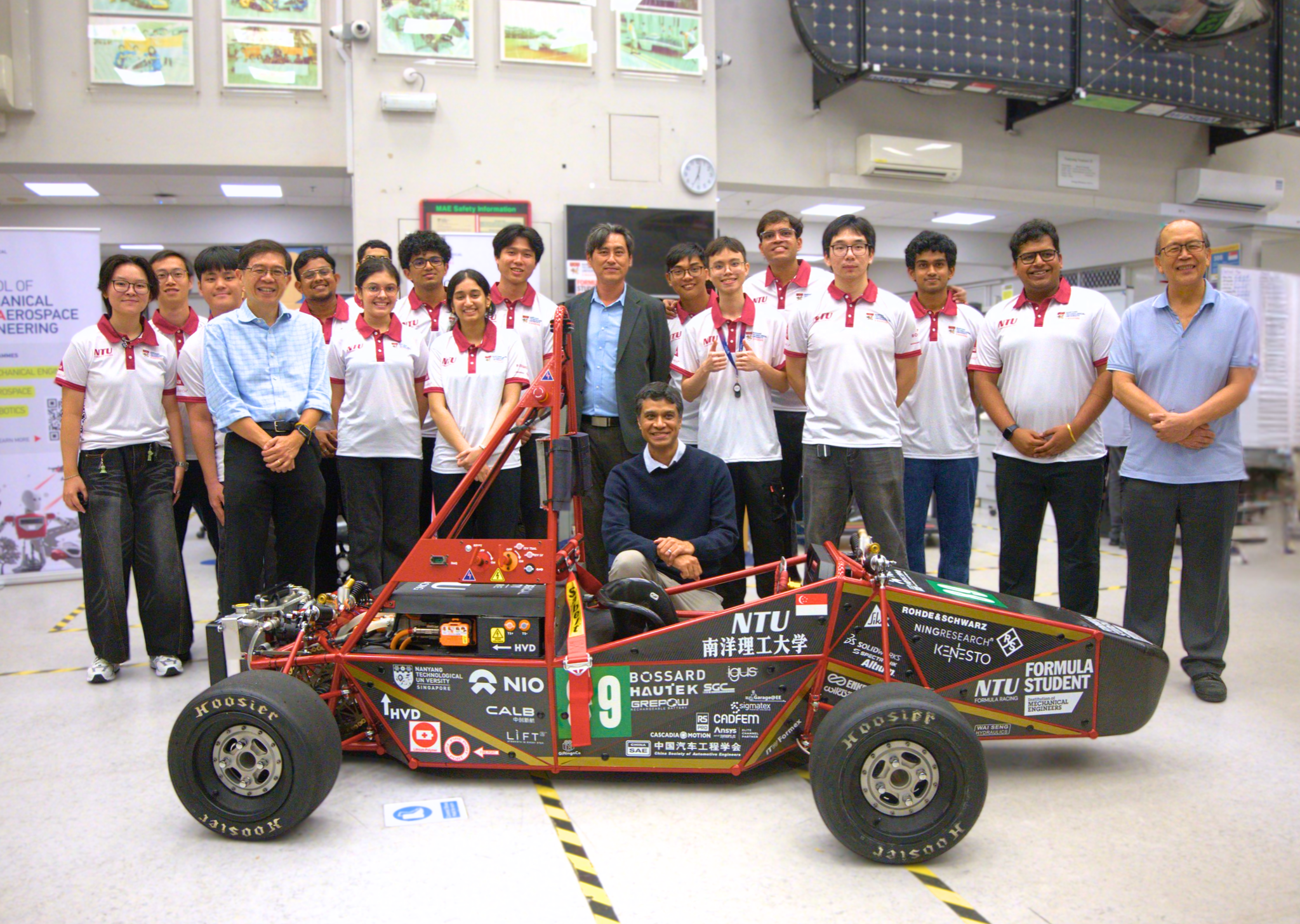 NTU Formula Racing with professors at NVF-3 unveiling event.
About NTU Formula Racing
NTU Formula Racing was established in 2020 in collaboration with Nanyang Venture, NTU’s premier team for eco-efficiency vehicles. Each year, students from across the university design, build and race a fully electric Formula-style car. The team was the first from Singapore and Southeast Asia to compete at Formula Student UK.
Since August 2025, more than 50 students have worked on building NVF-3 across seven subsystems. Together, they have clocked around 800 hours building the car, while also securing sponsors, managing costs and conducting their own data analysis.
The team’s 2026 car is named the Crimson Stallion, or Chitu (赤兔), after the legendary warhorse from Romance of the Three Kingdoms. The name evokes the horse’s speed, strength and spirit. It also nods to horsepower, a measure of power used in motorsport, and the Year of the Fire Horse in 2026.
Special Thanks
Special thanks to Faculty Advisor Emeritus Professor Ng Heong Wah, Associate Professor Holden Li and team advisor Yash Chandra Shekar for their guidance throughout the build.
The team is also grateful to its sponsors, whose support made NVF-3 possible. Thank you to Nanyang Technological University, Ning Research, ITW Formex, RS Pro, SKF, Altium, Bossard, Kenesto, Sika, Solidworks, Cascadia Motion, IGUS, Enkei, Sigmatex, Huatek, Willwood, Garage@EEE, SMART Systems, CADFEM, Ansys, GrePow, Rhode & Schwarz, SimScale, Spectronik, Gift & Co, Wai Seng Hydraulics, and Lift.
Edited by Regine Ng and Karen Chai, NTU MAE Communications
Photo credits: Hillary Tan (NTU Corporate Communications Office), Soham Gokhale (NTU Formula Racing)