NTU students develop smart spoon for safer, more independent meals
A team of five Year 4 NTU students created MealGuard, a smart spoon that helps people with hand tremors or swallowing difficulties eat more safely and independently, while tracking changes in their health over time.
The project was named Champion of the University Category in the Engineering Innovation Challenge (EIC) 2026, finishing ahead of more than 40 university teams.
The EIC is a national competition organised by the Institution of Engineers, Singapore (IES) as part of National Engineers Day (NED) 2026.
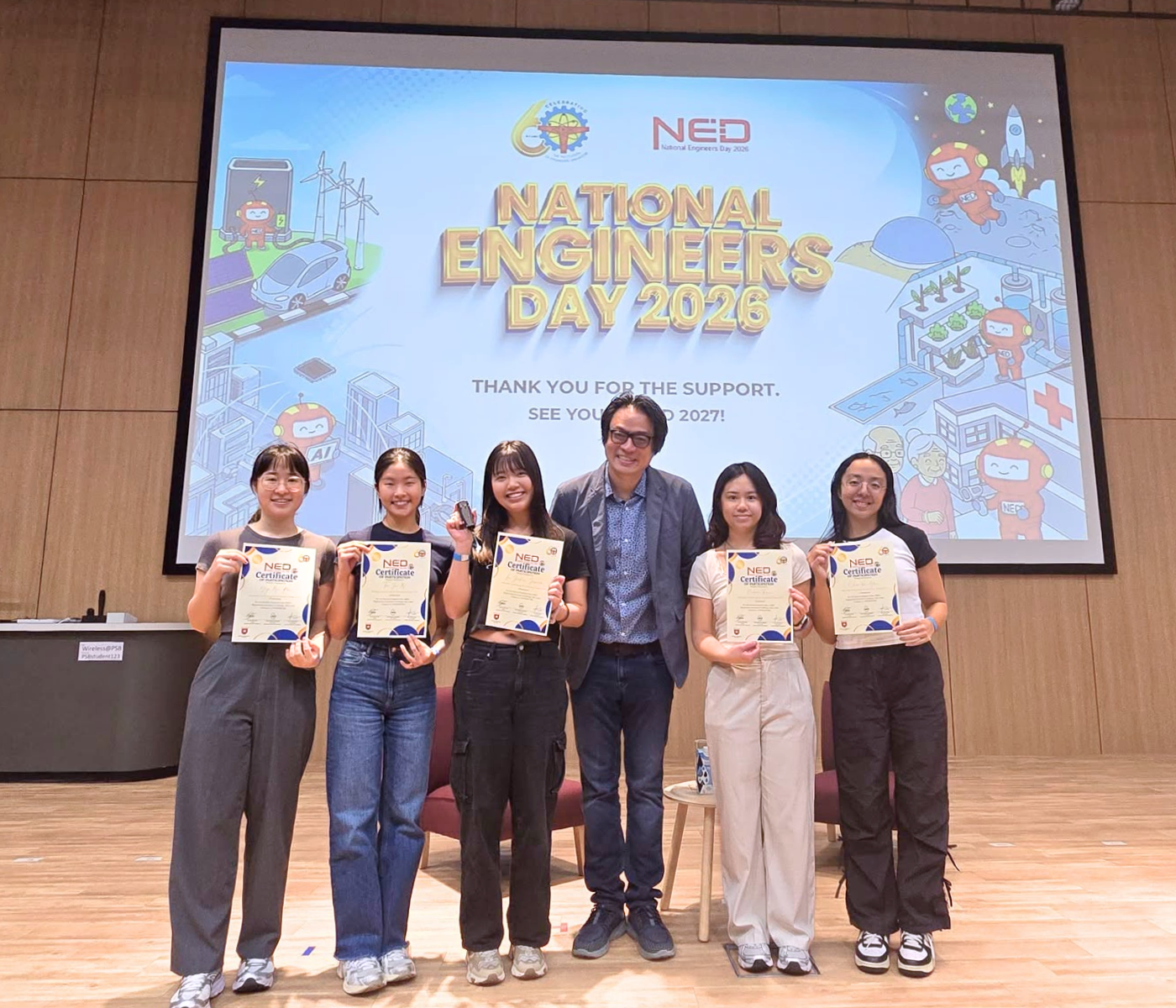 The MealGuard team receiving the first prize of SGD5,000 at the Engineering Innovation Challenge 2026. From left to right: Yap Xin Rou, Tee Jie Xi, Lee JiaTian Jessica, Dr Ang Keng Been (Chief Judge, EIC 2026), Eileen Fun and Chow Ven Yan.
For the team, the idea started at home. “MealGuard was inspired by our own family members who experience hand tremors and difficulties eating independently,” Jessica shared.
“Watching them struggle with simple daily meals made us realise how challenging and frustrating these conditions can be.”
Conditions such as Parkinson’s disease, dysphagia and diabetes are often picked up only after a person’s health has declined significantly.
The team set out to turn an everyday spoon into a device that could steady each mouthful and flag early signs of change, helping users stay independent at mealtimes.
From breadboard to spoon
The team built the first version of MealGuard on a breadboard, testing each sensor to make sure every function worked on its own.
Once they did, they designed a spoon housing in computer-aided design (CAD) software and set about fitting everything inside it.
That integration proved to be the biggest challenge. “The components are very small, and fitting them all inside a handle meant a lot of precise, delicate soldering, with wires and connections packed into very tight spaces,” Jessica explained.
“Things that worked fine on the breadboard sometimes failed once they were soldered and enclosed, so we had to rework connections, re-test each sensor, and adjust the layout until everything fit and worked together.”
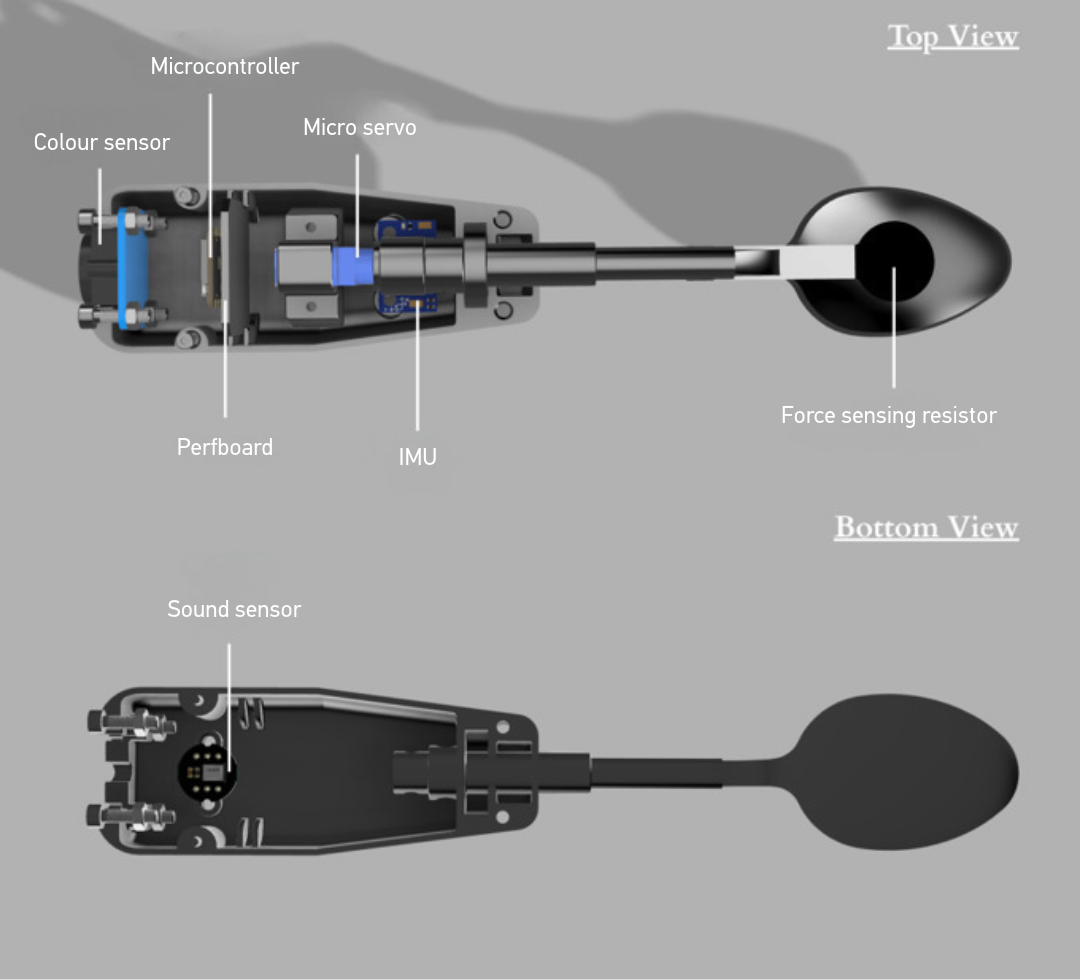 Labelled CAD render of MealGuard, top and bottom view
How MealGuard works
MealGuard brings spoon stabilisation and health monitoring together in one device. A motion sensor detects hand tremors, and a servo motor moves the spoon in the opposite direction to keep it steady.
At the same time, a colour sensor reads a saliva test strip to monitor glucose trends. Sound and force sensors detect coughing during meals to calculate a cough-to-feed ratio.
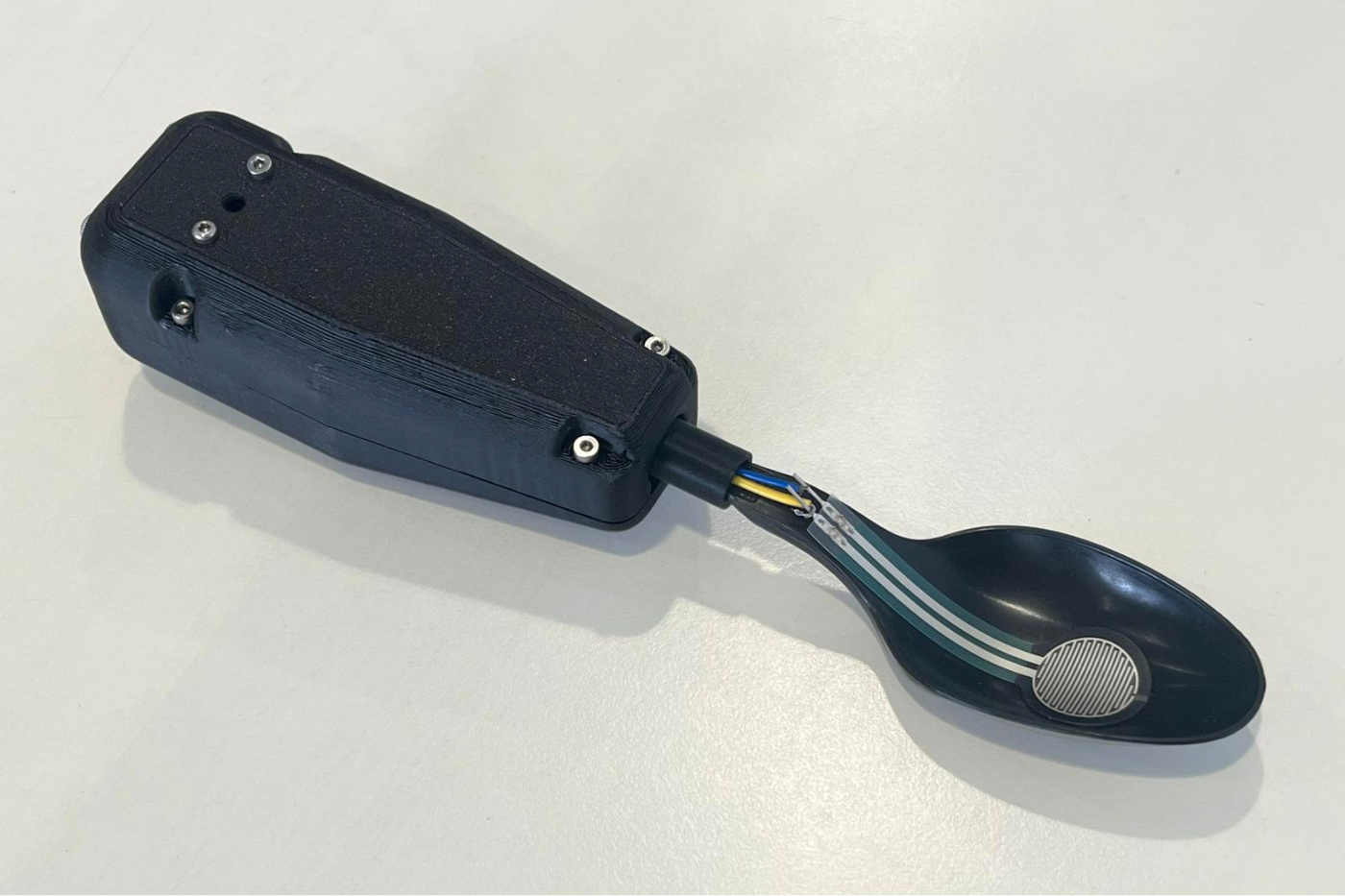 Assembled 3D-printed prototype
All the data is sent to a companion mobile app, where users and caregivers can track glucose trends and eating patterns in one place.
The team chose to combine these functions after finding no existing solution on the market that brought them together.
“Eating is something we do every day, so integrating these features into a spoon makes health monitoring more convenient and easier to maintain as a daily habit,” they said.
Five students, five subsystems
The team split the work by subsystem. Jessica led tremor control, Jie Xi and Eileen worked on acoustic and force sensing, Xin Rou handled colour and glucose sensing, and Ven Yan developed the mobile app.
Everyone contributed to the CAD design and housing before the team integrated all the parts on a single microcontroller and tested them together.
The mix of disciplines shaped the design from the start. The team’s Chemical and Biomolecular Engineering students evaluated the scientific basis and feasibility of each idea.
Jessica, from Mechanical Engineering, focused on the hardware, from identifying suitable sensors to integrating them into the spoon.
Ven Yan, with a background in data analytics, contributed ideas for the app and how the collected data could be presented and interpreted.
“During brainstorming, we looked at the same ideas from different angles, questioned each other’s assumptions, and discussed what was practical and what needed further validation,” Jie Xi said. “Sometimes, an idea that seemed promising from one perspective raised questions from another, encouraging us to refine our approach.”
“This experience showed us that diversity in engineering and STEM is also about bringing different ways of thinking to the table,” Xin Rou added.
Designed with real-world use in mind
MealGuard is designed to support independence at the dining table, with the companion app giving users and caregivers a single place to follow glucose trends and eating patterns over time.
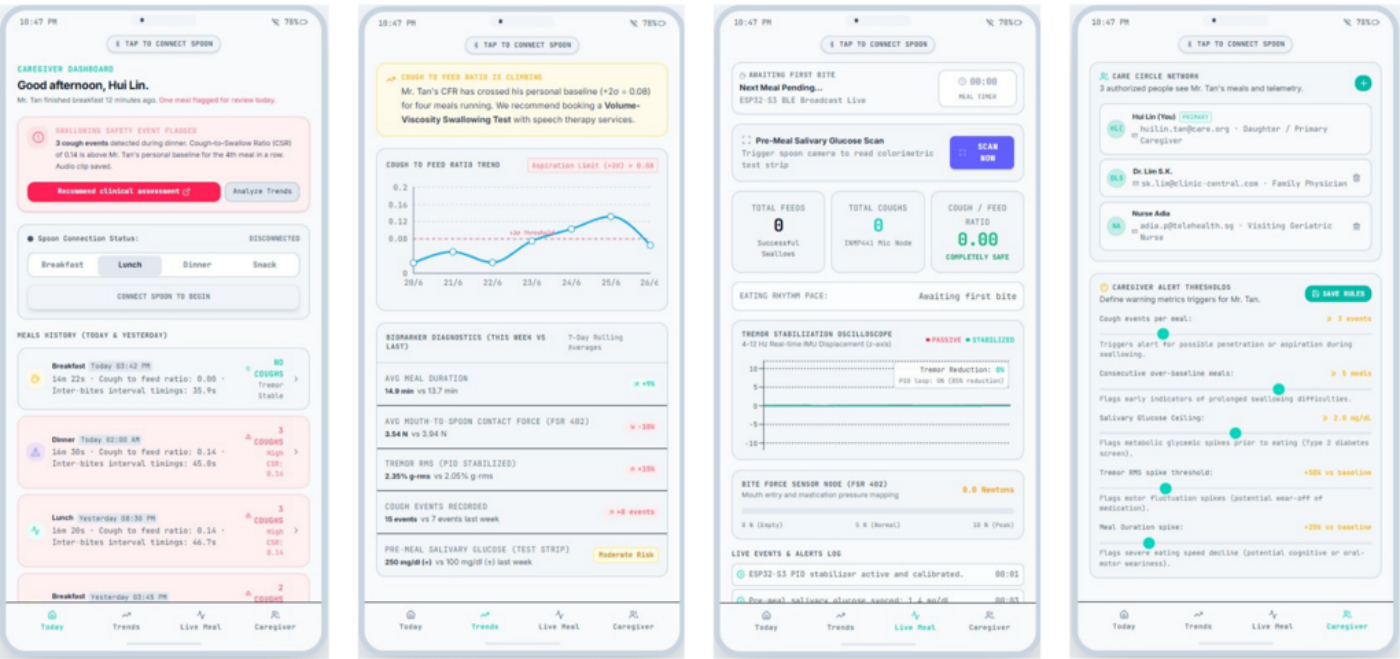 MealGuard companion mobile app dashboard
Throughout the competition, the team was mentored by Professor Domenico Campolo, Co-Director of the R3 Institute Singapore (previously known as Rehabilitation Research Institute of Singapore). Through the R3 Institute, the team held online meetings with clinicians to gather feedback on the practical aspects of the prototype.
“They shared their experience and hospital scenarios, which helped us better understand the practicality, functionality, and usefulness of MealGuard for real-world users,” Eileen said.
For the five students, the project also meant working with technologies that were new to most of them. “Looking back, the biggest way we’ve grown is through stepping into completely unfamiliar territory,” Ven Yan reflected.
“Even if we start with little knowledge, we can learn along the way and turn our own ideas into real products. Think big, trust the process, and never give up.”
About the team
The five teammates were friends from the same engineering cohort long before the competition. While on their internships, they found pockets of free time after work and decided to challenge themselves to build something meaningful together. Driven by that shared motivation, they signed up for the EIC.
Lee JiaTian Jessica is a Year 4 Mechanical Engineering student in the Robotics & Mechatronics stream, from the School of Mechanical and Aerospace Engineering (MAE). She worked on tremor control, using a motion sensor and servo motor to keep the spoon steady.
Chow Ven Yan is a Year 4 Chemical and Biomolecular Engineering student with a Second Major in Data Analytics from the School of Chemistry, Chemical Engineering and Biotechnology (CCEB). She developed the MealGuard companion mobile app.
Eileen Fun is a Year 4 Chemical and Biomolecular Engineering student with a minor in Business from CCEB. She worked on acoustic and force sensing, which detects coughing during meals.
Tee Jie Xi is a Year 4 Chemical and Biomolecular Engineering student from CCEB. She worked on acoustic and force sensing alongside Eileen.
Yap Xin Rou is a Year 4 Chemical and Biomolecular Engineering student from CCEB. She worked on colour and glucose sensing, which reads saliva test strips to monitor glucose trends.
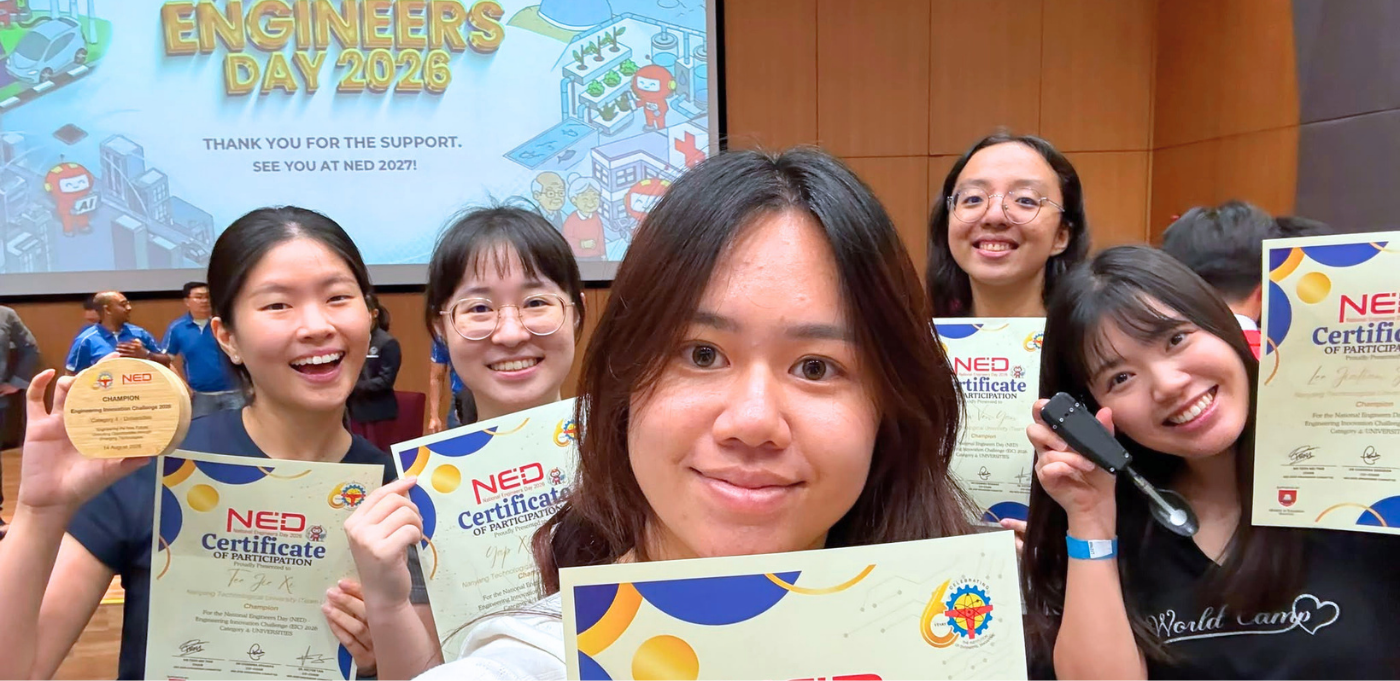 From left to right: Jie Xi, Xin Rou, Eileen, Ven Yan, Jessica
About R3 Institute Singapore
R3 Institute Singapore, formerly the Rehabilitation Research Institute of Singapore (RRIS), was established in 2016 by NTU, A*STAR and National Healthcare Group. The R3 in its name stands for Reconstruction, Restoration and Rehabilitation. Bringing together expertise in academic research, science and technology, and healthcare, the institute develops solutions for unmet clinical needs and helps older adults age in place.
Edited by Regine Ng, NTU MAE Communications