One Student's Leap from Maths to Robotics
From solving problems to preventing them, Mateo Lizcano Cabezas found his calling at the edge of artificial intelligence and robotics.
Mateo used to struggle with multiplication, working through the foundations with his father until they held.
Years later, that same boy would represent Colombia at the International Mathematical Olympiad, standing in a room full of the brightest young mathematicians in the world.
Most students with a Math Olympiad background take the well-worn path into pure mathematics or computer science.
Mateo chose robotics. He wanted to work on problems where the stakes were highest and the impact most tangible.
Today, he is a Year 1 Robotics Engineering student at NTU's School of Mechanical and Aerospace Engineering, working on some of the most consequential questions in technology: how do we build intelligent systems that actually do what we want them to do?
That arc, from arithmetic struggles to AI alignment research, is not accidental. It is the result of a relentless habit: find the hardest problem in the room, and get to work.
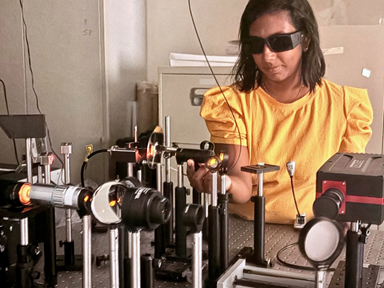
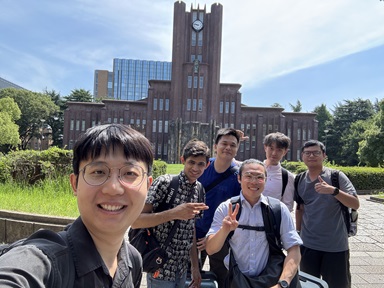
.png?sfvrsn=94df2dfc_1 "Mateo Lizcano robotics - photo edit (grp project)") Left picture: Mateo (in white at bottom right) with his project groupmates for MA1603: Intro to Embedded Systems.
Left picture: Mateo (in white at bottom right) with his project groupmates for MA1603: Intro to Embedded Systems.
Right picture: The team’s final project.
Redirecting His Career Path
Mateo was a former math Olympian and instructor for the Colombian team. When it came to university, the obvious choice was Computer Science and Mathematics.
He had considered it. In the end, he made a different call.
"I felt that to truly be at the forefront of technology, robotics was the stronger choice," he said. "I can get the same intellectual stimulation when solving hard problems as I enjoyed with math."
In the summer of 2024, he was accepted into the Non-Trivial Fellowship in the United Kingdom, selected as one of 172 fellows from over 11,000 applicants, a 1.5% acceptance rate.
The programme brought together young people working on the world's most pressing problems.
It was there that he encountered AI safety for the first time: the challenge of building intelligent systems that reliably act in accordance with human values.
"I think a lot about intelligent systems, their role in society, and most of all their impact on our individual lives," Mateo reflects. "As of now, I consider that humanity's most pressing problem is that of aligning intelligent systems to our goals and values."
His project at the fellowship, applying advanced probability theory to model virus spread for pandemic preparedness, stalled. He had never written a line of code.
The lesson, however, endured: it is never too early to work on problems that matter, and intellectual honesty about your limitations is the first step toward overcoming them.
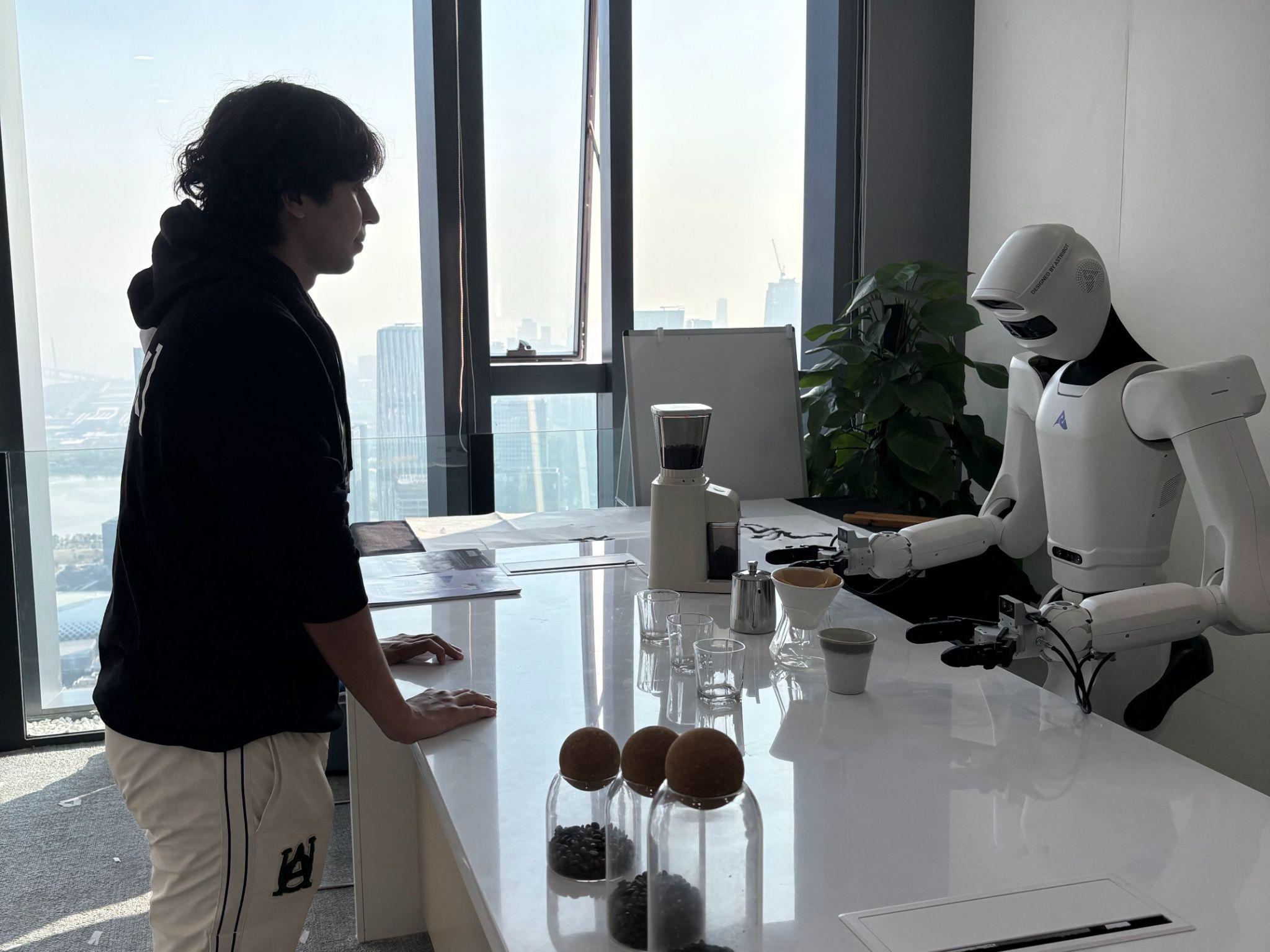 Mateo with an Astribot S1 during an NTU robotics programme trip to Shenzhen in Dec 2025.
New Beginnings in Singapore
In July 2025, Mateo enrolled at NTU for its standing in both AI and mechanical engineering, and for the chance to immerse himself in Southeast Asia's fast-growing technology industry.
The launch of NTU's new Robotics Engineering programme felt like perfect timing. In his first semester, he got to experience firsthand the technologies being developed at NTU MAE, like microscopic drug-delivering robots, 3D movement tracking, and even cyborg insects.
Studying robotics placed him at the intersection of physical intelligent systems and the alignment challenges that would inevitably follow.
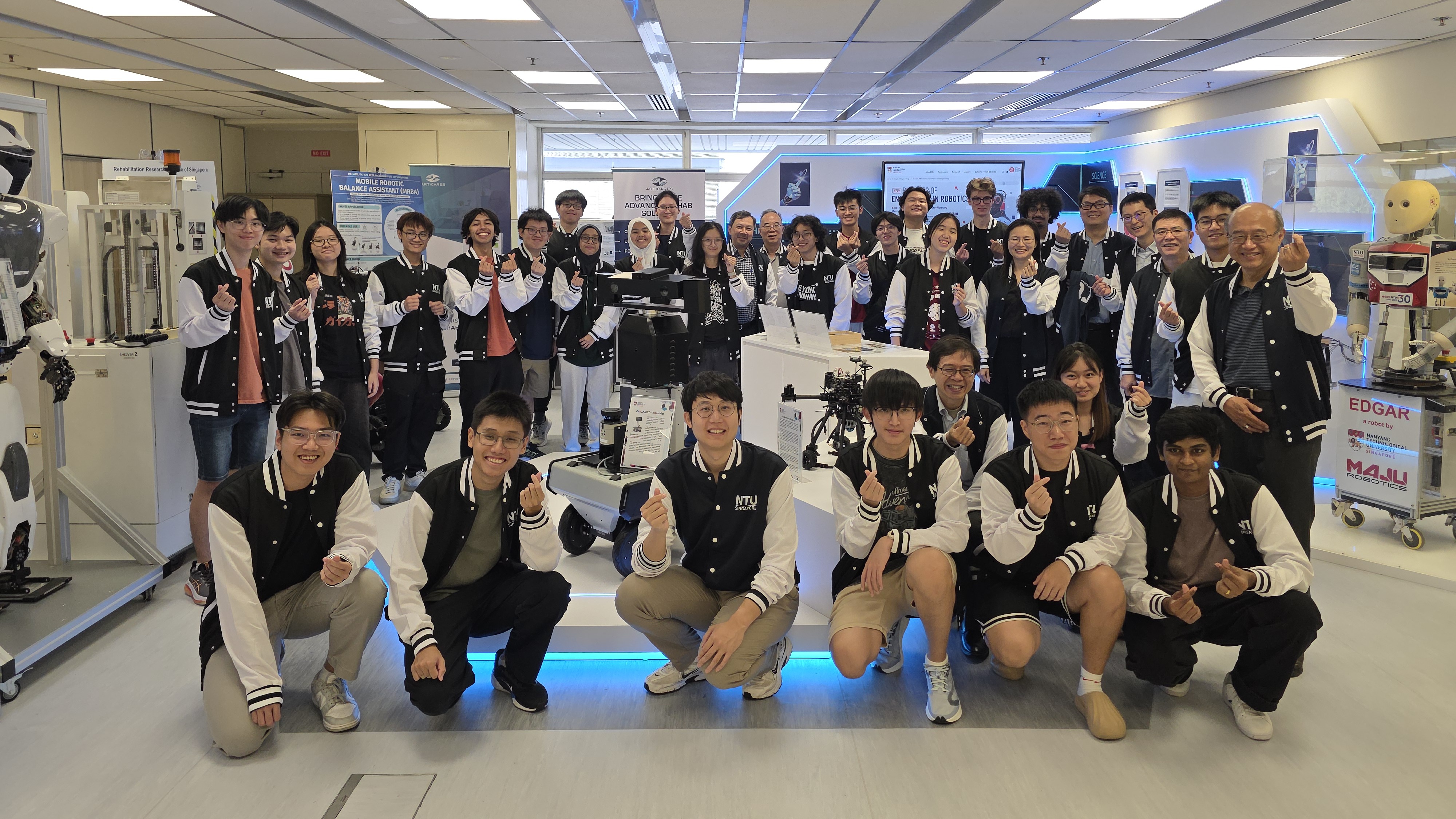 Mateo (Second row, fifth from left) and robotics students at Robotics Research Centre Gallery, NTU MAE.
Seeing the Future of Robotics
Later that year, Mateo joined NTU's robotics trip to Shenzhen and Dongguan, China, led by Professors Yang Jianfei and Chen I-Ming.
The trip was designed for the first cohort of MAE's Bachelor of Robotics students, to give them a firsthand look at the global frontier of robotics and embodied AI.
Over several days, the group visited some of China's fastest-growing robotics companies, exploring the full ecosystem from core hardware and AI algorithms to global commercialisation.
"We were shown how ideas are adapted to consumers' interests and commercialized, across companies ranging from early-stage startups like LimX Dynamics to tech giants like Tencent and DJI."
.jpg?sfvrsn=254e4441_1 "LimXDynamics (crop)") Mateo (bottom right) and the group visiting LimX Dynamics.
Mateo (bottom right) and the group visiting LimX Dynamics.
They also saw robotics applied across manufacturing, medical and surgical fields, logistics and supply chain.
"Undeniably, China houses some of the most advanced technologies and is continuously growing at an extraordinary pace," Mateo added.
.png?sfvrsn=142fddab_1 "Direct Drive Tech (crop)") Mateo (front row, third from right) and the group visiting Direct Drive Technology, a motors and robotics company.
Mateo (front row, third from right) and the group visiting Direct Drive Technology, a motors and robotics company.
The students were inspired by the demonstrations and advancements beyond their expectations, such as modular robots that snap together like Lego to form assembly lines.
.png?sfvrsn=a06551b4_1 "Direct Drive Tech2 (crop)") Mateo (far left) viewing the showcase by Direct Drive Technology.
Mateo (far left) viewing the showcase by Direct Drive Technology.
On one of their visits, they caught a glimpse of the Huawei Dongguan campus, a research and development hub designed with European architecture styles. Mateo was inspired to set his sights on working there one day.
"Experiencing firsthand technologies that felt futuristic made it clearer than ever that this is exactly where I want to be."
 Mateo taking in the view of the Huawei Dongguan campus.
Diving into Autonomous Driving
A few months before Mateo's move to Singapore, Huawei's recruiters reached out to him directly on LinkedIn.
He told them he had no coding experience. They hired him anyway.
In January 2026, Mateo started his internship as a Computer Vision Algorithm Engineer, contributing to autonomous driving research.
He often took longer than expected on tasks that seasoned engineers would handle quickly. His mentors pointed him toward resources and let him find his footing. He learned something new every day.
.jpeg?sfvrsn=608753d8_1 "Mateo robotics - Huawei portrait (1)") Mateo at the Huawei office in Singapore.
Mateo at the Huawei office in Singapore.
"Mateo has shown strong initiative and curiosity throughout his time with us. He is highly proactive in exploring new ideas and is always willing to experiment with emerging techniques from recent research. In particular, he has been actively working on integrating methods from various papers into our next-generation algorithms, bringing fresh perspectives to the team. His positive attitude and willingness to take on challenges make him a valuable contributor."
— Yang Xin, Mateo's supervisor at Huawei
The research focus is object detection for low-light footage, a critical challenge in autonomous driving.
His work involves multimedia data processing and cleaning for machine learning models that predict optical flow, as well as employing state-of-the-art techniques to train models for optical flow inference and video denoising.
"Normally, this problem is tackled by targeting the quality of cameras and other sensors," Mateo explained. "However, at Huawei we are working on creating robust steps that sit between data collection and detection. Honestly, it is very exciting work!"
The mathematics had given him a way of thinking. The fellowship had given him a mission. The NTU robotics programme and Shenzhen trip had shown him where the frontier was.
And now, he is finding his way there.
About Mateo Lizcano CabezasMateo is a Year 1 Robotics Engineering student at NTU's School of Mechanical and Aerospace Engineering. He is a former International Mathematical Olympiad medalist, and an instructor for the Colombian Mathematical Olympiads till 2026. He is currently a Computer Vision Algorithm Engineer intern at Huawei, working on object detection for autonomous driving. |
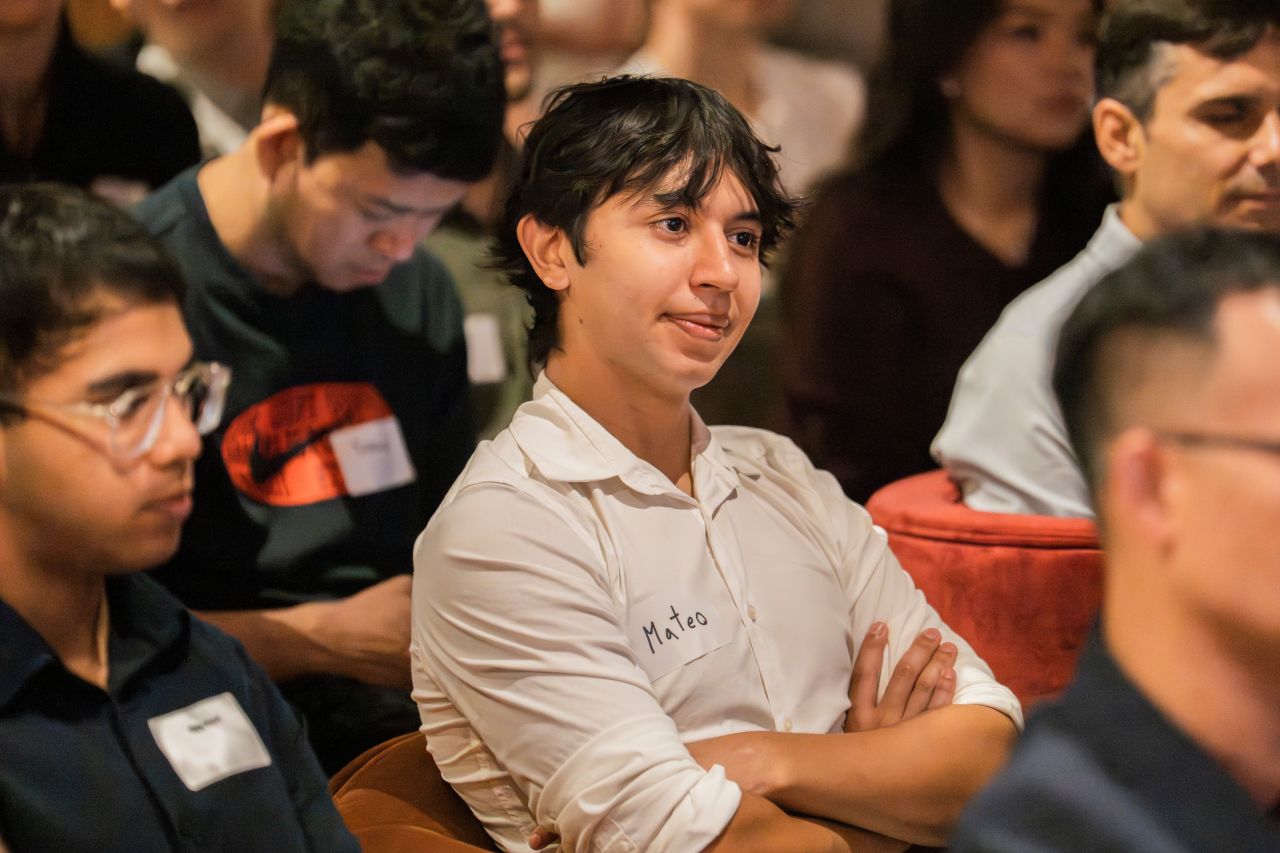 Mateo at the Global Leader Series: Steve Chen (YouTube Co-founder) event, organised by Singapore Global Network (SGN).