From Reactive to Predictive: One Dashboard at a Time
The question Akshat Jain kept returning to was a simple one: if the data already exists, why are machines still failing without warning?
For Akshat, an Aerospace Engineering student, the question was not theoretical. Having interned at Airbus, he had seen first-hand how even minor technical issues could cascade into significant operational consequences in the aviation industry.
Reactive maintenance was the norm, not because better tools were impossible, but because no intelligent layer existed between raw sensor data and the engineers who needed to act on it. That gap became the foundation of PredictIQ.
A Team Built for the Problem
The four had crossed paths long before the hackathon. They met during freshman year hall orientation and bonded further through cultural events by student communities.
Friendships built over shared experiences eventually became the foundation of a working team.
When Akshat and his teammates came across the ElasticON Hackathon 2026, organised by Elastic and powered by Amazon Web Services (AWS), they saw an opportunity to test whether that gap could be closed.
The team was multidisciplinary by design, including Akshat Jain (Aerospace Engineering), Dheemant Rastogi (Electrical and Electronic Engineering), Sanjana Yalamanchili (Data Science and AI), and Arushi Verma (Computer Science), all year 3 NTU students, each bringing a distinct technical perspective to a shared problem.
"The interdisciplinary composition of our team was arguably one of our greatest assets," Akshat reflected. "We each brought a distinct lens to the problem, and those perspectives shaped every layer of the solution."
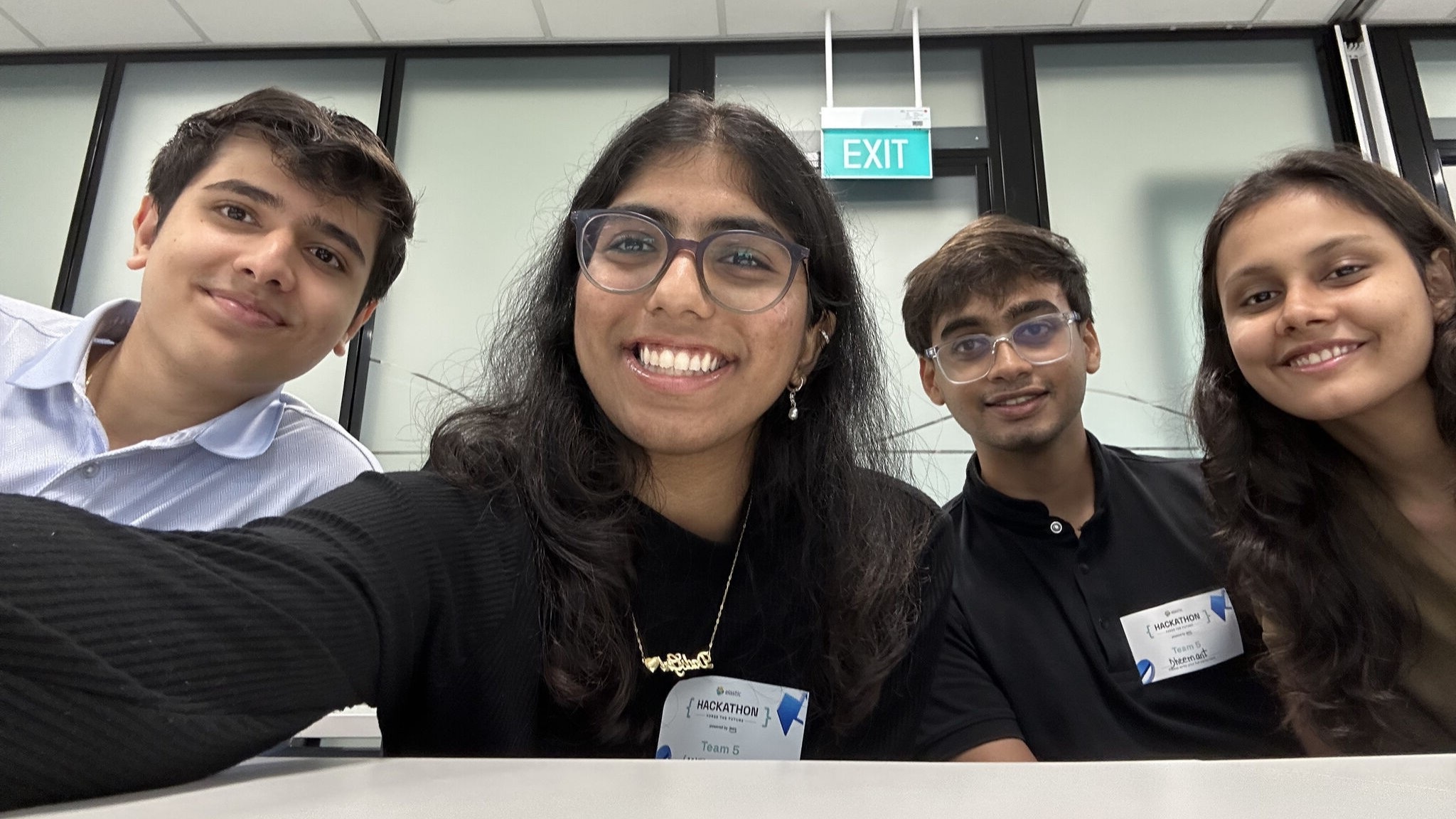 From left to right: Akshat, Sanjana, Dheemant and Arushi at the AWS Office for the hackathon.
Four Agents, One Mission
Over four hours of intensive development at the AWS office in Singapore, the team built PredictIQ: an agentic AI predictive maintenance platform designed to detect equipment anomalies before they become failures.
The system works through four AI agents, each with a distinct role.
Firstly, the Data Labelling Agent collects and analyses engine sensor data, predicting how severe a potential failure might be and how soon it could occur.
Next, the Retrieval Agent links each detected fault to the specific maintenance procedure needed to address it.
This information is then passed to a third agent, the Insights Agent, that generates clear, actionable recommendations for engineers.
Finally, a Chat Agent brings everything together through an interactive dashboard, where engineers can ask questions and get detailed answers about what went wrong and why.
The entire system was built using Python, React, Elasticsearch, and AWS Bedrock.
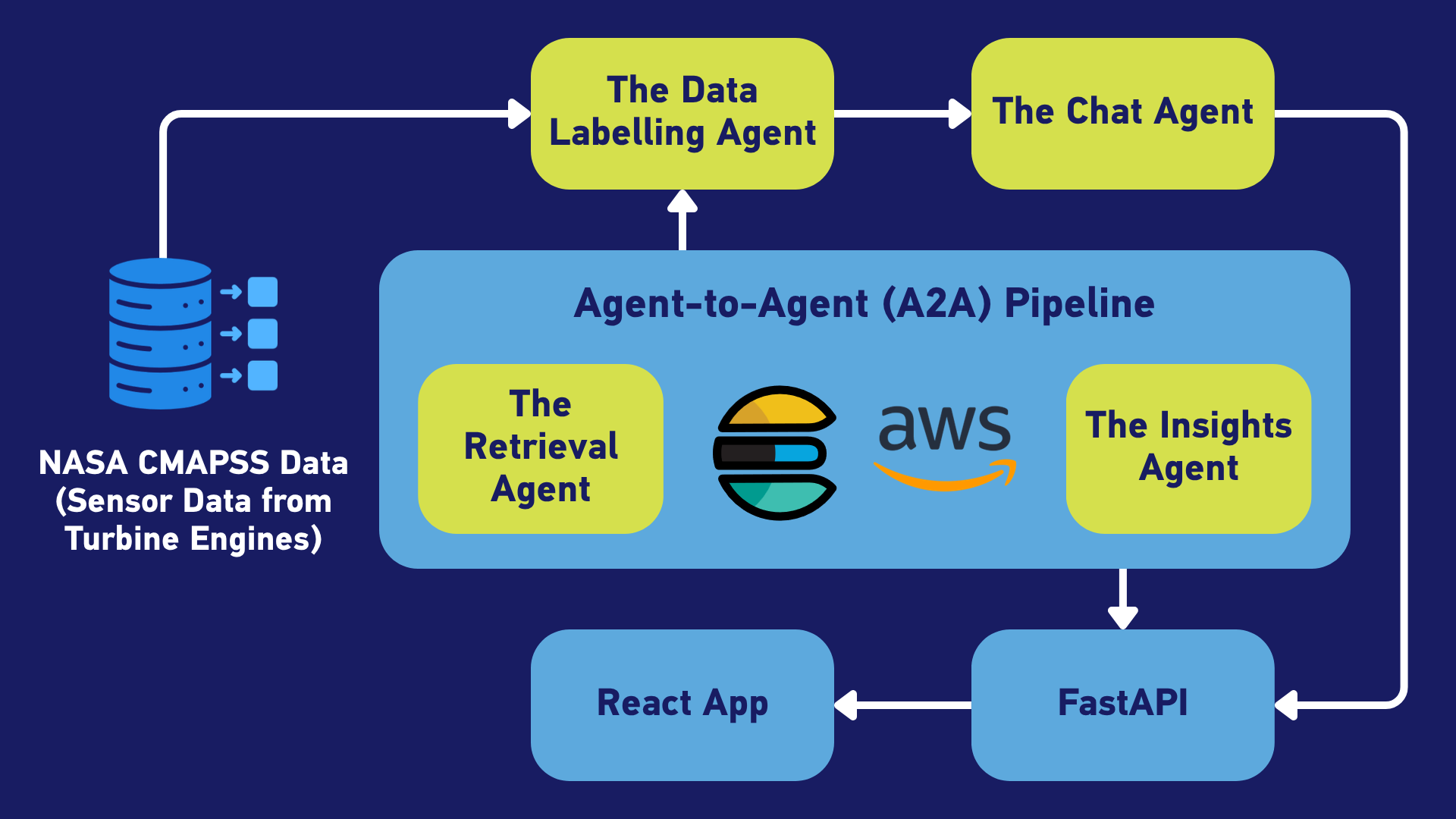 The Agent-to-Agent (A2A) pipeline powering PredictIQ, built on Elasticsearch and AWS Bedrock.
"Relying on a single agent for all tasks would create severe performance bottlenecks and reduce output accuracy," Dheemant explained. "By delegating responsibilities to distinct sub-agents, we were able to achieve superior output quality."
"Engineers can not only understand what might fail," Akshat added, "but also why, and interact with the system through follow-up questions to dig deeper."
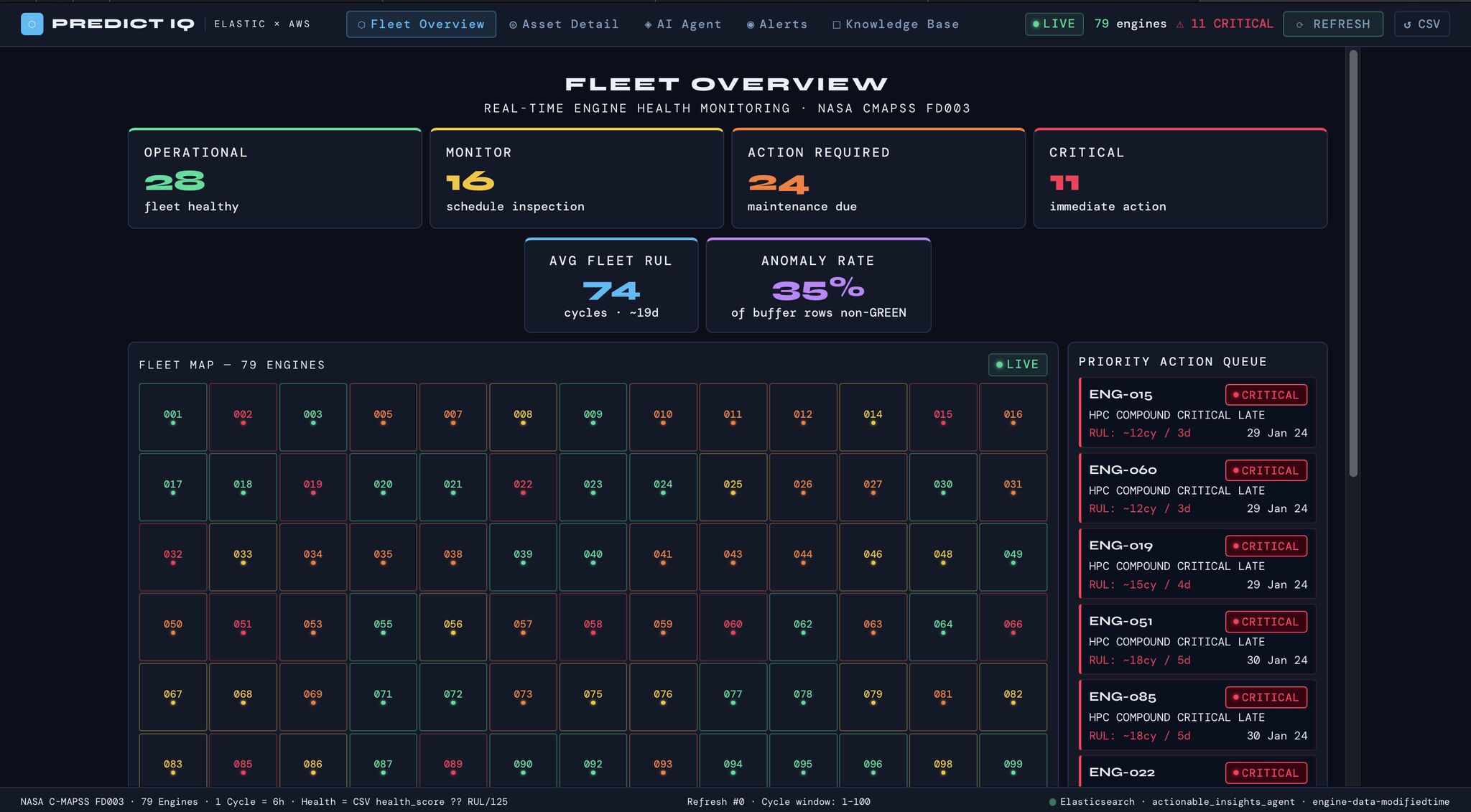 The PredictIQ Fleet Overview dashboard displaying real-time engine health monitoring and AI-generated priority actions.
Students vs Professionals
The international hackathon drew a competitive field of over 80 participants, including experienced professionals from leading technology companies. After four hours of coding, PredictIQ placed in the top three, earning the team a spot in Round 2.
That next stage brought a different kind of pressure. The team presented on stage at ElasticON Singapore 2026, before an audience of hundreds of industry leaders and a panel of five judges.
When the results were announced, the NTU team emerged as the winners, rising above a field dominated by experienced engineers and technology professionals.
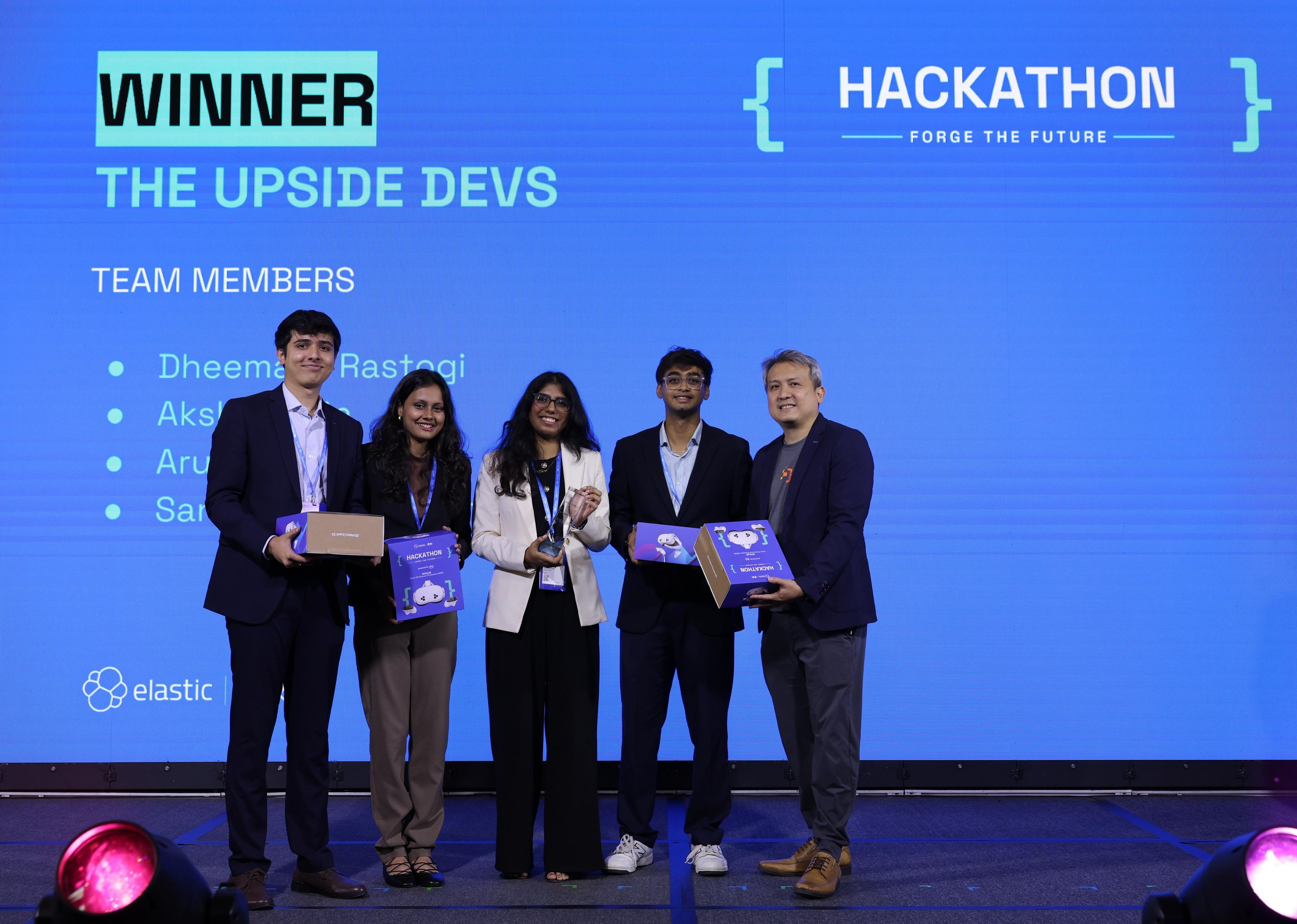 The team receiving the first prize at the ElasticON Singapore event at Marina Bay Sands.
The team's approach had been deliberate from the start.
They studied what previous winning teams had built and arrived at a clear conclusion: the strongest entries were not always the most technically complex, but the ones that addressed problems large enough to matter.
"No matter how skilled or experienced the people in the room are," Arushi noted, "if your idea doesn't connect to a problem that's big enough to matter, it won't land."
Building the system under competition conditions came with its own challenges. Ensuring each agent could reliably pass information to the next required careful coordination.
When the system began hitting processing limits, the team found a creative workaround by distributing the load to keep everything running smoothly through to the final demo.
Closing the Gap Between Data and Action
Unplanned equipment downtime carries significant costs across industries. In aviation and manufacturing, unexpected failures disrupt operations, generate financial losses, and in high-stakes environments, create serious safety risks.
What PredictIQ addressed was not a lack of data, but a lack of interpretation. Modern machines generate extensive sensor readings, and the challenge is transforming that data into foresight engineers can act on before a failure occurs.
By combining anomaly detection, semantic search, and a conversational interface, PredictIQ functions less like a monitoring dashboard and more like an intelligent maintenance partner. It explains what is wrong, why it matters, and what should be done next.
Beyond the Hackathon
For a team of Year 3 students competing against industry professionals, the result reflected more than technical execution. It demonstrated what becomes possible when domain knowledge, engineering rigour, and clarity of purpose are brought together under constraint.
The ambition does not stop at the competition podium. In a world where predictive insights are becoming a necessity rather than a luxury, the team sees a clear opportunity to take PredictIQ beyond a student setting.
Post-graduation, the goal is to develop it into a startup. The vision is for PredictIQ to become a tool used by industry leaders and professionals to prevent costly downtime and extend equipment lifespan.
"The philosophy behind the project remains the same," Sanjana added. "Your data, our insights. We provide the foresight so companies can focus on what they do best, without the fear of unexpected failure."
The judges saw a winning project. The team sees something larger: a platform that could redefine how industries relate to machine failure, before it happens.
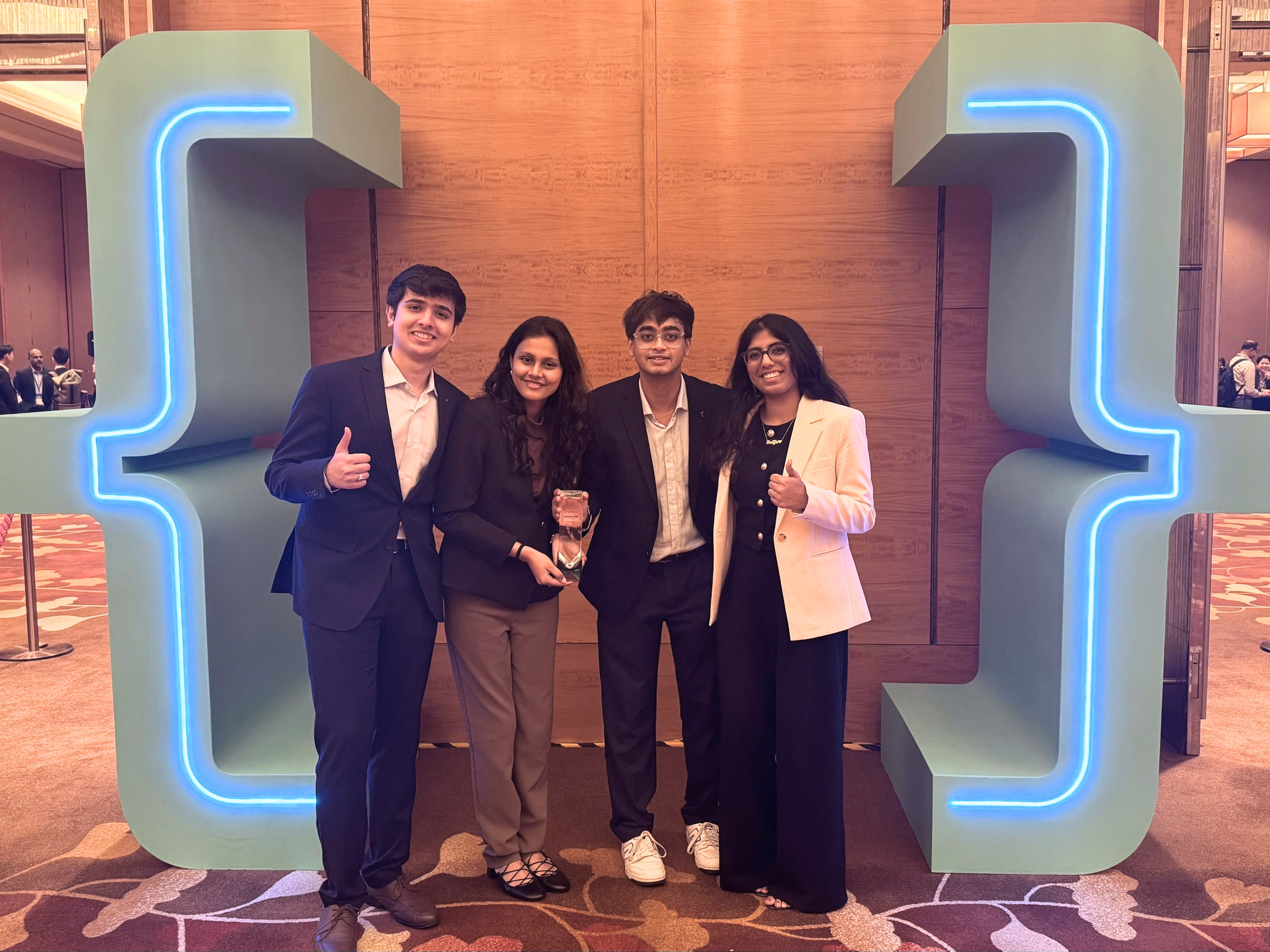 A celebratory photo of the team holding the first-place award.
About the TeamAkshat Jain is a Year 3 Aerospace Engineering student at NTU's School of Mechanical and Aerospace Engineering. Drawing on his domain knowledge and experience as an Airbus intern, he led the development of PredictIQ's dashboard, ensuring the interface reflected how engineers think and work. Arushi Verma is a Year 3 Computer Science student at NTU's College of Computing and Data Science. She was responsible for creating the agent architecture, orchestration, and the core coding that brought PredictIQ to life. Dheemant Rastogi is a Year 3 Electrical and Electronic Engineering student at NTU's School of Electrical and Electronic Engineering. He developed the agent architecture and Retrieval-Augmented Generation pipeline, and contributed to agent orchestration and data processing. Sanjana Yalamanchili is a Year 3 Data Science and AI student at NTU's College of Computing and Data Science. She led data processing and data visualisation, translating raw sensor outputs into meaningful representations for the platform. |
By Regine Ng and Karen Chai, NTU MAE Communications