MUSE-Fi: Contactless Multi-Person Sensing Exploiting Near-Field Wi-Fi Channel Variation
Synopsis
MUSE-Fi is the first Wi-Fi multi-person sensing system with physical separability. It is based on the phenomenon that when a Wi-Fi device (e.g., smartphone) is placed very close to a subject, the near-field channel variation caused by the subject significantly overwhelms variations caused by other distant subjects.
Opportunity
Since obtaining CSI (channel state information) in certain Wi-Fi devices, Wi-Fi human sensing has been attracting significant attention from both academia and industry. Existing Wi-Fi sensing applications include, among others, vital signs monitoring, gesture detection, activity recognition, as well as localisation and motion tracking. While such sensing applications have the potential to be integrated with ubiquitously deployed Wi-Fi communication infrastructures, they face a major obstacle in conducting realistic multi-person sensing as the limited Wi-Fi bandwidth fails to offer sufficient range resolution to distinguish different sensing subjects.
As Wi-Fi communication does not seem to embrace a super-wide bandwidth due to its contention-based multi-access nature, existing sensing proposals often avoid its limitation by resorting to radars with a GHz-level bandwidth. Nevertheless, radar sensing remains inferior to Wi-Fi sensing as it demands extra deployments. To continue exploiting Wi-Fi’s potential in integrated sensing and communication (ISAC), two makeshifts are often adopted. Many distributed antennas can be used to achieve enhanced spatial resolution for separating subjects, at the cost of messing up with the Wi-Fi communication functions. At the same time, signal processing techniques for separating five subjects at the CSI level have been attempted without offering guaranteed separability in general.
Technology
Rather than revamping the design of Wi-Fi, MUSE-Fi signifies two fundamental concepts neglected in the past decade. This makes multiple-person sensing viable with existing Wi-Fi devices. As shown in Figure 1, a realistic multi-user communication scenario involves each person having its own wearable Wi-Fi device(s), hence:
- Each personal-AP link uniquely identifies the human subject to be sensed; and
- Since the subject is within the near-field (less than 0.2m in range) of its own Wi-Fi device, the channel variation caused by its motions to its personal-AP link could be so strong as to push the interference from other subjects down to the noise floor.
In other words, the default multi-user communication setting of Wi-Fi may be extended to multi-person sensing, if one can properly integrate sensing into communication. In practice, frame (hence CSI) rate per link is typically low and irregular, thanks to the contention-based multi-access nature of Wi-Fi. To tackle this challenge, MUSE-Fi promotes a sparse recovery algorithm (SRA) to mask the potential variance in frame rate. Notably, it regulates the input samples to deliver a unified data flow to later processing pipelines for respective sensing functions.
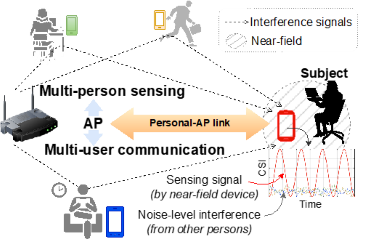
Figure 1: While each personal device uniquely identifies a person, the sensing signal (upon the person) offered by the identifying device within near-field overwhelms the interference from other persons, making individual sensing subjects (e.g., vital signs of a person) physically separable from others.
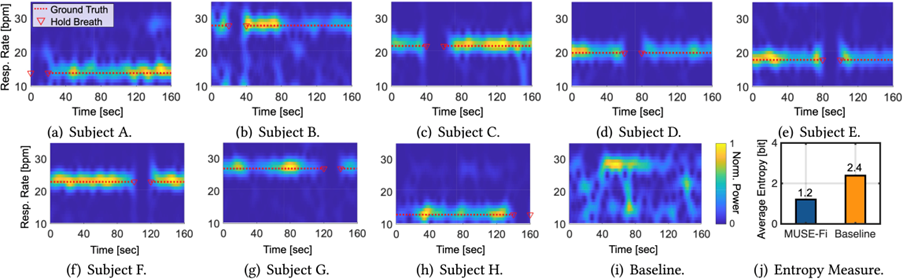
Figure 2: Comparison and analysis on MUSE-Fi and the baseline, in terms of the respiration spectrograms. The discontinuous segments indicate periods when subjects are holding their breath, aiming to prove that no interference is sensed for each individual subject.
Applications & Advantages
MUSE-Fi, for the first time, enables Wi-Fi multi-person sensing, capable of supporting all Wi-Fi sensing applications proposed so far, including, among others, vital signs monitoring, gesture detection, activity recognition, as well as localisation and motion tracking.
The technology is especially suitable for eXtended Reality (XR). In particular, integrating gestures and activities recognition into Wi-Fi communication reduces the peripheral sensors, leading to lighter and less power-consuming virtual reality (VR) and merged reality (MR) headsets, making them more desirable for long-time wearing.


.tmb-listing.jpg?sfvrsn=462ec612_2)