Turning multidisciplinary energy research into deep-tech ventures
Inside NTU I&E’s collaboration with ERI@N to build pathways from systems-led research to commercial deployment.
Energy problems rarely present themselves as tidy research questions. A new battery chemistry might be promising, but it must fit optimally into grid operations, meet safety codes, survive real-world duty cycles and make economic sense. In other words, the hardest part is often not simply the science — it is everything around the science.
That is why energy research tends to reward teams that work across disciplines and think in systems. At NTU, this multidisciplinary effort is built in early in the process, then carried forward through deliberate support for translation.
A clear example is the partnership between the Energy Research Institute @ NTU (ERI@N) and NTU I&E. ERI@N brings together expertise across the university to tackle energy challenges as integrated systems. NTU I&E, working alongside, helps those ideas confront market needs, deployment pathways and venture-building decisions early — so the route from lab to pilot to company becomes clearer and more navigable.
A pan-university model designed for deployment
Professor Madhavi Srinivasan, Executive Director of ERI@N, describes energy challenges as “system-level challenges” that cut across engineering and science as well as economics, business, policy and user contexts. “ERI@N is structured as a pan-university institute, pulling together expertise across NTU rather than operating within a single disciplinary silo,” Prof Srinivasan said. “Teams are deliberately multi- and inter-disciplinary, integrating research across the university in the context of specific energy problems, then translating outcomes holistically into industry and practice.”
This matters because real-world energy solutions rarely succeed or fail on technical performance alone. They hinge on integration — into infrastructure, markets, regulations and operating environments. Crucially, embedding systems thinking early enables ERI@N teams to frame problems with deployment and scalability front of mind, shortening the path from lab discovery to pilot projects and, when appropriate, venture creation.
Where ERI@N builds the research and systems foundations, NTU I&E strengthens the translation pathway. Their collaboration spans the full pipeline and focuses on continuity. At the ideation stage, NTU I&E helps research teams stress-test ideas beyond novelty, pushing on questions of market need, differentiation and adoption.
As projects mature, NTU I&E supports venture building through mentors, entrepreneurs-in-residence and structured programmes that help teams refine value propositions and engage early customers. In pre-commercialisation, NTU I&E’s support around IP strategy, industry partnerships, pilot deployments and investor engagement becomes pivotal.
Translation shaped by multidisciplinary work and venture support
Two ERI@N spin-offs illustrate how this model plays out in practice. The journey of VFlowTech, which pioneers vanadium redox flow battery systems, began in electrochemistry and materials research, but its direction was shaped by collaboration with power systems engineers, industry partners and early customers focused on real energy storage deployment. That cross-disciplinary and external engagement pushed the technology towards operational requirements — safety, scalability, durability and grid integration — so it could move beyond laboratory performance. ERI@N anchored the systems-level development; NTU I&E supported the venture pathway through IP strategy, translational funding, industry engagement and early investor access, helping the founding team transition from researchers to deep-tech entrepreneurs.
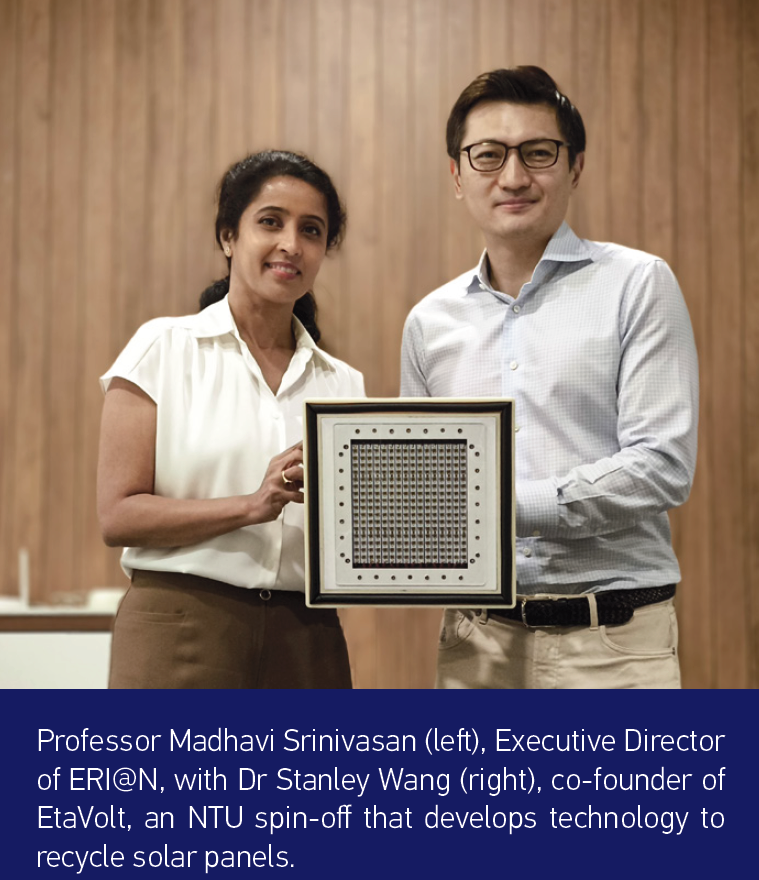 Focusing on solar-panel recycling, NTU spin-off EtaVolt’s path similarly reflects a convergence of disciplines, from materials science and electrical engineering to power electronics and energy systems integration. This interdisciplinary environment helped the team focus various facets, whether component optimisation, or system-level performance attributes such as efficiency, reliability and manufacturability that determine whether a technology can be deployed. External partnerships helped validate use cases, clarify deployment constraints and surface regulatory expectations earlier. Alongside this, NTU I&E complemented technical progress with venture development support, connecting the team to mentors, networks, pilot opportunities and funding to turn technical strength into commercial readiness.
From ERI@N’s perspective, some bottlenecks are persistent: the cost and complexity of piloting at scale, regulatory and safety compliance and the frequent mismatch between research timelines and market expectations. NTU I&E helps teams reduce these frictions by shaping credible development roadmaps and connecting researchers to the right stakeholders at the right time, lowering uncertainty for both external partners and investors.
Looking ahead, Prof Srinivasan sees opportunities “at the intersection of energy systems, AI, digitalisation and decarbonisation,” including earlier co-development of testbeds, embedded entrepreneurship within research programmes and stronger engagement with global industry and policy partners.
Read the full newsletter or subscribe to NTU I&E for the latest updates, events and programmes.