VFlowTech: Engineered for a cleaner future
From island microgrids to industrial power hubs, an NTU spin-off is redefining how renewable energy can be stored, scaled and shared.
Solar panels do not generate electricity after sunset. Wind turbines slow when the air stills. For all the momentum behind renewable energy, its variability remains a constraint — one that limits how far clean power can penetrate grids, industrial sites and remote communities. Making renewables reliable, not just available, depends on something less visible but just as critical: energy storage.
That challenge is what brought Dr Avishek Kumar and Dr Arjun Bhattarai together. Both NTU graduates, they recognised early that the transition to clean energy would stall without storage systems designed for long hours, heavy use and demanding environments. In 2018, they founded VFlowTech, an NTU spin-off focused on long-duration energy storage using vanadium redox flow battery (VRFB) technology. Its flagship system, PowerCube, was built to do one thing well — store renewable energy safely and deliver it when it is needed.
Designed for scale and longevity
Unlike conventional batteries that store energy in solid electrodes, VRFB systems store energy in liquid electrolytes held in external tanks. Power is delivered when these liquids circulate through a cell stack; capacity is increased simply by enlarging the tanks. This design makes flow batteries particularly suited for long-duration storage, where energy must be supplied over many hours rather than short bursts.
The sustainability advantages are practical. VRFB electrolytes do not degrade with repeated cycling, allowing systems to operate reliably for decades. The chemistry is non-flammable, reducing safety risks in dense urban or industrial settings. And because the electrolytes are reusable and recyclable, the technology lends itself to circular economy approaches.
VFlowTech’s ability to translate these attributes into a commercially viable system is rooted in NTU research. A key breakthrough emerged from NTU-led work on high-voltage VRFB architectures, paired with improved methods for determining a battery’s state of charge. Accurate state-of-charge control is essential for operating large storage systems safely and predictably, especially when power levels scale up.
This research enabled PowerCube’s latest-generation 500 kW system to operate at significantly higher voltages, between 700 and 1,150 volts. Higher voltage operation allows greater power density, reduces balance-of-system costs and simplifies integration into utility-scale and industrial energy infrastructure. Complementary studies on materials compatibility and long-duration reliability further supported system scale-up and lifetime performance, de-risking deployment for demanding customers.
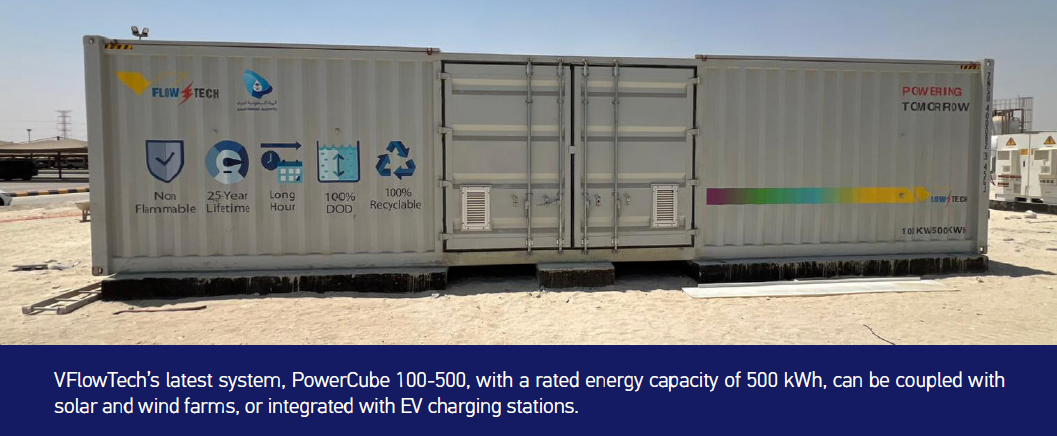
These advances are already being tested beyond the lab. PowerCube systems are operating in markedly different settings — from Pulau Ubin, where energy storage supports remote and off-grid needs, to Jurong Island, one of Singapore’s most energy-intensive industrial zones. The contrast underscores the system’s versatility: the same storage architecture can stabilise a microgrid or support continuous industrial operations.
VFlowTech’s progression from research concept to deployed system has been supported by NTU’s innovation ecosystem. Through NTU I&E and NTUitive, the company accessed laboratory facilities, specialised equipment and research manpower, enabling advanced R&D aligned with real-world deployment requirements. Collaborative programmes supported long-term performance testing, validation of new stack designs and reliability studies using repurposed industrial tanks, linking technology development with circular economy principles.
This foundation has helped accelerate VFlowTech’s transition from R&D to market. In 2025, the company raised USD20.5 million in its latest funding round to support the scaling of manufacturing and deployments of its VRFB systems, alongside enhancements to its AI-driven cloud energy management platform. By optimising dispatch, efficiency and system performance over time, the digital layer is designed to help customers extract greater value from stored energy, turning storage assets into flexible, revenue-supporting infrastructure.
Read the full newsletter or subscribe to NTU I&E for the latest updates, events and programmes.