Building the bridge from discovery to impact
NTU Innovation and Entrepreneurship helps researchers turn discoveries into ventures through funding, mentorship and programmes that bridge the gap from lab to market.
Despite more than US$1 trillion poured into research each year, far too few discoveries ever progress beyond the lab. This gap — often dubbed the ‘valley of death’ — leaves the path from publication to patent, or product, foggy at best.
However, the importance of closing this chasm is growing. Global technology spending is expected to hit nearly US$5 trillion in 2025, signalling both demand and opportunity for impactful innovation.
At NTU, the founder’s journey is intentionally streamlined. Faculty and students are supported through a structured pathway of early-stage funding, mentorship and venture-building — designed to translate curiosity-driven discovery into sustainable, market-ready ventures.
From proof of concept to investible ventures
The first challenge for any new technology is proving it can work outside the lab. The NTUitive Gap Fund supports researchers at this critical stage, providing up to S$250,000 proof-of-concept (POC) funding over 18 months. Apart from technical novelty, projects are assessed for their potential market opportunity and value proposition. With this funding, researchers have the opportunity to raise the readiness level of their technology from early proof points towards pilot runs, the stage at which investors begin to take interest.
On the other hand, some technologies need that extra push to progress and reduce risks before attracting venture capital investments. For instance, those in healthcare often require more data on safety and effectiveness through animal testing before proceeding to clinical trials. Similarly, materials science innovations may need funding to scale up production for industry partners to conduct sample testing.
Once a spin-off is formed, the NTU Seed Fund (by invitation) steps in with early-stage equity investment. By backing NTU-affiliated start-ups with strong market potential, the Seed Fund helps young companies accelerate development, hire talent and enter competitive markets.
Collectively, these funding instruments provide a ladder that enables researchers to move from raw discovery to investible enterprise.
Beyond funding: people and programmes
Indeed, it takes more than money to carry an idea to market. That is why NTU embeds researchers within an ecosystem of venture builders, mentors and industry champions. The Technology Development and Venture Building teams work closely with innovators from the start, setting realistic milestones and conducting regular check-ins. When gaps appear — whether in technical progress, business planning or team composition — they step in with tailored guidance.
Mentorship is equally central. Through structured programmes such as the National Graduate Research Innovation Programme (GRIP), researchers are paired with commercial champions who bring domain-specific expertise. Some mentors are generalists in venture creation and business modelling, while others specialise in sectors like medtech, semiconductors or energy. The combination ensures that every team can benefit from both broad entrepreneurial perspective and deep industry knowledge.
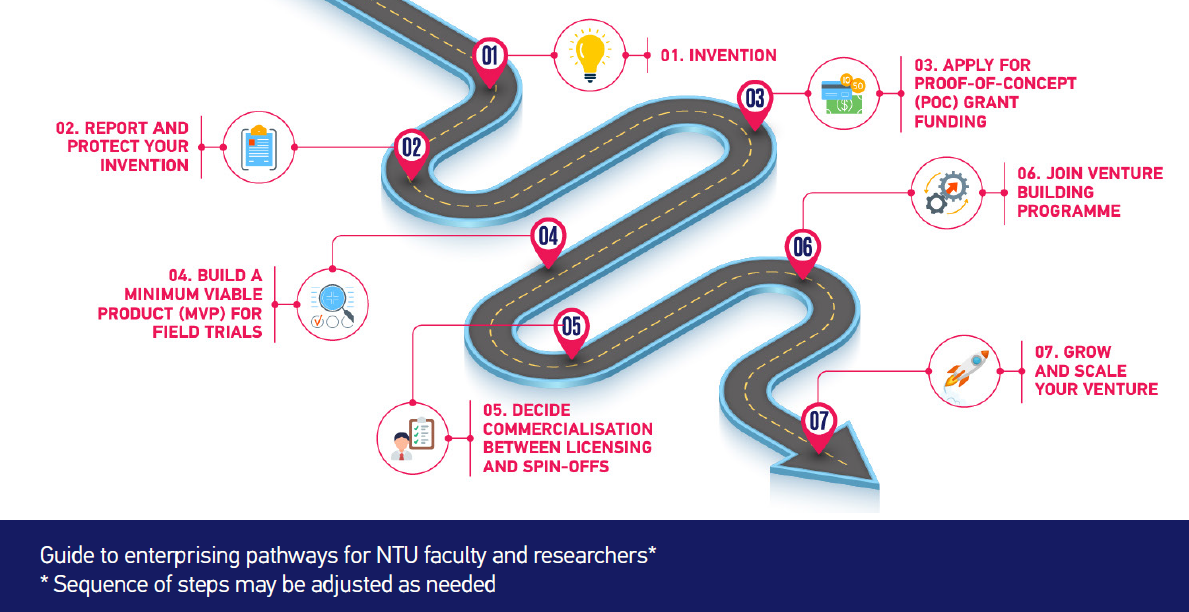
Importantly, support does not end once a POC grant is awarded. Post-POC, researchers can access fellowships and fractional advisors who help shape go-to-market strategies, refine pitches and connect with investors. NTU’s venture builders also provide hands-on help in competitions and investor forums, where telling a compelling research story can make the difference between being overlooked or backed.Building the mindset for translation
Perhaps the most important shift is mindset: learning to frame research not only as knowledge, but as tangible value. NTU supports this transition through various workshops such as the Business Immersion Programme and NTU Entrepreneurship & Startup Training (NEST), which equips aspiring entrepreneurs with design thinking principles and tools to approach problem-solving, as well as customer discovery techniques to uncover customers' needs and pain points.
Specialised programmes expand this foundation. For example, National GRIP equips deep tech teams with the tools to validate markets, design robust business models and prepare for investment. The Singapore Climate Ventures programme, launched in 2024, offers a 10-week sprint into climate-tech venture creation. Meanwhile, the newly launched Singapore Semiconductor Ventures programme links researchers with global mentors in the fast-evolving semiconductor space. These initiatives give NTU researchers not just knowledge, but networks: exposure to investors, potential partners and peers across Singapore and beyond.
From seed funding to seasoned mentors, from mindset workshops to global networks, NTU lays down the founder’s path with care and intention. Crossing the ‘valley of death’ is never easy, but with the route mapped, lit and reinforced, researchers have the chance not only to bring their ideas safely across, but to see them take root and thrive long after.