Learning the ropes of entrepreneurship
The Experiential Learning team at NTUpreneur partners with student founders to stress-test, refine and connect ideas into ventures.
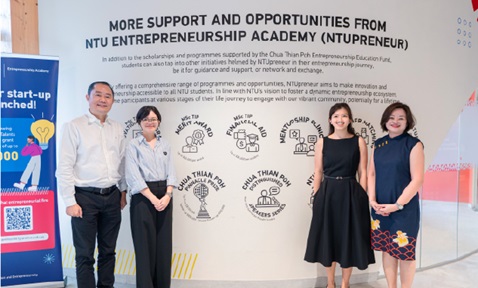
At the NTU Entrepreneurship Academy (NTUpreneur), ‘experiential’ means building in the real world. The Experiential Learning team at NTUpreneur partners with student founders at the earliest stages, stress-testing ideas, sharpening business models and connecting them with mentors, peers, alumni and industry.
Students also gain exposure through local and international competitions, where they validate concepts and receive actionable feedback. For projects that demonstrate potential, the team bridges them to NTUitive for structured incubation and commercialisation support.
Here we highlight three ventures — each distinct, but all nurtured by this hands-on journey.
DripGuard: pivoting a class project into safer IV care
DripGuard began as a simple consumer gadget: a smart water-bottle detector at the Mechanical and Aerospace Engineering (MAE) Engineering Innovation & Design (EID) showcase. Seeing its potential, the Experiential Learning team invited the MAE students Vineet Negi, Jain Aaditah, Ng Jun Jie and Leon Lim Jia Hong for a venture-building consultation to explore pathways beyond the showcase. Early feedback revealed a bigger opportunity: many hospitals still rely on manual intravenous (IV) drip monitoring, which burdens nurses and risks patient safety when bags run low.
Guided by mentors, the team pivoted to develop a low-cost sensor that fits existing IV sets, tracks levels in real time and issues timely alerts. However, the shift came with challenges, from designing reliable sensors to keeping costs down and navigating regulatory requirements. With structured mentorship, they refined their value proposition, pitched at competitions and gained feedback from industry experts.
Now, DripGuard has a working proof-of-concept and is refining its prototype while preparing for regulatory mapping and pilot opportunities. What began as a showcase gadget is now a venture aiming to improve patient safety and hospital efficiency.
PocketMed: a smarter pill routine, one nudge at a time
For Boonsom Suramit and Theeraphat Trong-metheerat, the idea began at home. Watching grandparents juggle multiple pills daily — and experiencing their own struggles with supplement routines — they set out to design a personal helper for medication adherence. PocketMed is their solution: a portable smart pillbox with a companion app that reminds users with light, sound and vibration, logs doses automatically and notifies caregivers when support is needed.
Their first concept, automating pharmacy dispensing, was infeasible due to packaging diversity. Guided by Experiential Learning mentors, they pivoted to adherence, where technology could make a direct impact. Venture clinics emphasised discipline: cut to a true minimum viable product (MVP), prioritise reliability, test weekly with users and track costs with a live bill of materials. Mentors also encouraged them to sharpen their problem statement, map go-to-market options and anticipate compliance and data-privacy demands.
The turning point came after a failed Growing Entrepreneurial Talents (GET) innovation grant application. Seeking feedback, the team connected with their NTUpreneur mentor who offered hands-on guidance in product design and strategy. With a rebuilt architecture and sharper value proposition, they are now prototyping, preparing user trials and resubmitting with stronger evidence and momentum.
SoloTogether: a platform for independent artists to find work
Solomon Chua’s idea for SoloTogether was sparked by a bruising encounter pitching live music to a business owner. Frustrated by how fragile the livelihoods of artists could be, he envisioned a platform to connect independent performers with venues and communities — an ‘Airbnb for the arts’ designed to make the ecosystem more inclusive and sustainable.
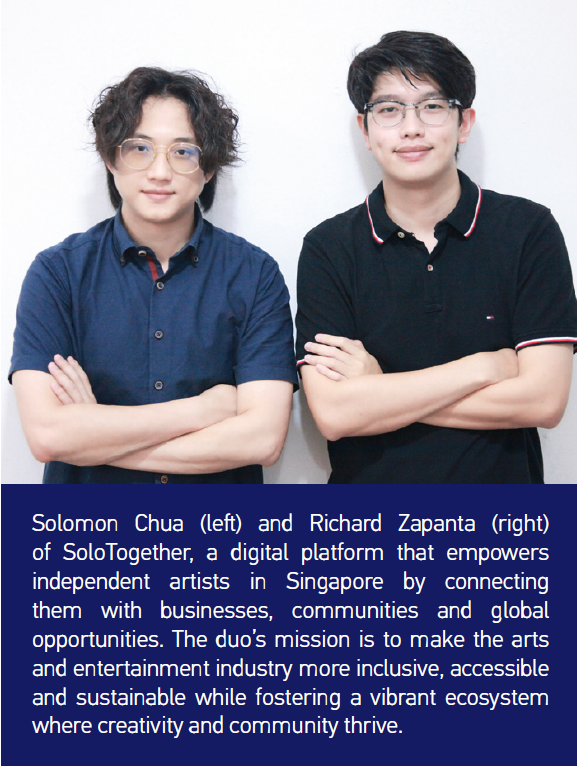
He met co-founder Richard Zapanta at NTU, and together they began toying with the idea. Both had submitted separate proposals for innovation grants — Solomon’s arts community platform and Richard’s healthcare data project — though neither advanced. With support from Experiential Learning mentors, they refined their concepts, tackled hurdles in validation and development and eventually joined forces.
A Europe immersion trip to Amsterdam’s A Lab was the catalyst. Inspired by its vibrant creative community, they recognised their complementary strengths — Solomon’s arts background and Richard’s software expertise — and committed to building SoloTogether. Mentors kept them focused by paring down an ambitious feature list to one goal: build an MVP to validate demand before scaling. They are now preparing a soft launch, aiming to give independent artists more reliable and sustainable access to work.
“By pairing students with mentors, competitions and industry feedback, we help them test, pivot and scale faster — ultimately accelerating their learning curve. Our goal is to nurture resilient founders who know how to build, again and again,” said Ms Faith Teh, Deputy Director, NTUpreneur.