The first spark: where NTU ideas begin
From NTU lab to global clinics, Dr Asif Hussain’s journey as an entrepreneur shows how protecting a vision can turn research into impact.
When Dr Asif Hussain first joined NTU’s Robotics Research Centre as a postdoctoral fellow, starting a company was far from his mind. What drew him to Singapore was the opportunity to work with Professor Domenico Campolo (School of Mechanical and Aerospace Engineering) on a bold idea: bringing robotics to patients’ bedsides by making them intelligent, affordable and portable. At that stage, the team was focused squarely on clinical impact, not commercialisation. Yet that decision to come to NTU set in motion a journey that would eventually see Dr Hussain co-found Articares, an NTU spinoff developing robotic technologies for decentralised healthcare, including use in the home.
Dr Hussain’s entrepreneurial journey was shaped by an earlier experience that left a lasting impression. While pursuing his doctorate at Imperial College London, one of his systems was picked up and commercialised by a large firm. At first, it seemed like a success story. But as the product rolled out, he felt the purpose was slowly slipping way. “It became more about technology than the people it was meant to help,” he recalled.
“That outcome really stayed with me. It showed how a lot of hard work never truly translated into impact.”
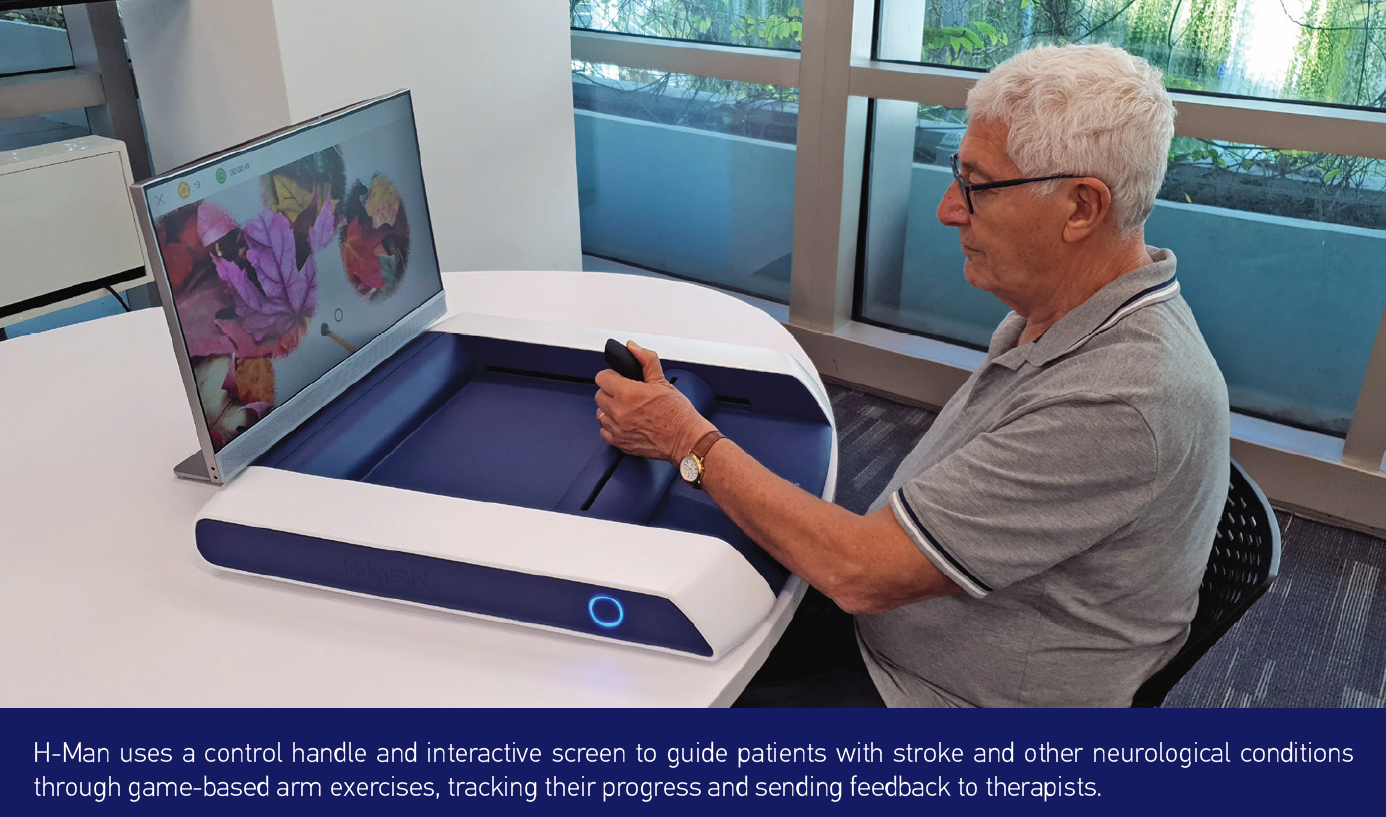
At NTU, he saw history looming to repeat itself. Together with Prof Campolo, he had developed a portable rehabilitation robot, H-man, designed to support stroke survivors and other patients in regaining arm mobility. In clinical trials involving 60 stroke patients, H-Man delivered improvements on par with conventional therapy — with the added benefit of being usable in community clinics and even at home.As licensing interest in the technology mounted, Dr Hussain worried that the original intent — to make rehabilitation accessible and meaningful for patients — might again be lost in translation. That fear became a turning point. “We decided it was time to roll up our sleeves, lose some hair and take on one of the hardest challenges: starting a medical robotics company,” he said. With the support of NTUitive, Articares was born in 2018.
From researcher to CEO
The transition from research fellow to chief executive was anything but smooth. Regulations, clinical trials, business planning, fundraising and a myriad other matters tested the fledgling spinoff. But the toughest hurdle, Dr Hussain reckoned, was holding fast to the original vision while making compromises needed for survival.
Equally challenging was the mindset shift required to navigate the uncertain waters of running a business. “In research, you live in a controlled world. In business, it is the complete opposite. Things you spent months perfecting turn out to be problems only in your head, while something you worked on for an hour becomes the game-changing feature,” he added. The weight of decision-making also grew heavier: “Unlike in research, where you almost always have collaborators and peers to support you, the CEO role can feel lonely. Many critical decisions that can impact many are, in the end, yours alone.”
Rising from the challenges, Articares has since found its footing. The company now serves patients in more than eight countries from Australia to Germany to China, operates profitably, and is backed by a dedicated team representing nine nationalities. Dr Hussain did not hesitate about what made the difference: “It always comes down to the people you have on your team, the persistence you bring and how practical your technology is.”
Reflections for future founders
Looking back, Dr Hussain is candid about what it takes to make the leap from researchers to entrepreneur. In particular, financial rewards or the idea of independence are not the strongest reasons to begin.
Instead, what sustains founders through the uncertainty is something that runs deeper. “Passion is one of the most potent drivers,” he said. “If you have a deep passion for something and you don’t see any other way to achieve it without starting a company, then go for it. Be prepared to give it everything, because that is what it takes to turn that vision into reality.”
Read the full newsletter or subscribe to NTU I&E for the latest updates, events and programmes.