Designing a holistic ecosystem for deep (tech) impact
With founder-friendly pathways and a resilient, supportive environment, NTU transforms research breakthroughs into thriving ventures that deliver long-term societal and economic impact.
The age-old aphorism good things take time rings especially true in the world of deep tech. Indeed, bringing an innovation to market takes time, capital and resilience. NTU’s strategy is to reduce friction at the get-go, surround founders with the right support and cultivate a conducive ecosystem where progress compounds.
Over the past two years, NTU has streamlined how its community licenses intellectual property (IP) to start companies. “Accessing university IP often meant lengthy negotiations,” says Professor Louis Phee, Vice President (Innovation & Entrepreneurship) at NTU. “Simplifying the process enables our faculty, students and alumni to secure standard agreements in just one week!”
Crucially, payment terms are also adjusted to fit the realities of startups. Prof Phee stresses that “NTU does not want to burden a new startup with payments to use the IP — this is deferred to a point where the startup is in a better position, generating revenue.” Ultimately, the aim is to accelerate the path from lab to market so that technologies reach society more quickly.
Safer to try, faster to learn
Startups are by nature high-risk ventures. While risk cannot be eliminated, it can be managed. “Some companies will fail, some will cut through the noise and succeed. That is just the nature of the game,” Prof Phee adds.
To encourage the NTU community to experiment with their ideas and boost their chances of success, the university leans on three levers.
First, education. From the Minor in Entrepreneurship, to the Master of Science in Technopreneurship and Innovation (MSc TIP), students and faculty gain practical skills to be better prepared for this journey, whether it is preparing business proposals or braving that crucial first pitch to potential investors.
Second, capability. A centralised Makers’ Lab gives startups access to advanced equipment and expertise across the university, raising prototype quality and investor readiness.
Third, real-world testing. NTU’s smart campus is like a living laboratory, where technologies can be trialled in authentic conditions: autonomous buses that once ran on campus roads; temperature-reducing paint piloted on NTU buildings; and student-built delivery robots that ferry meals to residence halls.
From lab to founder
For teams working in robotics, AI, materials science, healthcare, climate tech, energy and water — areas where NTU is notably strong — the National Graduate Research Innovation Programme (GRIP) provides a year-long runway to transform research into market-ready deep-tech startups. Throughout the programme, founders will have access to a plethora of NTU Innovation & Entrepreneurship (I&E) resources, from early-stage funding and venture builders’ support to advanced development infrastructure and various tech offerings ripe for commercialisation.
Split into three phases, National GRIP enables participants to validate market potential, connect with like-minded founders, craft a strategic business model, develop a minimum viable product, engage with potential customers and have the opportunity to pivot based on feedback. Those that make it through incorporate as private companies.
On the other hand, entrepreneurial undergraduates have a pathway to turn their ideas into marketable reality through the brand-new NTU Venture Creation Programme. Working in interdisciplinary teams, students identify problems, design viable products or services and build startup concepts in emerging fields areas such as sustainability and AI, with access to NTU I&E’s resources. Teams with the most promising ideas may be awarded grants of up to S$100,000 to scale their projects.
Of course, funding is only one part of the equation. A holistic ecosystem requires more than just a hefty cash injection. To enable such an ecosystem NTU is assembling places and networks that inspire moments of serendipity.
“Beyond funding, what is important is building a community,” Prof Phee says. “Our NTU Innovation Centre sits beside an up-and-coming MRT station. This place will be buzzing even at night!”
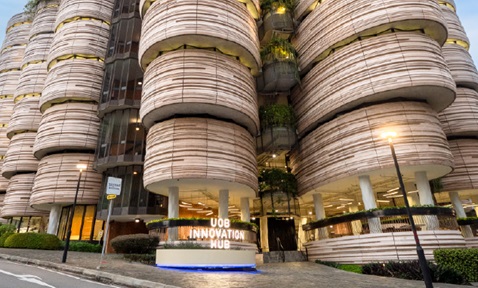
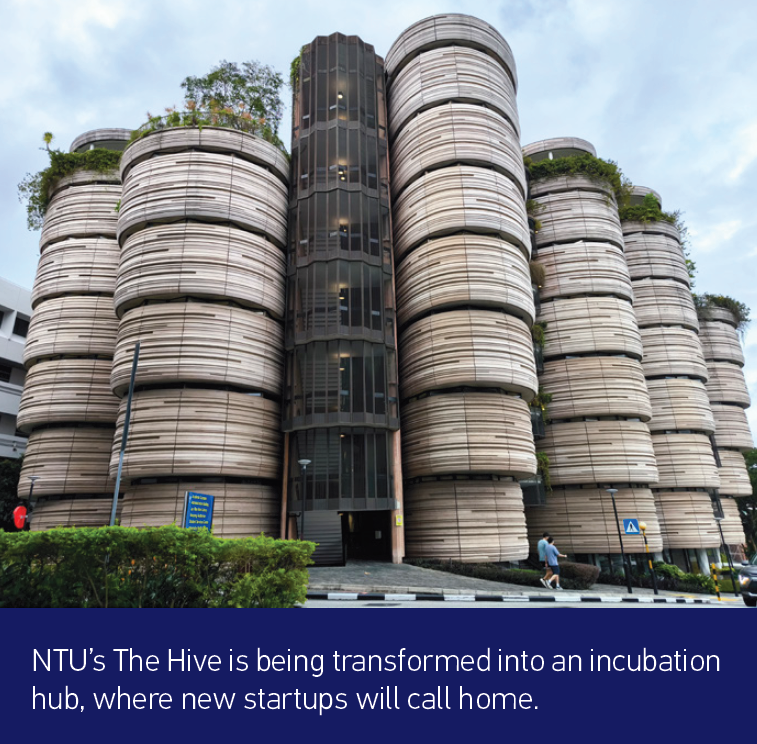
The iconic Hive building is also being transformed into an incubation hub where new startups will call home. Alongside this, the NTU Seed Fund and the Nanyang Frontier Fund expand access to capital, while alumni, angels and VCs open doors to customers and markets.
Looking outwards, NTU draws lessons from global exemplars while adapting them locally. “Stanford University has Silicon Valley in their backyard. We don’t have something similar...yet — but we can look forward to the Jurong Innovation District,” Prof Phee says. “It takes time. We have to contextualise and find our own ingredients and formula.”
Success, Prof Phee adds, must be visible and repeatable: “Very simply put, if we have an NTU-based startup that goes through acquisition, merger or IPO every year — that is something to be proud of.” His vision is for NTU to be an international hub for innovation and entrepreneurship — the go-to place for startups to set up shop and expand their impact.
“Above all, don’t be afraid to get your hands dirty — just try it,” adds Prof Phee, underlining his number one advice to budding entrepreneurs. “We certainly hope you’ll succeed, but even if you don’t, it’s still a fantastic learning journey you can apply to your next attempt.”