Building ventures and shaping founders
As an entrepreneurial academic, Professor Lam Kwok Yan has built ventures, mentored students and demonstrated how NTU-born ideas can scale from the lab to the global stage — even to the attention of Bill Gates himself.
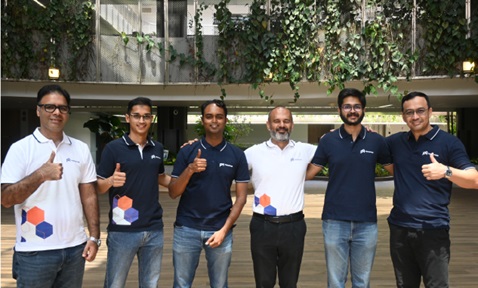
An opportunity to present to Bill Gates, in the flesh, is rare. So when a team of entrepreneurial NTU students had a chance, it became a collectively proud moment for the university. It was also the culmination of months of hard work, trial runs and an afternoon of coaching that shifted the team’s delivery from a classroom-style presentation to an industry-ready pitch.
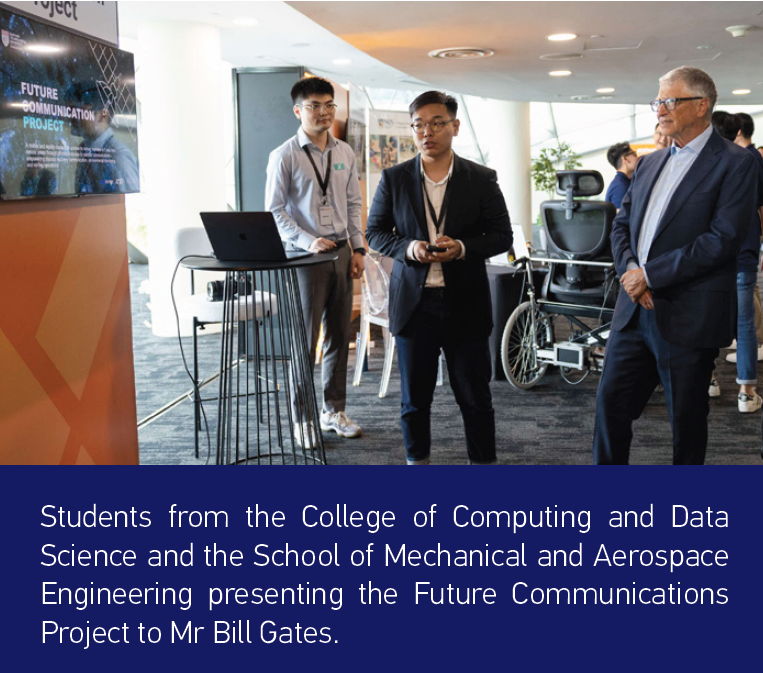
At ATxInspire 2025, an event showcasing the latest advancements in technology, the students, from the NTU College of Computing and Data Science and the School of Mechanical and Aerospace Engineering, presented the Future Communications Project: a mobile, energy-efficient system that transmits real-time Internet-of-Things (IoT) data via satellite in areas with no terrestrial connectivity. With potential applications in areas ranging from disaster recovery to agriculture productivity, the project was recognised as one of only four student-led innovations selected nationally for the event.
For project supervisor Professor Lam Kwok Yan, Associate Vice President (Strategy & Partnerships) at NTU, the significance ran deeper. The opportunity captured what he has long championed: research that translates into impact, and students who apply their learning beyond lecture theatres.
“At NTU, entrepreneurship is not an afterthought,” he said. “It is part of how we approach research.”
From research for good to ventures with purpose
A world-renowned researcher and practitioner in cybersecurity, Prof Lam’s ‘North Star’ has always been clear — do research that meets real-world demand. Be it advancing cybersecurity infrastructure, developing privacy-preserving AI or exploring transformers before they became mainstream, he consistently asks whether the work will matter beyond academia. This orientation towards ‘research for good’ is the overarching principle driving his ventures as well as his teaching.
The spinoffs he has founded illustrate this trajectory. PrivyLink, launched in the late 1990s, delivered e-security solutions for financial and government infrastructures when digital trust was still nascent. Soda Pte Ltd, launched in 2012, carried that expertise into broader markets and went on to win international recognition. TAU Express, born from a case retrieval system developed in collaboration with the Singapore Supreme Court, now delivers enterprise text analytics to government and private clients. More recently in 2022, Hintsight emerged from his work on privacy-preserving AI, showing how theoretical advances can become commercial opportunities.
The common threads that tie these ventures are now valuable lessons he passes on to students. Building strong, multidisciplinary teams is essential — no man is an island is especially true in the cutthroat world of entrepreneurship. Secondly, positioning research from the perspective of users and customers is non-negotiable — technical brilliance alone does not convince. Finally, systems must be designed for scalability, not for piecemeal fixes. For the latter Prof Lam recalled how early success at PrivyLink left him fielding endless custom requests — until he overhauled the software to a standardised, configurable design. That hard-won lesson in scalability now guides TAU Express from the outset.
Mentorship that bridges academia and enterprise
Prof Lam sees the same challenges play out in the students and postdocs he mentors. Moving from proof-of-concept to startup often exposes gaps in business modelling, prioritisation, management and fundraising. Young researchers often wax enthusiastic about their ideas but struggle to translate them into viable companies without guidance. Prof Lam finds fulfilment in helping them build clarity of direction, strengthen their management skills and connect with the right partners and investors.
The Future Communications Project is one in many instances where Prof Lam puts his passion into practice. He spent an afternoon with the team, helping them reframe their pitch for decision-makers rather than academics. More often than not, many researchers fall back on technical lingo or communicate within their own silos — an Achilles’ heel when it comes to reaching audiences beyond academia. “To be able to explain ideas across different stakeholders, with varying levels of knowledge and priorities, can make or break innovations trying to reach the real world,” added Prof Lam. That wisdom was indeed transformative, enabling the students to present not just a technical achievement but a product vision with clear societal value at ATxInspire.
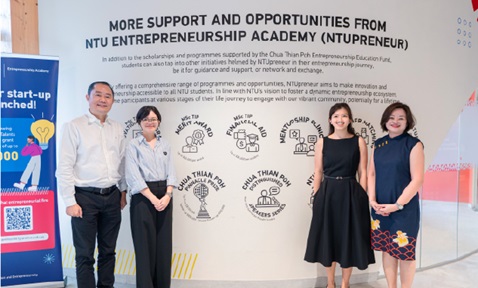
Beyond individual projects, Prof Lam has also shaped NTU’s I&E ecosystem. As former director of the Nanyang Technopreneurship Centre (now NTU Entrepreneurship Academy), and through involvement in programmes like Lean LaunchPad (now integrated into the National Graduate Research Innovation Programme), he has equipped students to navigate the full venture journey. His leadership of major research centres in cybersecurity and digital trust — including the National Centre for Research in Digital Trust and the Strategic Centre for Research in Privacy-preserving Technologies & Systems (SCRIPTS)— ensures that NTU’s research environment continues to generate opportunities for translation, such as his current work on IoT security start-ups.
The effect is a flywheel: research leads to proof-of-concepts, industry collaborations validate demand and student ventures carry the work forward. NTU-trained founders, he believes, are well positioned to be bridges between deep technology and industry needs.
Offering his top advice to budding entrepreneurs, Prof Lam said: “It is important to be honest with our- selves when we develop a product or service. Ask whether there really is an opportunity or not, other-wise we must be open to adjusting and pivoting.”