‘Money won’t last, but education will’
Paeonia Group founder and NTU Board of Trustees member Alice Yin Hung made it in life. Now, she’s helping others make it.
Text: Kenny Chee
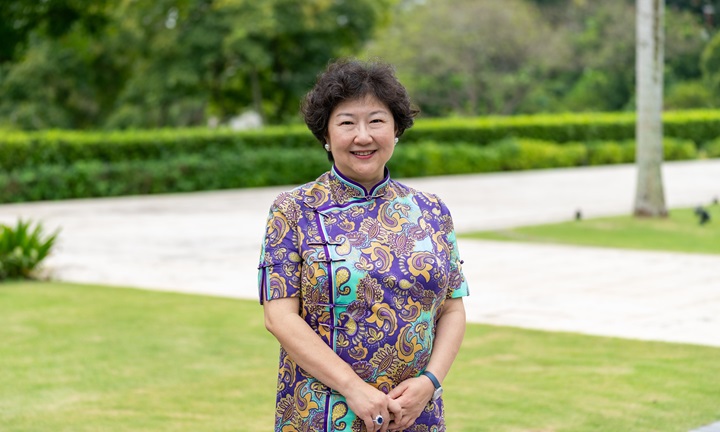
Inspired by the innovation she saw in an American mail-order catalogue in the days before the Internet, Ms Alice Yin Hung wanted to leave Hong Kong to study in the United States.
But her father initially objected. Just 14 then, Ms Hung did not know her family had enough money to pay for only one year of fees at a US high school.
Times were tough and the family of five, including Ms Hung’s elder brother and maternal grandmother, once lived in a cramped 80 square foot room in Hong Kong’s Tsuen Wan district.
When she broached studying in the US, her father argued that she could enrol in a local university. But her mother was adamant on fulfilling Ms Hung’s dream.
“My mother said: ‘She’s going to make it. And when she makes it, we will all make it.’ My mother had faith in me,” recounts Ms Hung, an entrepreneur and founder of Paeonia Group.
And she made it. After she graduated from the University of Pennsylvania with a dual degree in finance and economics, Ms Hung founded, among other companies, a successful Asian business distributing laboratory analytical and testing equipment. She also invested in deep technology startups and real estate globally.
Since Ms Hung’s relocation from Hong Kong to Singapore in 2020, these businesses have come under the Paeonia Group, which she established and headquartered in Singapore. The group is a family office and an international investment holding company.
‘Money won’t last, but education will’
Now a Singapore permanent resident and a member of the NTU Board of Trustees, Ms Hung’s experiences encouraged her to help others make it in life through education.
That is one of her priorities for Paeonia Foundation, the philanthropic arm of Paeonia Group. The foundation is also focused on advancing science and technology, as well as helping underprivileged families.
One of the foundation’s major goals is to also recognise achievements in science and medicine by setting up a prize in the future that is rooted in Singapore but global in scope.
“Money won’t last, but education will. As long as you are capable, you can go anywhere without fear,” says Ms Hung.
Through Paeonia Foundation, Ms Hung pledged S$5 million in February 2024 to NTU to support its education and research endeavours.
The University will use this gift to set up a new Professorship in Science and Technology to attract and train research talent, with a portion going towards advancing NTU's strategic initiatives in science, technology and business.
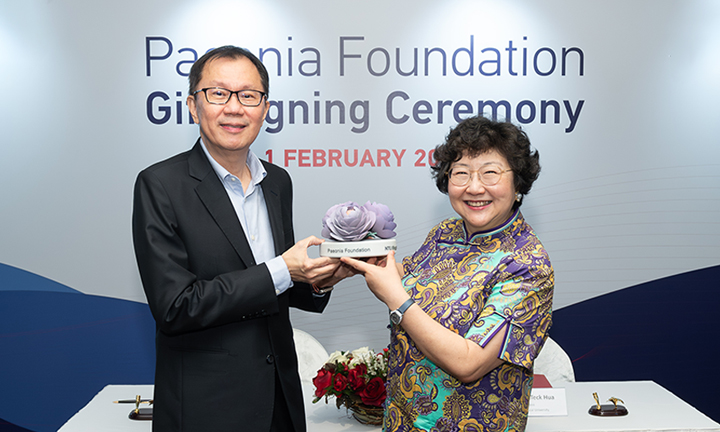 NTU President Prof Ho Teck Hua presented a token of appreciation to Ms Alice Hung, founder of Paeonia Group, after she pledged S$5 million to the University.
Grounded in familial love
Her interest in science and technology, as well as her entrepreneurial spirit, is rooted in her parents.
Ms Hung’s father studied geophysics and her mother read analytical chemistry, before clinching research jobs at the Chinese Academy of Sciences and China’s Ministry of Petroleum respectively.
But due to China’s Cultural Revolution, which began in the 1960s, her family was sent to a reform farm where life was challenging.
 Ms Alice Hung (front row from left) with her parents, grandmother and elder brother. She was born in Beijing but her family moved to Hong Kong when she was six due to the Cultural Revolution in China. (Photo: Alice Hung)
The family of five moved to Hong Kong when she was six. However, because her parents’ qualifications were not recognised there and they spoke neither Cantonese nor English, they started from scratch.
Mr Hung became a welder, while Mrs Hung worked as a seamstress. A school-going Ms Hung helped with household chores and earned some money by dressing up dolls for sale.
Despite the hardships, Ms Hung cherishes her childhood.
During Hong Kong’s winter months, when they could afford to boil water only twice a week, her family always let her shower last. “Because after the rest had showered, the toilet would be warm. So my parents, my brother and my grandmother all really loved me. That’s love,” says Ms Hung.
After the revolution ended, Ms Hung’s parents saw an opportunity in the 1980s. Mr Hung became an electrical engineer in a Shenzhen plant and Mrs Hung started a business trading analytical testing equipment in Beijing.
Her parents hoped that Ms Hung would follow the footsteps of famed physicist and chemist Marie Curie but she was not keen. Even so, they did not begrudge her and supported her pursuits.
Striking out on her own
After graduating from university in the US, Ms Hung returned to Hong Kong and worked at investment bank Lehman Brothers in 1990. But she saw a business opportunity when she realised China’s market had hit rock bottom.
With nothing to lose, she quit her job to venture to China, setting up Universal (Hong Kong) Technology distributing analytical and lab testing equipment instruments in 1991.
Her instincts were right. In the business’ first four to five years, she made her first US$1 million (S$1.35 million), which she used to buy a home for her family.
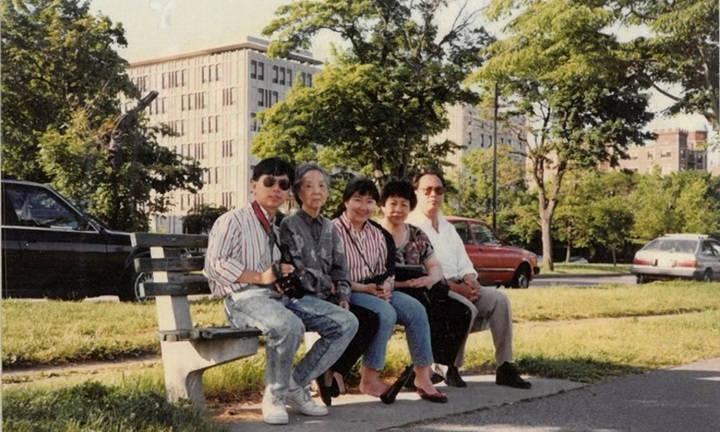 Ms Hung’s family visiting her (centre) in the US after she graduated from university. (Photo: Alice Hung)
Singapore connection
In 2020, despite the COVID-19 pandemic, she relocated from Hong Kong to Singapore because she believed that Singapore, being an international hub, would help her expand her business globally.
The Republic’s venture capital environment, quality healthcare, stable society and education prospects for her two teenage children were important factors too.
Her grandparents left China for Singapore in 1937 during the Second Sino-Japanese War. They moved to Indonesia’s Surabaya six months later to look for more opportunities, although her grandfather died shortly after. The family lived in Surabaya for many years before returning to China.
So while Ms Hung was later born in Beijing, she is familiar with Indonesian dishes like soto ayam (chicken noodle soup) and sate (skewered barbecued meat), which can be found in Singapore.
“I feel a sense of homecoming now that I’m here,” says Ms Hung. “When I got my first salary from a university internship, I took my grandmother to Singapore during the summer vacation. I have a picture of her in Raffles Hotel having breakfast from that trip on my dining table.”
Their love runs deep. When Ms Hung was leaving for the US at 15, her grandmother happily helped her to pack. She thought it was because her grandmother was proud of her.
She later learnt that her grandmother cried for a week after sending Ms Hung to the airport.
‘It’s their life, not mine’
Like her parents, Ms Hung does not want to dictate what her children pursue in life.
Unlike many business owners, grooming her kids to take over her business is not on the cards, unless they want to and are capable enough.
Passing fortunes to future generations does not sit well with her too. Instead, Ms Hung plans to give most of her wealth away through Paeonia Foundation by the end of her entrepreneurship journey.
One of the foundation’s major goals is to recognise achievements in science and medicine by setting up a prize that is rooted in Singapore but global in scope.
She wants her children to be able to make it out on their own and appreciate the process.
“Many Asian parents think they ‘own’ their kids. But I don’t ‘own’ my children. It’s their life, not mine,” she explains.
“As my mother said to my father: If I’m going to make it, we will all make it. Why don't I want my children to make it, so that I can make it?”