NTU debuts engineering summer camp with support from Woh Hup
Aspiring young engineers gathered at NTU Singapore for the first-ever Civil and Environmental Engineering Summer Camp, launched with the support of Woh Hup.
Text: Sadia Roohi
NTU Singapore has introduced a new learning experience to nurture and attract future engineers. Launched in July 2025, the University’s inaugural Civil and Environmental Engineering (CEE) Summer Camp brought together 60 aspiring engineers from polytechnics, junior colleges and universities. Through hands-on experiments, industry site visits and close mentorship, participants gained first-hand insights into real-world engineering in action.
Powering this new learning initiative is a S$100,000 gift from Woh Hup (Private) Limited, one of Singapore’s largest homegrown construction and civil engineering firms, whose partnership with NTU’s School of Civil and Environmental Engineering is helping shape the next generation of industry talent.
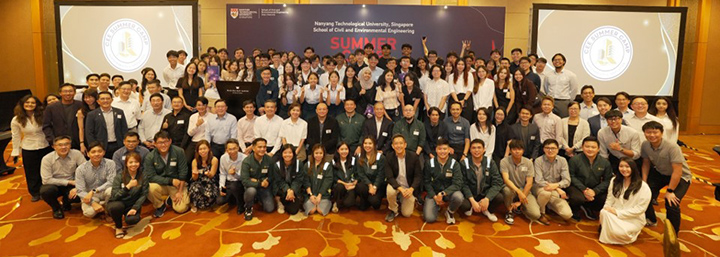 Student participants with Woh Hup representatives and NTU faculty and staff.
NTU CEE Chair Prof Chu Jian says: “Many students have learned engineering design and concepts in classrooms but seldom had the opportunities to see how the design and concepts are applied in practice. A week-long camp like this can shape the engineers that the students will become. We wanted the camp to give tertiary students a clearer sense of direction and a deeper appreciation for the civil engineering profession. It was meaningful to see how much they grew in just a few days.”
The camp also gave NTU students Lan Jichen and Lee Xiang Jun a chance to hone their leadership skills
Jichen says: “We envisioned a programme that would introduce young people to civil and environmental engineering in a meaningful and inspiring way. The camp helped bring those ideas to life, and it broadened the participants’ understanding of how engineering shapes society.”
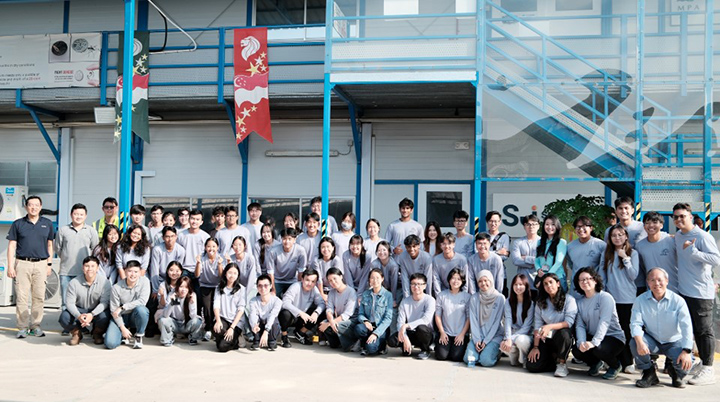 Jichen and Xiang Jun (back row, 2nd and 3rd from right respectively) at the visit to the Tuas Terminal Reclamation site.
Through technical talks, hands-on activities and guided visits to active worksites, the camp introduced participants to the theme “Sustainable and Intelligent Construction – Building Our Future”.
A key highlight of the camp was the opportunity to visit Loyang MRT Station, part of the upcoming Cross Island Line, where the students observed tunnelling operations and viaduct construction. They also visited work areas of Tuas Terminal Phase 2 at the Tuas Terminal Reclamation site to witness large-scale reclamation works.
Many participants were seeing such works for the first time, and the experience helped them bridge theory with applications. “It showed all of us the teamwork, precision and responsibility involved in delivering complex engineering projects,” says Xiang Jun.
Support that reached beyond funding
Woh Hup’s involvement played an essential role throughout the planning and execution of the camp. Their representatives guided site visits, offered technical insights, advised on logistics and linked the organising team with partners from across the sector.
One of the most impactful segments was the networking dinner, which brought together senior engineers, consultants, developers, and government representatives who interacted with camp participants. Meeting professionals from different parts of the company helped the students see the breadth of career pathways.
Woh Hup’s Executive Director, Mr Yong Derong, highlighted that programmes like this strengthen the connection between academia and industry. “Such initiatives give students early exposure to real-world challenges and help them see how their work in civil and environmental engineering can make a meaningful impact in building a more sustainable future,” he explains.
Mr Yong added that these engagements help the industry better understand what motivates young people and how the sector can attract and retain talent.
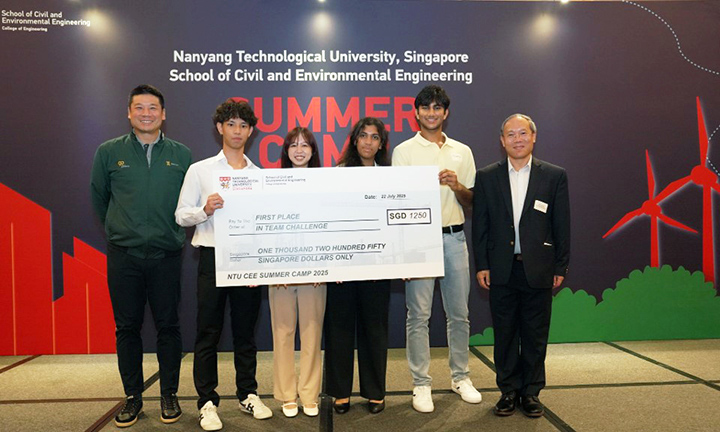 Woh Hup’s Executive Director Mr Yong Derong (left) and NTU CEE Chair Prof Chu Jian (right) with the winning student team from the case competition held during the camp.
The CEE Summer Camp adds a new dimension to more than 30 years of partnership between Woh Hup and NTU. Since 1992, the company has supported initiatives that strengthen education and talent development.
The Woh Hup Endowed Scholarship at NTU, established in 2009, has supported 16 engineering undergraduates who demonstrate academic excellence and leadership potential.
In 2025, Woh Hup also introduced the Woh Hup Bursary, which will support financially needy engineering students.
Together, these initiatives form a sustained and holistic commitment to nurturing future engineers.
Reflecting on this long-term partnership, Mr Yong says: “We believe that nurturing the next generation of engineers is essential for the continued growth of the built environment sector. Our long-standing partnership with NTU reflects this belief that building the future is not only about creating structures, but also about empowering the people and talent who will shape a more sustainable and forward-looking Singapore.”
“Woh Hup’s support shows that the industry genuinely cares about young engineers. It tells us that our potential is recognised and that our growth matters. It gives students confidence to pursue engineering with renewed passion,” says Jichen.