NTU and Gallagher Re partner to strengthen natural catastrophe research in Asia
Launched with the Asian School of the Environment and the Earth Observatory of Singapore at NTU, the Gallagher Re Asia Hazards Program will also support three new PhD students at NTU.
Text: Sadia Roohi
NTU Singapore has partnered with Gallagher Re, a global reinsurance broking and advisory firm, to establish the Gallagher Re Asia Hazards Program and co-fund three PhD scholarships, helping shape the next generation of hazard and risk experts in APAC.
The Program was launched in collaboration with the Asian School of the Environment (ASE) and the Earth Observatory of Singapore (EOS) at NTU. It will support three PhD scholars whose research will address some of Asia’s most pressing natural catastrophe challenges. The fully funded scholars, who will begin their research journey in January 2026, willstudy cyclone and tsunami risk, remote sensing for disaster response and advanced flood modelling for Asian cities.
 Mount Bromo in East Java, Indonesia, is an example of an active volcano. (Photo: Freepik)
“This new agreement demonstrates Gallagher Re’s commitment to capacity building in regions vulnerable to natural hazards,” said Hui Yen Tai, Regional Director of Southeast Asia, Korea and Taiwan at Gallagher Re.
“Outputs from the Gallagher Re Asia Hazards Program will support new, innovative property catastrophe insights that deepen understanding of risks across Asia and inform more effective disaster preparedness strategies. It will also help advance disaster risk science and promote knowledge exchange in this critical field, supporting efforts to mitigate the impact of natural disasters and strengthen community resilience in the region,” she added.
Strengthening scientific foundations for a safer Asia
With natural disaster losses increasing across Southeast, South and East Asia, the Program seeks to narrow the insurance protection gap by strengthening the scientific foundations that guide risk assessment, pricing and resilience planning. Many communities remain exposed to extreme weather events but do not have access to effective risk transfer mechanisms.
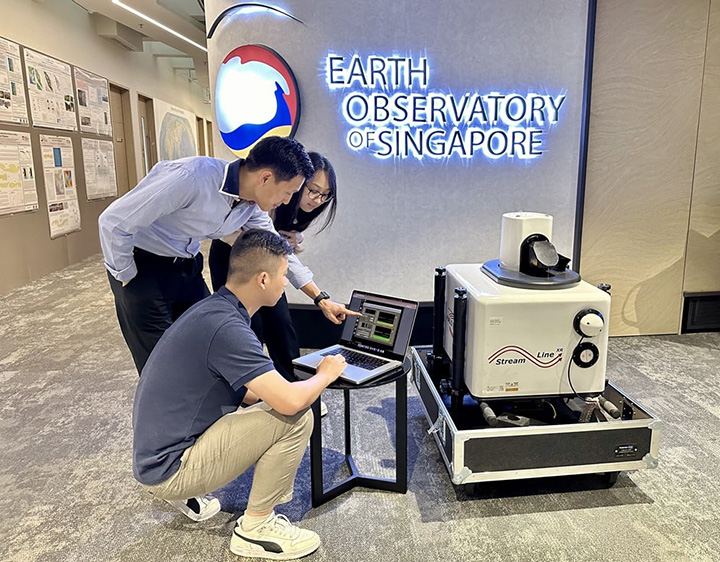 Prof Steve Yim (centre) from ASE, with NTU Lee Kong Chian School of Medicine Research Fellow Dr Huang Tao (front) and ASE Research Fellow Dr Fang Tingting, looking at data collected by a light detection and ranging station.
Associate Professor Sang-Ho Yun, Director of Remote Sensing at EOS, noted that remote sensing technologies are revolutionising how disasters are managed. He said: “Our work will enhance real-time monitoring and damage assessment capabilities, enabling faster and more effective humanitarian and governmental responses.”
Associate Professor David Lallemant, who heads the Disaster Analytics for Society Lab at EOS and ASE, explained: “Flood modelling is a critical tool for urban planning and disaster preparedness. Our work will help cities across Asia better anticipate and respond to extreme weather events, ultimately saving lives and reducing economic losses.”
Professor Adam Switzer, Assistant Dean (Development) at NTU’s College of Science and leader of EOS’s Climate Transformation Programme at NTU, highlighted the importance of coastal resilience: “Cyclones and tsunamis pose increasing threats to coastal communities and infrastructure. Through this programme, we will develop science-based strategies to mitigate these risks and support sustainable development in vulnerable coastal regions.”
A partnership advancing resilience across the region
Gallagher Re’s support represents a growing trend of (re)insurance sector collaboration with academic institutions to strengthen data-driven resilience and climate risk understanding.
The partnership supports NTU’s pursuit of high-impact research that advances sustainable risk management solutions and closes the protection gap across Asia. Ranked among the world’s top universities, NTU is committed to delivering research that improves lives, supports climate resilience, and contributes to a more secure and sustainable future for the region.