Philanthropy advances NTU’s climate-health science research
As climate change intensifies across Southeast Asia, its public health impacts are growing more complex. The Tsao Family Foundation supports NTU in expanding research in this area.
Text: Sadia Roohi
Heat stress, air pollution and water-borne diseases are intersecting in ways that demand urgent, coordinated research.
NTU Centre for Climate Change and Environmental Health (CCEH), an interdisciplinary research centre launched in April 2025, is scaling up specific areas of its works to address them on a regional level with support from the Tsao Family Foundation.
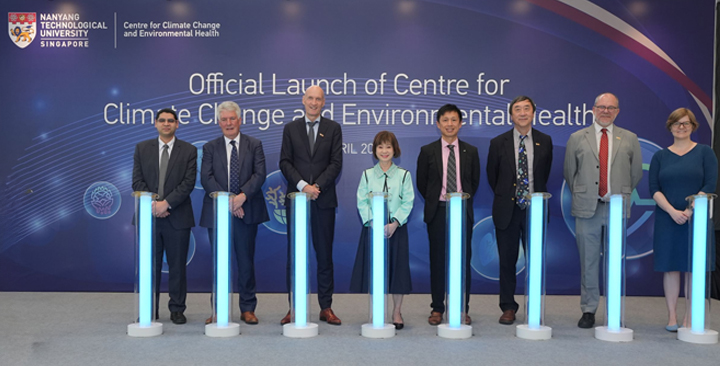 (From left) Assoc Prof Sanjay Chotirmall, Vice Dean (Research), NTU Lee Kong Chian School of Medicine and Deputy Director of CCEH; Prof Frank Kelly, School of Public Health - Faculty of Medicine and Deputy Director, MRC Centre for Environment and Health, Imperial College London; Prof Ernst Kuipers, NTU Vice President (Research); Dr Amy Khor, then Senior Minister of State for Sustainability and the Environment and Senior Minister of State for Transport; Assoc Prof Steve Yim, Director of CCEH; Prof Joseph Sung, NTU Senior Vice President (Health & Life Sciences); Prof Simon Redfern, Dean, NTU College of Science; and Prof Emma Hill, Chair, NTU Asian School of the Environment and Interim Director of Earth Observatory of Singapore, at the launch of CCEH on 15 April 2025.
The main portion of the Foundation’s gift supports CARE-ASIA, a research group involving climate and health researchers across Hong Kong, Malaysia, India, Indonesia, the Philippines, Singapore, Taiwan, Thailand, and Vietnam. The platform facilitates data sharing and collaborative research.
“Data availability has always been one of the major barriers for climate and health research in Southeast Asia,” said Professor Steve Yim, Director of CCEH. “Through CARE-ASIA, we work with researchers from different countries who bring their expertise and data, allowing us to understand regional climate-health problems much more comprehensively.”
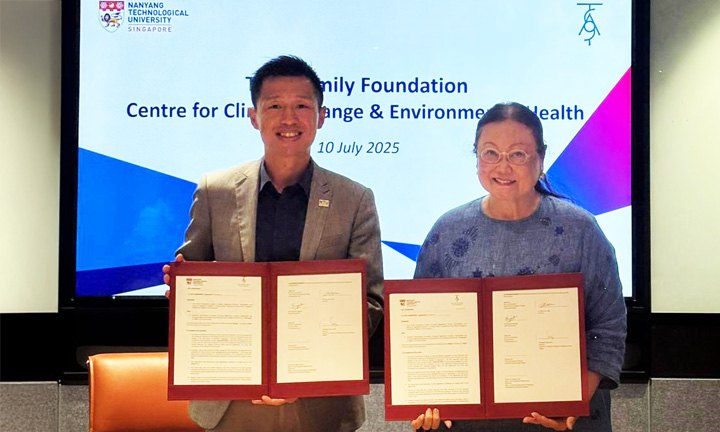 Prof Steve Yim with Dr Mary Ann Tsao, Vice Chair of Tsao Family Foundation, at the gift agreement signing ceremony in July 2025.
The Tsao Family Foundation was motivated to support CCEH, one of the very few centres globally that focuses explicitly on the intersection of climate and health, and the only one in Asia.
“What stood out to us was its commitment to building a rigorous scientific evidence base that reflects the lived realities of people in this region. Southeast Asia faces some of the most acute climate-related health risks, yet regional data and analysis remain limited. Supporting CCEH allows us to help generate the knowledge and datasets needed to inform practical, real-world decisions for public health systems and policymakers across the region,” the Foundation said.
The support from Tsao Family Foundation helps NTU expand research on climate-linked health risks, strengthen regional collaboration and generate insights that guide public health action.
Several aspects of CCEH’s mission resonated strongly with the Tsao Family Foundation.
“We were also inspired by CCEH’s collaborative ethos and openness to knowledge sharing across borders and disciplines. CARE-ASIA convenes climate and health researchers across Asia, building a strong regional evidence base and positioning CCEH to translate regional insights into policy-relevant knowledge. This ability to generate rigorous science while connecting researchers, practitioners, and policymakers reflects the kind of leadership we believe philanthropy should help strengthen,” the Foundation added.
With the Foundation’s support, CCEH held the 2nd CARE-ASIA Annual Meeting in October 2025, bringing members together alongside invited experts from the University of Washington, Imperial College London, and the World Health Organization.
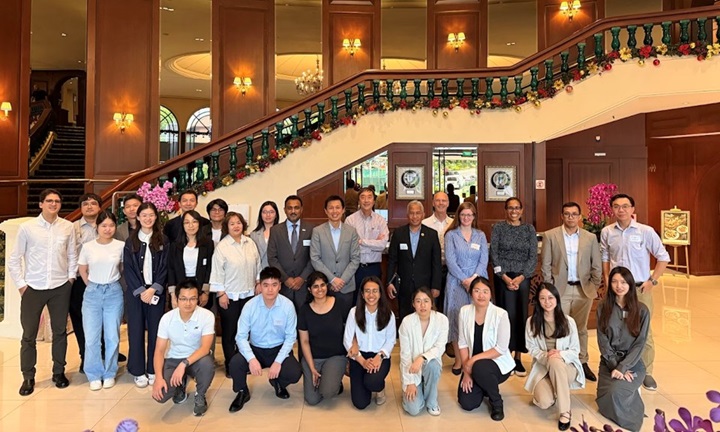 Participants at the 2nd CARE-ASIA Annual Meeting: Advancing Health Research on Air Pollution and Heat, organised by CCEH in collaboration with NTU’s Lee Kong Chian School of Medicine.
Expanding research on heat and air pollution
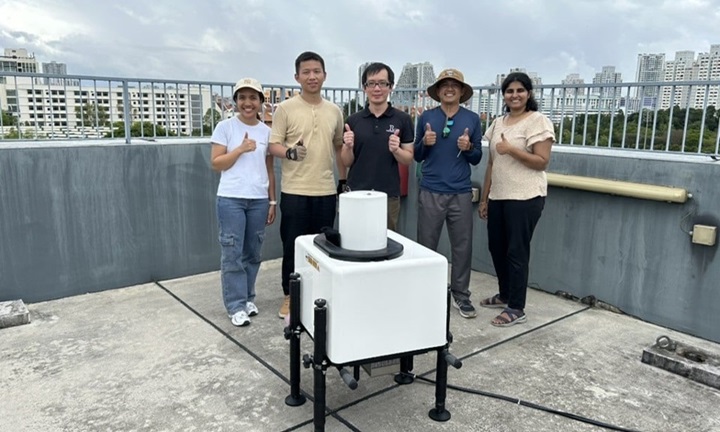 CCEH researchers with the second LiDAR system for the 3DREAMS@SG project. Installed on the rooftop of Raffles Girls’ School, this system joins the first LiDAR at the NTU campus, creating a robust network that operates 24/7 to monitor Singapore’s upper-level atmospheric environment.
One of the CCEH’s research priorities is studying the synergistic effects of heat and air pollution – two hazards that frequently occur together. While the CCEH currently conducts work in five Asian cities through a Wellcome Trust grant, donor support allows this important research to expand.
“Thanks to the Foundation’s gift, we can include additional cities such as Ho Chi Minh City and Jakarta,” Prof Yim explained. “This allows us to build a more complete regional picture. We are not duplicating funding. Instead, we are leveraging both sources of support to extend the science.”
Medical research increasingly shows that the combined effects of heat and air pollution can be far more harmful than each hazard on its own.
Prof Yim noted that “the combined effect is larger than each hazard individually,” making it crucial to understand these interactions so authorities can better prepare healthcare responses during such episodes.
Beyond air and heat, CCEH is also expanding work on water-related diseases, which can be influenced by extreme rainfall, prolonged heat or changing environmental conditions. This area of research is kindly supported by the Tsao Family Foundation.
The Foundation hopes that this support helps strengthen the evidence and coordination needed to improve climate-health outcomes across Southeast Asia.
“Many climate-health initiatives in the region continue to suffer from a persistent technological relevance gap, where well-intentioned interventions fail because they do not consider their utility for communities. CCEH’s commitment to connect researchers across Southeast Asia is a crucial part of the Foundation's agenda to fund regional scaling of applied models that link heat, air quality, and vulnerable populations, and to ensure that local data meaningfully informs national ministries. As a funder committed to learning and understanding the needs of communities, we hope to inspire projects that are community-focused, localising climate-health narratives to drive meaningful action,” the Foundation shared.
CCEH takes a holistic, integrative approach, allowing researchers to evaluate interconnected impacts across multiple hazards. This comprehensive outlook is vital for regions like Southeast Asia, where climate events often overlap and compound each other.
“This is a very important topic in climate and health research,” said Prof Yim. “Their contribution enables us to pursue work that may not otherwise be funded. Tier-2 or Tier-3 grants, and even international grants, tend to support research within Singapore. But climate challenges do not stop at national borders. Philanthropic gifts fill critical gaps by enabling us to conduct multi-country research and maintain the platforms that bring experts together.”
Importantly, most established climate CCEHs around the world are located in, and focused on, high- to mid-latitude regions. CCEH fills a critical gap by addressing climate-health issues specific to the tropics, where rising temperatures, humidity and extreme weather pose different and often more immediate risks.
Prof Yim shared that current guidelines in Singapore may not yet reflect the combined effects of heat and air pollution or variations across outdoor occupations. With stronger scientific evidence and broader regional data, CCEH’s findings will help shape public health guidelines and inform policymaking.
CCEH also aims to increase public awareness, helping communities understand how to protect themselves during episodes of extreme heat, haze, or water-borne disease outbreaks.