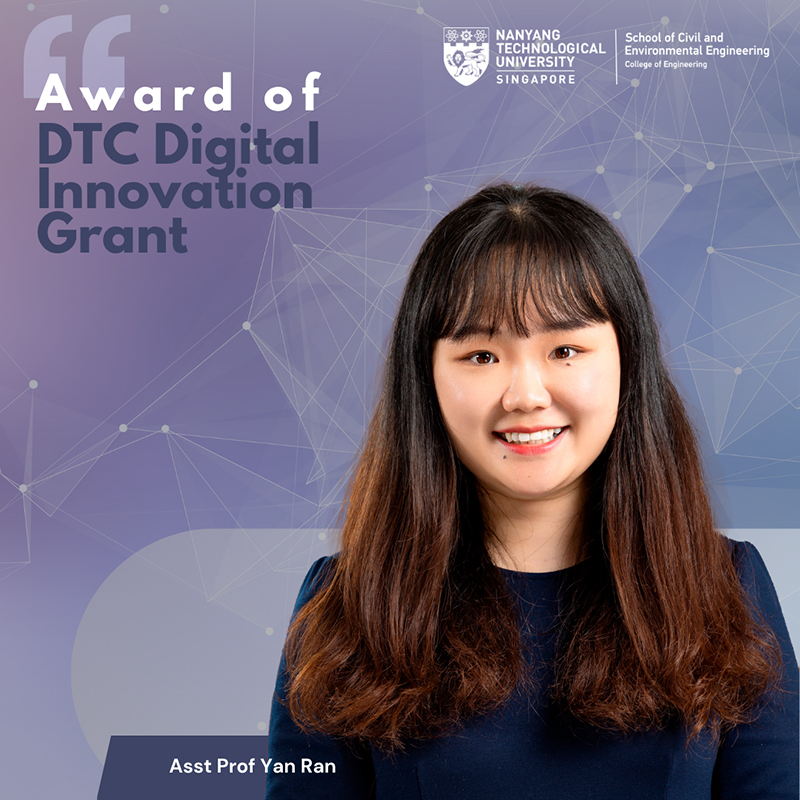
Award of DTC Digital Innovation Grant - Assistant Professor Yan Ran
Congratulation to Assistant Professor Yan Ran on the award of DTC Digital Innovation Grant for her project Employing trusted AI to enable maritime decarbonisation and digitalisation.
About DTC Digital Innovation Grant
The DTC Singapore Innovation Grant Call is a competitive research funding initiative that seeks to support collaboration between Singapore-based Institute of Higher Learning (IHLs)/Research Institutes (RIs) and companies with a presence in Singapore (“companies”) to co-develop Trust Tech solutions. The goal is to promote and facilitate innovation in Trust Tech, support digital transformation and translation into actual use cases. IHLs/RIs are required to collaborate with companies (“team”) to form multi-disciplinary teams and consortia of industry domain experts, engineers, researchers, scientists, academics and other professionals to be eligible for this grant.Project Write-up
The continuous expanding of world fleet leads to an increase in ship fuel consumption (SFC) as well as emissions of greenhouse gases. Accurate SFC prediction not only aids the shipping industry in regulatory compliance but also in enhancing operational efficiency and reducing costs. However, SFC data are highly-sensitive and cannot be shared among the stakeholders, leading to the problem of data silos. Moreover, physics laws are usually ignored in the construction of SFC prediction models based on machine learning, leading to prediction results that do not align with the established domain knowledge.
This project aims to develop a trustworthy federated learning (FL) framework to address the above two research gaps. To address the first research gap, it proposes a comprehensive FL-based trustworthy AI system to enhance SFC prediction while preserving data privacy. To address the second research gap, the ship energy efficiency prediction models will be based on neural networks that innovatively considers shipping domain knowledge in terms of monotonicity, convexity, and Lipschitz continuity between specific input features and the SFC as the target. These prediction models will also innovatively address the issue of different update frequencies in features and target of SFC data from one company and among datasets provided by different shipping companies. The proposed FL-based trustworthy AI system will be validated by real ship fuel consumption data from noon reports and/or onboard sensors provided by three local bulk carrier companies that are the industrial collaborators of this project.
Our project aiming to enhance SFC predictions using a FL framework directly supports DTC Singapore’s focus on trust technologies that support digital transformation, especially in traditional industries such as the maritime industry where trust among competing stakeholders is the key barrier to promoting digitalisation. The proposed FL framework can benefit the maritime shipping industry by introducing significant cost reductions and environmental benefits, fostering a culture of collaboration and trust among maritime industry players, and promoting the adoption of digital tools in real maritime use cases. The proposed FL framework can also be scaled up to other use cases within and outside of the maritime industry.