
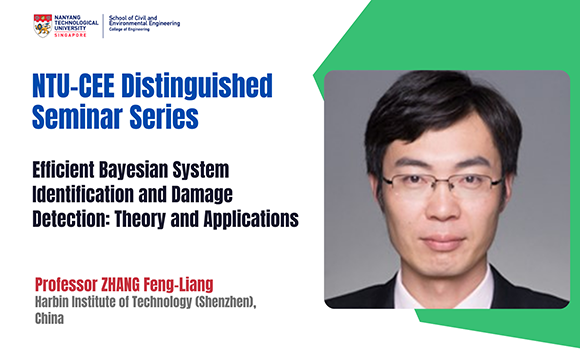
NTU-CEE Distinguished Seminar Series: Professor ZHANG Feng-Liang
Organized By
CEE Seminar Committee
Host By
Professor Ivan Au
Topic
Efficient Bayesian System Identification and Damage Detection: Theory and Applications
About the Seminar
As the service life of buildings and bridges extends, an increasing number of structures exhibit varying degrees of damage. Detecting damage before it compromises structural safety is a critical objective in structural health monitoring. Vibration-based structural damage detection methods have been a research focus over the past two decades. These methods reveal the correlation between structural damage and parameter variations by observing key structural parameters such as natural frequencies and mode shapes, thereby enabling the detection of damage location and severity. Since key structural parameters often rely on vibration data acquisition under ambient excitation during the identification process, both data collection and modeling involve unavoidable uncertainties, resulting in inherent uncertainty in the identification parameters.
This study focuses on Bayesian modal identification and explores damage identification methods in a Bayesian framework. A fast Bayesian modal identification method was established, and a Bayesian structural damage identification approach was developed based on the most probable values of critical parameters and the associated covariance matrix. This approach enhances damage detection accuracy while providing a novel pathway for structural modal identification and damage detection. Beyond theoretical development, the method has been applied to representative structures such as the Shanghai Tower, Tsing Ma Bridge, and Canton Tower, enabling efficient assessment of the dynamic performance of large-scale structures.
About the Speaker
Dr. Feng-Liang Zhang , Professor/Associate Dean at the School of Intelligent Civil and Ocean Engineering, Harbin Institute of Technology, Shenzhen. His research focuses on structural health monitoring, Bayesian system identification, damage detection. He has published more than 100 research papers with a h-index of 25 (Web of Science), granted 10 national invention patents, and he is the principalinvestigator of five national-level research projects.
He serves as an Associate Editor of Frontier in Built Environment and Editorial Board Member (ECR) of Engineering Structures, and he is Executive Director of the Engineering Diagnosis and Operation & Maintenance Branch of the Architectural Society of China, Executive Director of the Urban Safety Monitoring and Early Warning Branch of the China Disaster Prevention Association, Dynamic Committee Member of ASCE. He is a recipient of JSPS Fellowship and several research awards, including Editor’s Featured Paper Award in Engineering Structures, Second Prize of Shenzhen Science and Technology Progress.