
From Early Detection to Targeted Therapy: NTU Team Reports New Cancer Research Breakthrough
Researchers led by Prof Kanyi Pu at Nanyang Technological University, Singapore (NTU Singapore) have reported two advances that address a persistent challenge in cancer care: translating in vivo biological activity into measurable signals that can be read quickly and sensitively, including at clinically relevant tissue depths, without complex workflows.
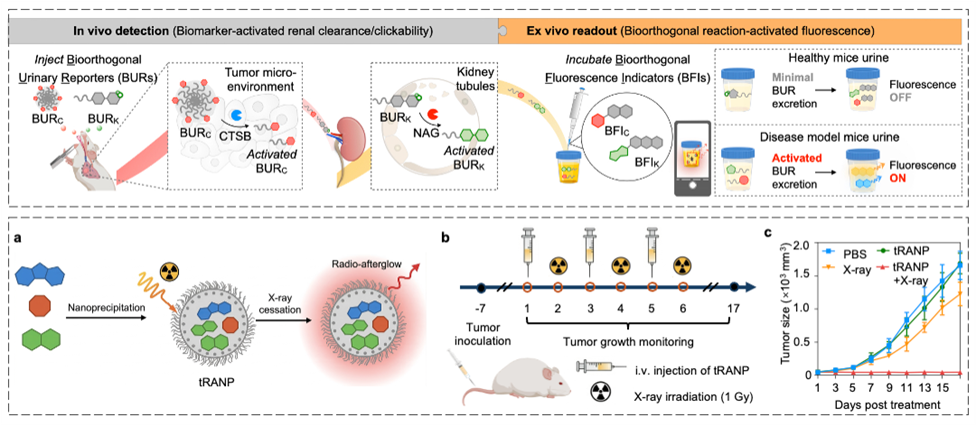
In cancer treatment, chemotherapy remains one of the most commonly used therapeutic approaches. However, while potent drug treatment can suppress tumors, it may also cause severe kidney injury. In current clinical practice, there is still a lack of simple methods that can simultaneously evaluate therapeutic efficacy and treatment-related toxicity. To address this challenge, the Pu team reported a urine-based in vitro detection strategy in Nature Biomedical Engineering that can track both chemotherapy response and treatment-related kidney injury at the same time. By leveraging bioorthogonal chemistry, the system enables precise probe activation only in the presence of specific biomarkers, thereby achieving high sensitivity and specificity. This work provides a more convenient and noninvasive approach for dynamic monitoring during cancer treatment, and also shows strong potential for future home-based testing and long-term patient follow-up.
Radiotherapy is widely used in cancer treatment because of its strong tissue penetration and high tumour-killing efficiency. Yet its clinical use is often limited by collateral damage to healthy tissues. In work published in Nature Nanotechnology, the Pu team tackled this challenge by developing a smart nanoprobe that produces tumour-specific signals, enabling ultrasensitive detection and the surgical removal of very small tumours under a low X-ray dose. This design improves therapeutic efficiency without causing unnecessary damage to surrounding healthy tissue, leading to prolonged survival and fewer radiation-related side effects, provides a new molecular design strategy for precision cancer radiotherapy.
These two studies highlight the Pu team’s broader vision of advancing cancer care through innovative molecular design, offering new possibilities for safer, smarter, and more precise diagnosis and treatment.
Please click below to read the full publications: