Emily Xi Tan receives 2026 IUPAC-Solvay International Award for Young Chemists
Her award-winning research aims to design SERS nanosensors that are smarter, faster
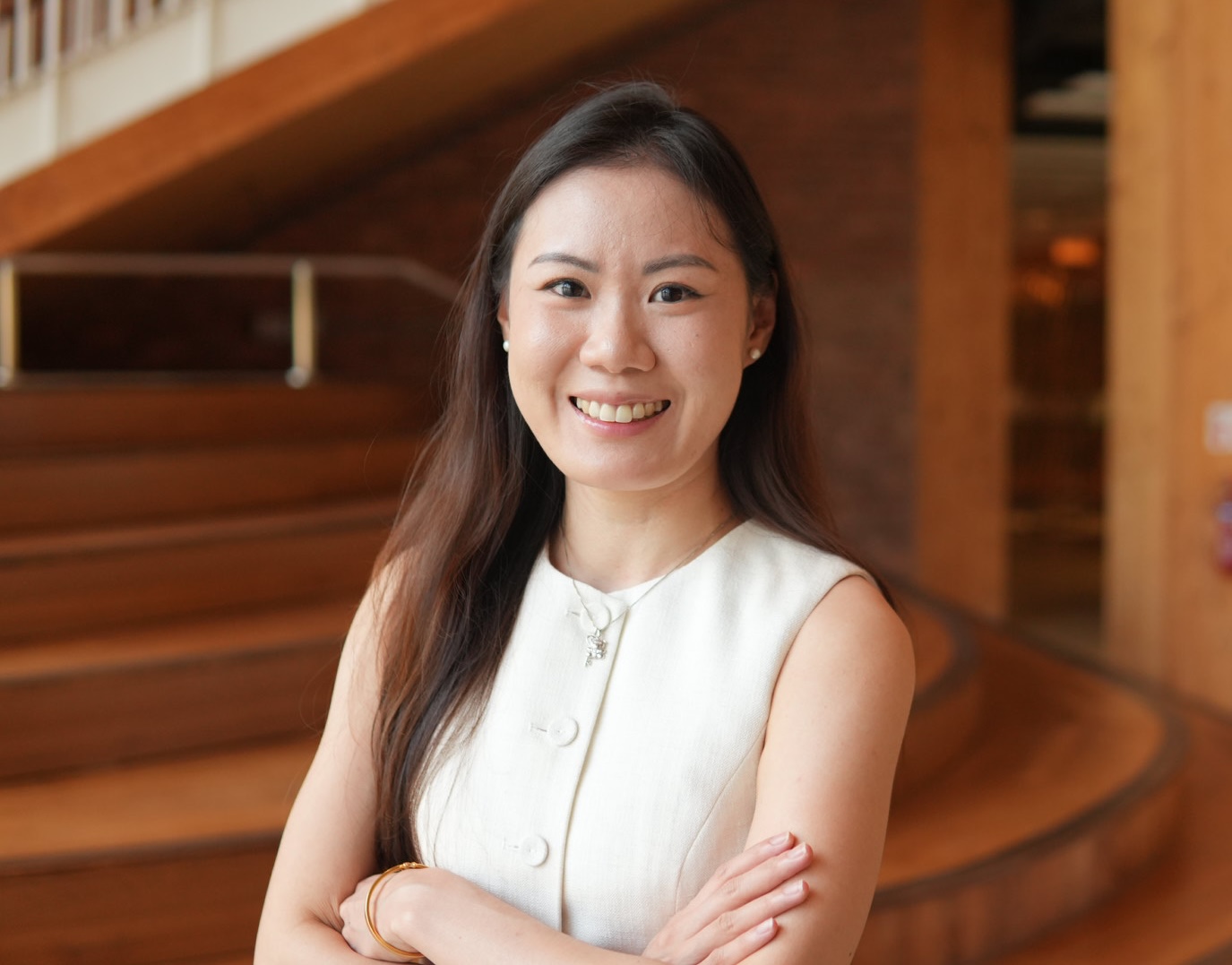
Emily Xi Tan
Postdoctoral Research Fellow
NTU School of Chemistry, Chemical Engineering and Biotechnology (CCEB)
As a recipient of the 2026 IUPAC-Solvay International Award for Young Chemists, NTU CCEB’s Dr. Emily Xi Tan makes history as the first-ever winner to have completed her doctoral research entirely within a Singapore institution. No stranger to the global scientific stage, the postdoctoral researcher previously represented Singapore at the 74th Lindau Nobel Laureate Meeting alongside 33 Nobel Laureates. We caught up with Dr. Tan to delve into her award-winning research and explore how the environment at NTU CCEB fueled her scientific journey.
Huge congratulations on receiving the IUPAC-Solvay International Award for Young Chemists! Could you share what went through your mind and how it felt when you first received the news of this global recognition?
When I first received the news, it was a mixed bag of emotions—one of surprise, excitement, and gratitude to be the first PhD graduate from a Singaporean institution to receive this award. There was also a special sense of continuity because my supervisor, Prof. Ling Xing Yi, received the same award in 2009 after completing her PhD at the University of Twente in the Netherlands. So, receiving it years later as her student felt incredibly meaningful!
Could you describe the core focus of your award-winning submission in 100 words or less, using the simplest of terms—as if you were explaining your breakthrough to someone completely outside the scientific research field?
At its heart, my PhD thesis focused on using chemical domain knowledge and machine learning to make sense of complex chemical data. Using ML without domain knowledge is like using brute force to solve a puzzle without knowing the rules. You might find patterns, but you won’t necessarily know which ones are meaningful, or why they matter. My research therefore combined chemical domain knowledge with machine learning in two complementary ways: first, to accelerate the design and synthesis of metallic nanoparticles as the building blocks of chemical sensors; and second, to extract meaningful information from the highly complex chemical signals those nanosensors produce. Ultimately, the goal is to make real-world chemical and biological sensing faster, more accurate, and adaptive. A real-life application of this was our breathalyzer platform, which uses a custom algorithm to non-invasively detect COVID-19 in just five minutes!
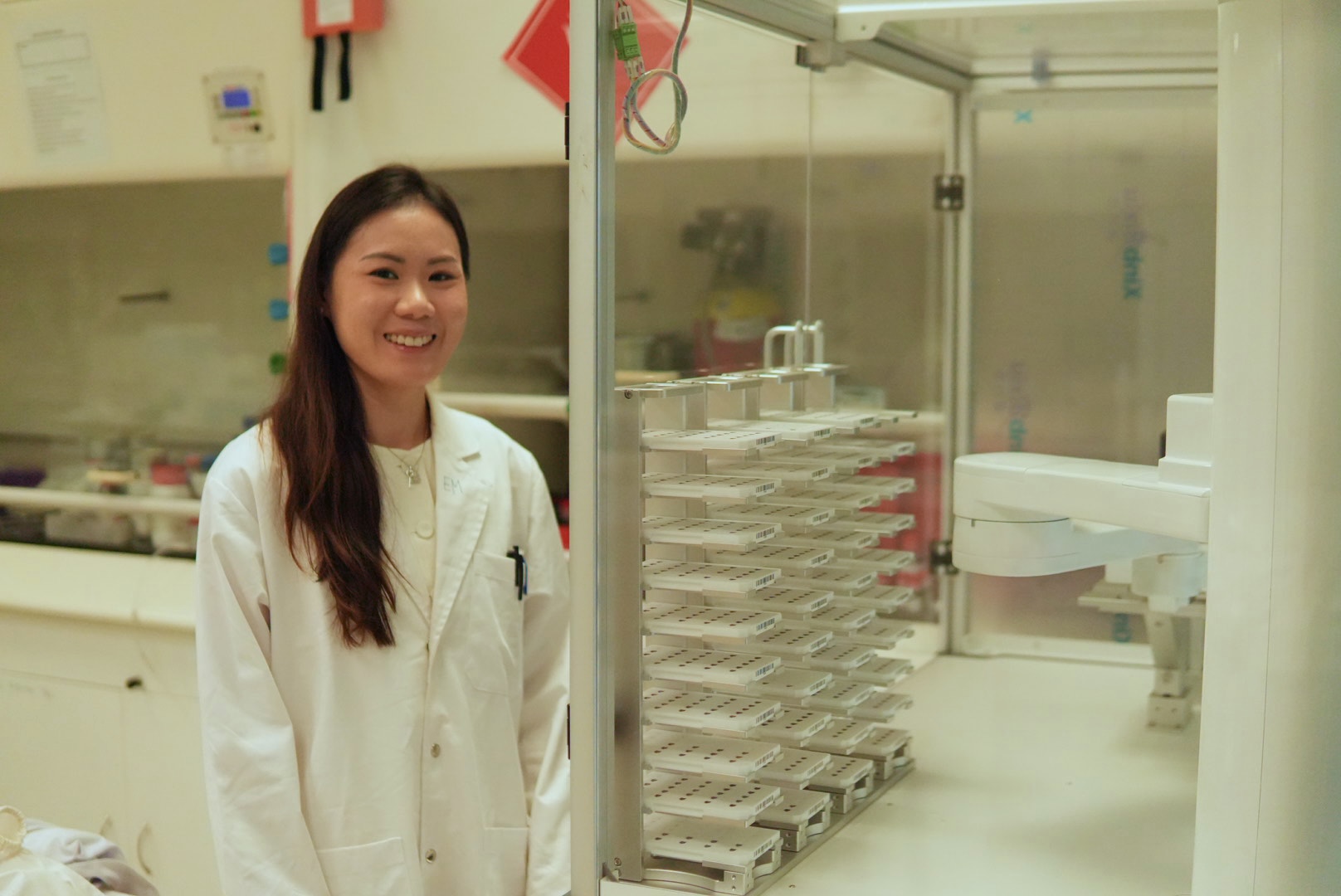 Emily with a robotic platform she co-designed for automated Raman measurements.
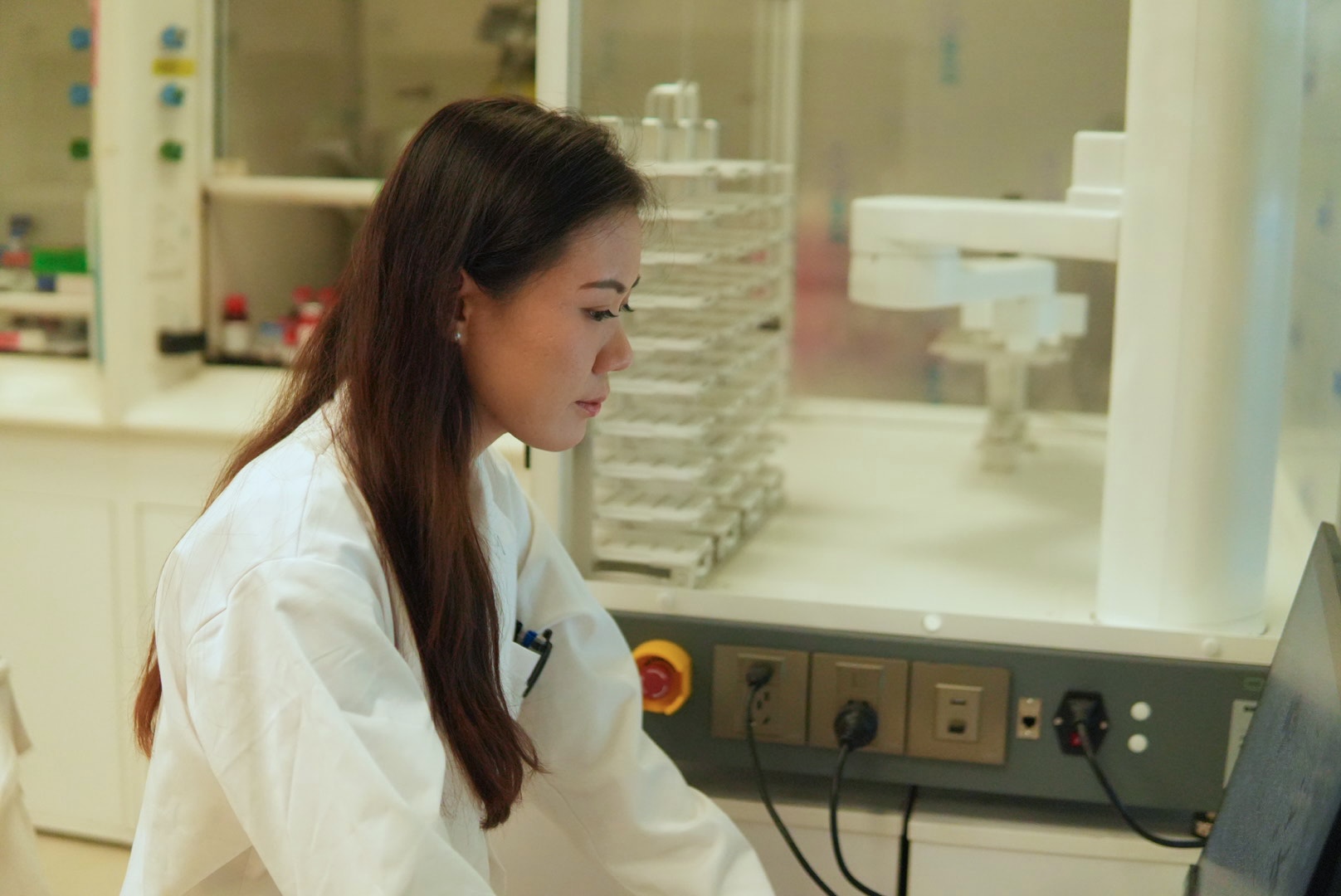 Emily reviewing automated Raman measurements.
What were some of the most impactful opportunities you experienced during your PhD journey at NTU? Additionally, how does your doctoral experience compare with your current role and responsibilities as a postdoctoral researcher?
My time at NTU opened doors I never could have imagined. Last June, I was selected by NTU and the National Research Foundation to attend the 74th Lindau Nobel Laureate Chemistry Meeting, where I had the rare opportunity to interact directly with Nobel Laureates.
In January 2023, I also had the opportunity to help set up a research laboratory from scratch at Jiangnan University in China, where I subsequently trained three batches of Master's and PhD students from 2023 to 2026! This eye-opening experience taught me a lot about mentoring, leadership, and communicating research to people with different backgrounds and levels of experience.
Perhaps most importantly, the chance to work with Prof. Ling gave me a lot of autonomy and freedom to explore. She allowed me to design robots for chemical synthesis and experiment with all sorts of unconventional AI algorithms in my work. That freedom to explore ideas, even the wacky ones, was incredibly valuable.
Ultimately, the biggest difference between then and now is independence. In your first two years of your PhD, you’re learning the ropes and figuring out how to approach research problems. Once that first project is published, you start to fly solo. In your third and fourth years, and even more so now as a research fellow, you’re solving problems independently and mentoring juniors. The focus shifts from simply completing a project to deciding which questions are worth asking next.
Looking back at your journey, what is the single most cherished memory or aspect of your time at CCEB that you will always hold closest to your heart?
There are many individual moments, but they all share one common thread: the generous people I met and the kindness I received. From my supervisor and seniors, especially Yong Xiang who taught me a lot, to my collaborators and mentees, each person has shaped my journey.
Jiahao from the organic lab selflessly taught me how to use the glovebox, while I helped Daqian from physics with Raman measurements, and he helped me with XRD. In between all of that, we would just chat about life. My mentees continue to surprise me time and again with their insights and ideas. Looking back, it is these exchanges, the things we learn from one another, and the friendships we build along the way that I will cherish most and carry in my heart long after I leave CCEB.
We must ask a crucial campus question: What is your ultimate, go-to bubble tea order? Flavour, toppings, and sugar levels?
CHICHA’s osmanthus oolong with mango, aloe vera, 50% sugar, and normal ice. A very carefully optimized formulation for the lactose-intolerant.
What is the most valuable piece of wisdom or guidance you received from your own mentors that you would most like to pass down to your juniors at CCEB?
The harder you work, the luckier you get.
Research has a huge element of uncertainty. You cannot control when an experiment will work or when an unexpected opportunity will come along, but you can control how much effort you put in and how prepared you are. So, to my juniors: keep working hard, stay curious, and put yourselves in a position where luck has a chance to find you!
🎓 Find out more about CCEB's postgraduate programmes here.
💬 Stay connected! Follow CCEB on LinkedIn, Instagram, and Facebook to keep up with our latest research highlights, student stories, and campus happenings.
Story by Sumita Thiagarajan, NTU CCEB