What AI cannot replace in your career
As AI becomes more capable and accessible, what will set professionals apart? Three NTU alumni at the forefront of AI share insights on the skills, knowledge and judgement that matter.
Text: Sadia Roohi
What happens when everyone has access to the same powerful AI tools? What will distinguish one professional from another, or give one organisation an edge over its competitors?
These questions are becoming increasingly important as artificial intelligence (AI) transforms the way people work and businesses operate.
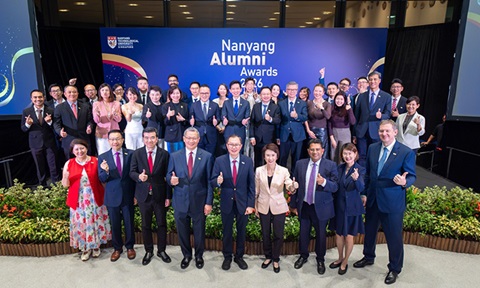
At the inaugural NTU Tech Summit & Alumni Conference 2026 in Silicon Valley on 23 October, three NTU alumni working at the forefront of AI explored the opportunities and challenges presented by the rapidly evolving technology.
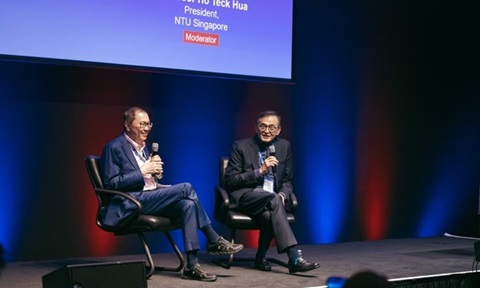
At the panel discussion “Leading Innovation in the Age of AI”, three alumni working at the forefront of AI shared perspectives on the skills and expertise professionals need to navigate an AI-driven workplace. The panellists were Dr Jia Li, Co-founder of LiveX AI; Steven Lin, Research Engineer at Google DeepMind; and Prukalpa Sankar, Founder and Co-CEO of Atlan. The discussion was moderated by then NTU Vice President for Lifelong Learning and Alumni Engagement Professor Boh Wai Fong.
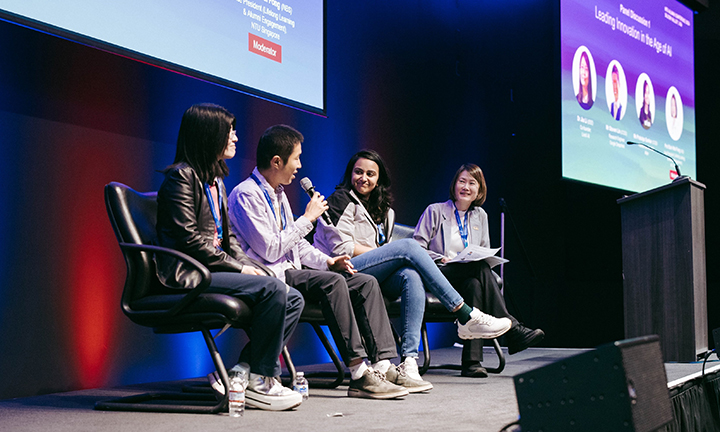 (From left) Alumni panellists Dr Jia Li, Co-founder of LiveX AI; Steven Lin, Research Engineer at Google DeepMind; and Prukalpa Sankar, Founder and Co-CEO of Atlan, explored the opportunities and challenges presented by the rapidly evolving technology. The discussion was moderated by then NTU Vice President (Lifelong Learning & Alumni Engagement) Prof Boh Wai Fong (far right).
Here are three takeaways for alumni looking to make the most of AI while continuing to develop their own capabilities.
1. Solving the right problem matters more than having the most powerful AI
With new AI models and tools emerging at a remarkable pace, it is easy to assume that the most advanced technology will always deliver the best results.
But as Dr Jia Li highlighted, the effectiveness of AI also depends on whether it is being applied to the right problem, using the right data.
She pointed out that the industry is moving beyond simply developing ever-larger models towards creating smarter, more targeted solutions. Data quality remains crucial. AI systems trained on information that does not adequately represent the problem being addressed may produce less useful results.
This has implications beyond the technology sector.
For professionals, adopting AI should begin with understanding the task at hand, rather than choosing a tool simply because it is new or popular.
For instance, before using AI to analyse customer feedback, an organisation needs to consider whether the information collected accurately reflects customers' experiences and whether the analysis will help address a genuine business need.
The learning takeaway: Develop the ability to identify problems, ask the right questions and evaluate the quality of information. These skills can help professionals make better decisions about when and how to use AI.
2. Human judgement and organisational culture remain powerful advantages
As AI becomes more widely available, access to technology alone may no longer be enough to distinguish one organisation from another. Prukalpa Sankar raised a thought-provoking question during the discussion:
“In a world where you and your competitor have access to the same intelligence, what do you do?”
Her observation points to an important consideration: how people use AI may matter just as much as the technology itself. She highlighted the role of organisational culture, including how employees work with AI, develop new capabilities and exercise qualities such as taste and judgement.
Using customer service as an example, Prukalpa discussed how the way a company treats its customers can build trust and loyalty. Even as AI takes on more customer-facing tasks, preserving these distinctive qualities remains important.
For professionals, this suggests that learning to work with AI should go hand in hand with strengthening capabilities that draw on human experience and understanding. These include making sound judgements, recognising the needs of others and understanding how decisions affect customers, colleagues and organisations.
The learning takeaway: AI proficiency is valuable, but so are critical thinking, communication and sound judgement. Professionals who can combine these capabilities may be better placed to contribute meaningfully in an AI-enabled workplace.
3. Knowing your industry could be as important as knowing AI
AI systems may possess impressive capabilities, but they do not automatically understand the organisations in which they operate.
Prukalpa illustrated this by comparing AI systems with new employees. A person's ability to perform well at work depends on more than intelligence alone. Experience, organisational knowledge, familiarity with established practices and an understanding of workplace expectations all contribute to effectiveness.
The same principle applies when introducing AI into business operations.
“How do you build contextual intelligence? How do you teach AI about your businesses?” she asked.
The challenge is not simply to provide AI with information, but to ensure that it understands the relevant business context and can use that knowledge appropriately.
Steven also emphasised the importance of understanding the problems that AI is intended to solve, particularly when considering how data and technology can deliver useful outcomes.
For professionals, these insights reinforce the value of the expertise they have accumulated throughout their careers. An experienced engineer, educator, healthcare professional or business leader brings knowledge of their field that can help determine how AI should be applied, what information is relevant and whether its recommendations are appropriate.
Rather than viewing AI as a replacement for expertise, professionals can draw on their experience to guide AI towards better outcomes.
The learning takeaway: Continue deepening your knowledge of your industry while building AI literacy. Understanding both the technology and the context in which it is used can make you a more effective problem-solver.
Learning to work with AI, not just use it
The panel discussion offered a reminder that the future of work is not solely about how sophisticated AI becomes, but also how effectively people and organisations harness its capabilities.
For NTU alumni at different stages of their careers, developing AI literacy is only part of the learning journey. Equally important is continuing to strengthen the knowledge and human capabilities that help turn technological potential into real-world value.
As AI evolves, the opportunity is not simply to learn what the technology can do, but to become better at deciding what it should do, and why.
Related story:
Why Intel’s CEO told NTU alumni in Silicon Valley to “climb the right mountain”