From the newsroom to the Atelier
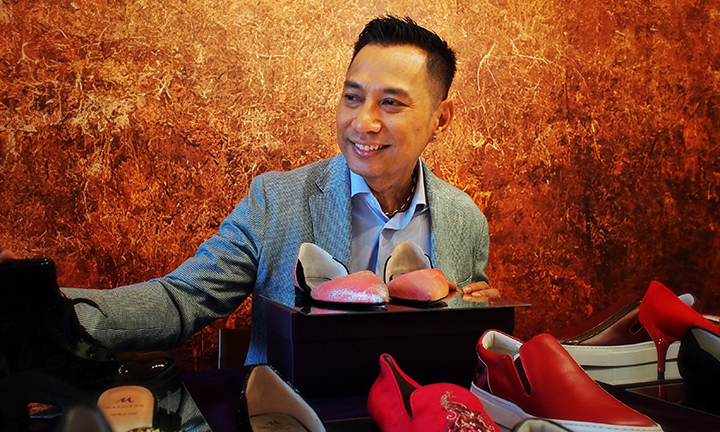
Mashizan Masjum spent 18 years in journalism and TV documentary production before an Italian sabbatical grew into MASHIZAN, his luxury shoe label. He reflects on that leap, his craft, and engaging with NTU students in the US where he currently resides.
Text: Sadia Roohi
Long before he was sketching silhouettes for his luxury shoe label, Mashizan Masjum, a pioneer-batch graduate of the Wee Kim Wee School of Communication & Information, was hosting a fashion show on the steps of a heritage building.
It was 1994, and the then School of Communication Studies Club, the School’s student body, was celebrating its first anniversary. Mashizan, then the club’s second president, and his committee had an idea: turn the grand interior steps of what is now the Chinese Heritage Centre into a runway. The School itself was new, effectively the University’s first communications school, in a university then dominated by engineering and business.
The team went knocking on doors with a fair bit of creative pitching, determined to land sponsors for a school hardly anyone had heard of yet. LASALLE College of the Arts came on board first, showcasing its graduating class’s work. Then the distributor for KL by Karl Lagerfeld said yes too. “Imagine, we had Lagerfeld as a sponsor!” Mashizan says.
The show went ahead, dry ice and all. “As the president of the club, I hosted and sat next to then-President of NTU, Dr Cham Tao Soon, in the front row,” Mashizan recalls. “And when smoke from the dry ice machine was released for dramatic effect, it was all too much for the VIP guests in the front row. They were drowning in dry-ice smoke!” Dr Cham and the late Professor Eddie Kuo, the School’s first Dean, took it in good humour.
More than three decades on, Mashizan is the founder of MASHIZAN, a luxury shoe brand he built using the access he gained to Italy’s shoe industry.
The Florence pivot
Mashizan’s path to shoemaking did not begin with a plan. After nearly two decades in journalism and TV documentary production, which began in New York, he took what was meant to be a sabbatical in Florence. What he found there was access to leather suppliers, tanneries, workshops and factories, and accessory components, essentially the entire shoe industry in Italy.
“There wasn’t really one light bulb moment of realisation that the stint in Florence meant something a lot more,” he says. “I think it was more of an evolution than anything else.” The sabbatical, as he describes it, became a stepping stone. With access to the industry’s building blocks came a bigger idea: that a brand, with its own codes and its own universe, could be built from nothing.
Journalism, he says, is where he first learnt to tell a story with an audience in mind. “Every story has a beginning, a middle and an end. It has to have a hook, a captivating peg,” he says of his documentary years. “It’s the same with brand storytelling.” In luxury, he explains, product quality is necessary but never sufficient. “Luxury consumers want to buy into that brand’s universe and feel like they are a part of it,” he says.
Inside the Atelier
A MASHIZAN shoe rarely starts with a sketch. It starts with a memory, often something pulled from his years travelling for documentary work, or a concept he wants to explore for a collection. From there the process turns methodical: colour schemes, silhouettes, and a hard-nosed read on what will actually sell. He travels to sourcing shows like Linea Pelle in Milan and Première Vision in Paris to find leathers and components before a single sketch is drawn.
Design comes next, followed by prototypes and samples built with specialists and artisans in Italy. Clients preview the samples; the ones that land well go into production. “So it’s both an art and a science,” he says, and it is a description that could just as easily apply to the reporting instincts he brought with him from television.
Staying close to NTU
Despite two decades based between New York and Paris, Mashizan has kept his NTU ties intact, including his friendships with professors like Assoc Prof Lee Chun Wah and Dr Mark Cenite. “We might not see each other often, but the memories that we built in those early years really helped to shape me,” he shares.
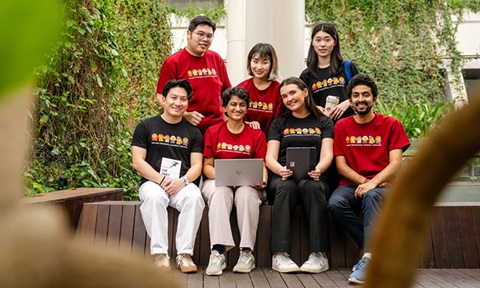
Those relationships have done more than sustain old friendships. Professors have connected him with younger NTU alumni looking for mentors abroad, something he has come to welcome. He is also active with the NTU Alumni Association (USA-East) and has used his own home in midtown Manhattan to host newly arrived NTU interns, cooking for 30 guests in one sitting.
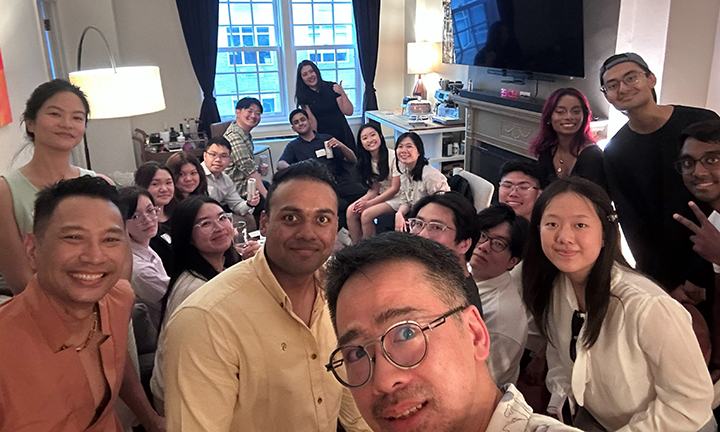 Mashizan (bottom left) hosting NTU interns at his apartment in Manhattan.
“NTU may be a young university, but its alumni span the globe. I’m happy to help build this international community,” he says. For homesick students far from Singapore, he adds, the aroma of Asian curries wafting through the apartment was a small comfort.
What he hopes they carry with them
Mashizan is candid about how different the landscape looked when he was starting out. When he first arrived in New York in the early 2000s, few Singaporean creatives had ventured to compete there, and it took a certain nerve to find out whether the industry was ready for them.
What he tries to pass on to younger alumni is the same lesson he carried from that time: be bold, be hungry, and don’t let geography limit ambition.
It is the same message he hopes will stay with NTU interns long after they leave his dinner table. If, 20 years from now, a former guest tells him that the evening changed the course of their life, he knows exactly what he would want that to mean: that he had helped them find courage and resilience, and that they, in turn, had become a mentor to someone else.
“Singapore will always be home,” he says, “but the world can be your playground.”
This article first appeared in issue 8 of U, the NTU alumni magazine.