The heartland boy made good
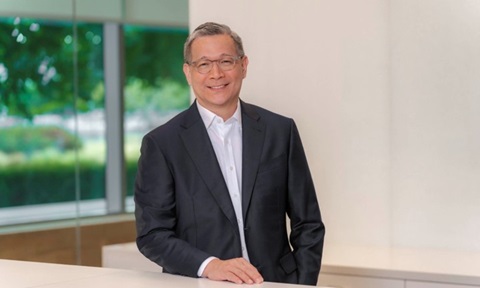
Raised in a three-room flat in Bukit Ho Swee, Mr Desmond Tan’s journey from the SAF to NTUC and the Prime Minister’s Office is driven by resilience and purpose. As a 2025 Alumni Achievement Award recipient, he shares the values that guide him.
Text: Vivien Yap | Photos: Desmond Tan
Growing up in a three-room flat in Bukit Ho Swee, Mr Tan’s journey from humble beginnings to national leadership is a shining example of how purpose and hard work can transcend circumstance.
The 2025 Nanyang Alumni Achievement Award recipient has held different roles throughout his three-decade career, from brigadier-general in the Singapore Armed Forces to his current positions as Deputy Secretary-General of the National Trades Union Congress (NTUC) and Senior Minister of State in the Prime Minister’s Office.
Whether in uniform, in public service or in Parliament, Mr Tan’s career and leadership in public service is built on the conviction that everyone deserves a fair chance to succeed.
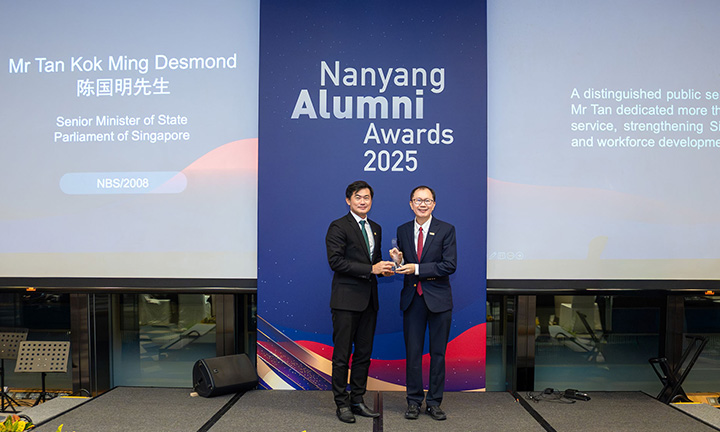 Mr Desmond Tan receiving the Nanyang Alumni Achievement Award at the 2025 Nanyang Alumni Awards.
What does education mean to you?
I’m a product of Singapore’s education system, and I’ve personally experienced how it can open doors for those willing to work hard. Beyond just imparting knowledge, education teaches lessons that stay with us long after we leave the classroom. I have witnessed firsthand how education can be a powerful equaliser and a key driver of social mobility.
You’ve led in the military, public service and now at NTUC, Singapore’s national trade union body advocating for workers and social welfare. What leadership qualities have stayed with you across these roles?
To me, service is at the heart of leadership. Serving effectively boils down to three key principles – having a clear sense of purpose, staying committed to my core values, and prioritising the wellbeing and development of the people I serve. To put it simply, I stay anchored to three main things: mission, values and people.
How did your Nanyang Business School (NBS) experience influence your career and leadership philosophy?
I was fortunate to be selected for the Nanyang Business School’s MBA (Nanyang Fellows) programme when I was a civil servant. The programme opened my eyes to new perspectives. Coming from an engineering background, I found the economics and finance modules of my MBA course engaging and insightful. The leadership course was especially impactful as it helped me reflect on my personal journey in leadership and refine my skills as a leader. Cross-cultural exchanges with my course mates also taught me how to work with and lead diverse teams effectively.
Grit and empathy have been central to your journey. How do you nurture these traits in others, and how can leaders create opportunities for social mobility in Singapore?
I believe in leading by example. A good leader is attentive to the individual needs of their team members and consciously supports those who need help. We serve our people best by being strong role models, creating supportive environments, offering opportunities for growth, and providing thoughtful coaching.
To me, social mobility starts with the belief that everyone deserves a fair opportunity, no matter where they begin, and ensuring that everyone has a chance to succeed.
Overseeing workforce training and future-readiness at NTUC, what do you see as the key skills for Singaporeans in the evolving economy, particularly with artificial intelligence (AI) on the rise?
Be curious, stay humble, and don’t be afraid to try new things. You also need to be courageous in failing and trying again. It’s all about your mindset. While it is important to understand how to use AI tools, soft skills are equally important. The ability to ask the right questions, connect the dots and work well with others are human skills that will let us thrive in this new space.
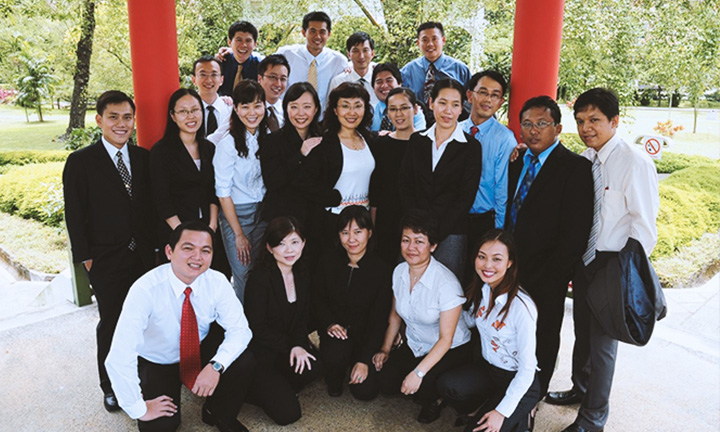 Coming from an engineering background, Mr Tan (last row, second from left) found the economics and finance modules in NTU’s Nanyang Fellows MBA programme particularly engaging and insightful.
Related story:
This article first appeared in issue 7 of U, the NTU alumni magazine.