The career coach is in
With the job market getting tougher, NTU is extending career support to its fresh graduates for an entire year after graduation.
Text: Brenda Kang
Graduation marks the start of a new chapter, but it can also bring questions about career direction and readiness.
“With the job market becoming more competitive, some fresh graduates may need extra support,” says Prof Boh Wai Fong, Vice President (Lifelong Learning & Alumni Engagement). “As such, NTU continues to guide them even after graduation, offering a full year of career support. After all, even when they leave campus, their journey with NTU is a lifelong one.”
The job search in today’s economic climate comes with practical challenges such as identifying opportunities, preparing effective CVs, progressing through interviews, and assessing the competitiveness of salary and offer terms.
Ms Enna Tan, Director of NTU’s Career & Attachment Office, elaborates: “Some of the most common challenges our students face in their job search include finding roles that match their interests, not securing interviews, or not receiving offers after the interview stage. Others may struggle with writing their resume or feel unsure about the salary and overall terms of an offer. For these hurdles, we provide career coaching and advisory support that reassure students, help them plan strategically, and enable them to put their best foot forward.”
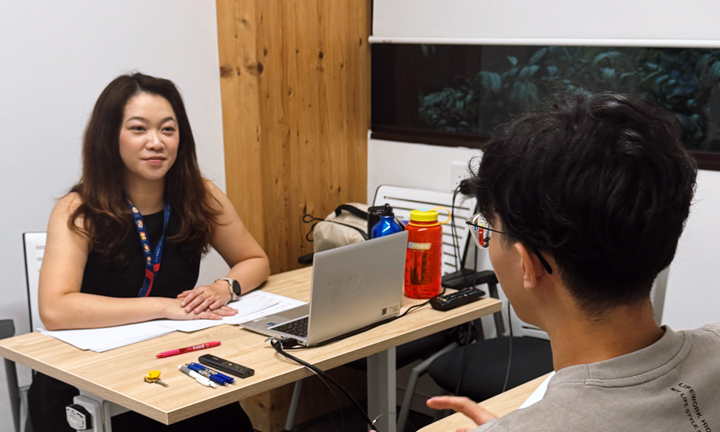 A student works with career coach Theresa Ong (left) to refine his career goals.
Tailored guidance
Personalised coaching often becomes the bridge that helps students move from uncertainty to clarity. And a closer look inside a coaching session reveals how this support translates into real, practical direction.
In a typical one-to-one session, career coach Gideon Koh starts by exploring how students approach their academic projects and challenges. This helps surface their strengths and transferable skills, which then guides the conversation towards clarifying their career interests and goals, and shaping a practical strategy for internships or full-time roles.
Each 45-minute session is personalised to the student’s needs. Depending on where they are in their job search, discussions may focus on sharpening their job-search strategy, strengthening their resume and cover letter, preparing for interviews or evaluating job offers. Students also receive guidance on managing the common challenges they encounter along the way, helping them gain clarity and confidence as they move forward.
 Career coach Gideon
Koh sharing advice and
encouragement at
a recruitment fair.
Career coach Gideon
Koh sharing advice and
encouragement at
a recruitment fair.
Gideon shares that what students often need most is the seasoned perspective of a coach. “Generative artificial intelligence (AI) can support the process, but it cannot replace the years of experience that help us connect the dots and guide students through their decisions,” he says.
He observes that many students feel the pressure of a tougher job market. With more graduates entering the workforce and growing concerns about AI replacing entry-level roles, some worry they are competing in a landscape that’s shifting faster than they can keep up.
Gideon recalls the time a third-year computing student approached him, nervous about an investment-management internship interview. “He struggled to structure his answers and explain how his AI and data science projects were relevant to a finance role and tended to speak too quickly when anxious. During our mock interview session, I helped him refine his responses and present his projects more clearly.”
The student later told Gideon that the session made a big difference to his job search, helping him land his first internship offer.
Another recent success story stays close to his heart. “A student came to me unsure how to stand out with only a few academic projects and one internship,” Gideon recalls.
Through targeted coaching, the student learnt how to tailor his CV and articulate his strengths clearly in interviews. Within weeks, he began receiving more interview invitations and eventually secured two offers, both above the median starting salary for fresh graduates.
“When he was deciding between the offers, we discussed not just the pay, but also the kind of growth each role could offer. He thanked me and said that the advice was ‘life-changing’ for him,” Gideon says.
Click here for career support for recent grads.
Shaping careers
The Margaret Lien Centre for Professional Success in Wee Cho Yaw Plaza was established in 2013 with a S$12 million gift from Mrs Margaret Lien, wife of the late banker, hotelier and philanthropist Dr Lien Ying Chow. Her gift was matched by the government, creating an endowed fund of about S$30 million. Inside the centre is a newly refurbished space that supports students and fresh graduates in their career development. In addition to career coaching, it also hosts programmes such as mentorships, recruitment talks, case competitions, hackathons and networking sessions. |
 The Margaret
Lien Centre for
Professional Success
equips NTU students
with the skills and
confidence to thrive
in the workplace.
The Margaret
Lien Centre for
Professional Success
equips NTU students
with the skills and
confidence to thrive
in the workplace.
This article first appeared in issue 7 of U, the NTU alumni magazine.