From N-Level to PhD
No two journeys to a PhD are alike. For these NTU alumni, humble beginnings only made their achievements more meaningful. While they took the longer route to a doctorate, their stories show that it’s how you keep moving forward that matters.
Text: Vivien Yap | Photos: Nigel Tan, Ernest Tan & Bobby Lee
Dr Nigel Tan: Rising above adversity
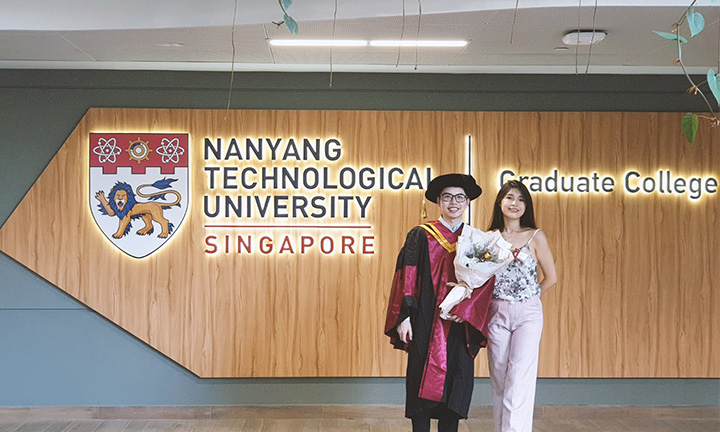 Nigel celebrating the end of his PhD journey with his wife.
Dr Nigel Tan now stands in front of a lecture theatre, but it feels as if it was only yesterday that he was a Normal (Academic) student in secondary five, struggling to make ends meet.
Nigel grew up in hardship. When he was eight, his father’s businesses failed, and his parents divorced soon after. Nigel went from living in a comfortable landed home to a rented two-room flat.
“Back then, I wasn’t a good student,” Nigel admits. “But when my family situation changed, I realised that if I didn’t work hard, I wouldn’t be able to escape poverty.”
At age 13, he began juggling schoolwork with part-time jobs, often working past 10pm. Despite the odds, he excelled in the N and O Levels, developing a love for maths and science.
At Singapore Polytechnic, he discovered a passion for teaching. Eventually, he did well enough to earn a place at NTU’s School of Materials Science & Engineering.
Finding his place at NTU
“NTU gave me independence and space to grow,” Nigel says. A personal highlight was a fully sponsored internship in Japan as a research engineer at JFE Steel Corporation. “I was too poor to travel, and this opportunity made me interested in seeing what the rest of the world had to offer.
Financial hardship persisted, but Nigel pressed on. “I didn’t think I was good enough for a scholarship,” he admits. “So, I applied for bursaries while working parttime selling shirts at Bossini.”
Receiving the Ma Jan Memorial Fund bursary eased his burden, and in gratitude, Nigel gave back to the NTU Bursary Fund as a donor.
Perserverance pays
After graduating with Honours (Highest Distinction) in 2016, Nigel planned to get a full-time job but was convinced by his former professor, Assoc Prof Terry Steele, to pursue a PhD under the Nanyang President’s Graduate Scholarship.
“Assoc Prof Steele gave me the courage to take that leap, even when I was still struggling financially,” he recalls. Paired with his wife’s steadfast support, Nigel weathered through failed experiments and dejections, before success.
His PhD research was on biomaterials and adhesive innovations that could one day replace surgical sutures – marrying his love for science with his desire to help others.
After getting his doctorate, Nigel worked at Micron as a Senior Engineer before joining Republic Polytechnic, where he guides the next generation of engineers.
“Seeing my students do well feels better than any research breakthrough,” he says. “I know what it’s like to start with nothing, so I want to help others find their way forward.”
Dr Ernest Tan: Inquisitiveness opens doors
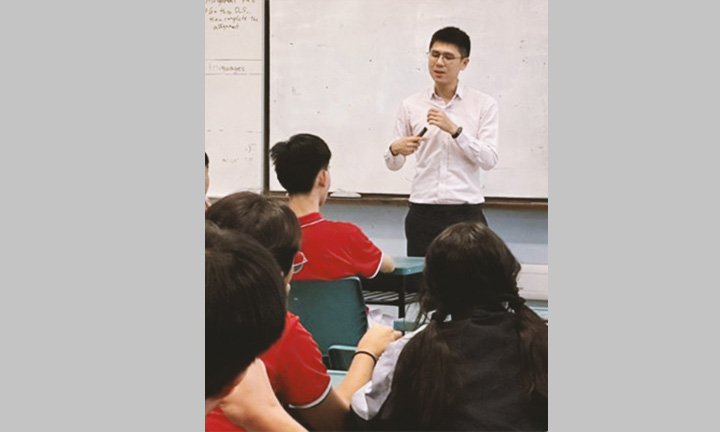 Ernest giving a career talk to secondary school students.
Growing up, Dr Ernest Tan scraped by in school and was not motivated to do well until his passion for computers propelled him to pursue a PhD at NTU’s College of Computing & Data Science.
“I became genuinely curious about computers after getting hooked on computer games in secondary school,” he says. That spark carried him from the communications technology programme at the Institute of Technical Education (ITE) to Singapore Polytechnic, and eventually to NTU.
“Many of my peers wanted to be software engineers, but I just wanted to learn more about computer networks,” he says.
A researcher in the making
At NTU, Ernest’s curiosity blossomed into research. His final-year project, which used brain signals to predict facial recognition, impressed his supervisor, Assoc Prof Vinod Prasad, who encouraged him to further it as an academic conference paper.
“It was tough juggling my modules while writing a conference paper, but that first paper changed my life. I learnt so much about what it means to be a researcher,” he says.
Later, under Assoc Prof A S Madhukumar, Ernest pursued his PhD in wireless communications with Airbus. “He was patient and incredibly quick at pinpointing problems. I aspire to be like him in the way I teach,” says Ernest, now an educator himself.
His research on the probability of wireless link failures in drones was published in a top-tier journal, the first of several papers arising from his research.
Ernest subsequently joined the Agency for Science, Technology & Research as a scientist before returning to academia.
Now an Assistant Professor at the Singapore Institute of Technology, he says: “My NTU professors made sure we never felt stuck. I want to do the same for my students.”
Bobby Lee: The power of being seen
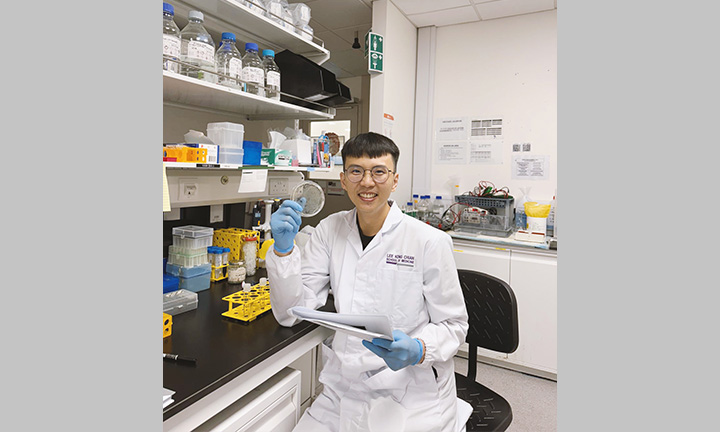 Bobby conducting research on bacteriophages at the Lee Kong Chian School of Medicine.
As a mischievous child who was more interested in having fun than studying, Bobby Lee never imagined he would one day be pursuing a doctorate at NTU’s Lee Kong Chian School of Medicine.
When I did badly for my O Levels and entered ITE, I felt lost and dejected,” he recalls. “However, the lecturers there never gave up on their students and even offered us extra help on weekends. I felt that if they believed in me, I should too.”
Bobby eventually decided to study chemical technology at ITE, where an elective introduced him to microbiology. “It was the first time I saw bacteria under a microscope. I was fascinated that something invisible could cause disease.”
After graduating second in his cohort and earning multiple academic prizes, he continued his journey at Singapore Polytechnic, where he studied biotechnology. During his internship, he helped to extract DNA from viruses that infect bacteria – an experience that foreshadowed his future research.
A path shaped by mentorship
After national service, Bobby joined NTU’s School of Biological Sciences, where the mentorship he received again changed his trajectory.
Under Assoc Profs Eric Yap and Tan Boon Huan, he joined the Undergraduate Research Experience on CAmpus (URECA) programme.
“Nothing on the URECA project list interested me, so I reached out to Assoc Prof Yap for help,” Bobby recalls. “He created a project just so I could pursue something I was deeply passionate about.”
His URECA project later became the foundation for his current PhD work. During his NTU internship at Mahidol University in Thailand, his supervisor there also designed a research project tailored to his interests.
Tackling a silent pandemic
Bitten by the research bug, Bobby chose to pursue further studies immediately after graduating from NTU earlier this year.
Now researching bacteriophages – viruses that infect and kill bacteria – as a PhD student, he hopes to contribute to the global fight against antimicrobial resistance, a “silent pandemic” that could claim millions of lives by 2050.
“The goal is to uncover insights that could lead to real-world applications to treat antibiotic-resistant infections,” he says.
This article first appeared in issue 7 of U, the NTU alumni magazine.