Steward of national progress
Recognised with 2025's Nanyang Distinguished Alumni Award, discover how Dr Yudhoyono’s time at NTU shaped his strategic thinking and leadership approach, influencing his rise in public service and earning him top alumni honours.
Text: Vivien Yap | Photos: Agus Yudhoyono
Leadership runs deep in the Yudhoyono family. The son of former Indonesian President Susilo Bambang Yudhoyono, Dr Yudhoyono has forged his own path in leadership and public service. A graduate of NTU’s S Rajaratnam School of International Studies (RSIS), he has worn many hats: army officer, policymaker and now Coordinating Minister for Infrastructure and Regional Development in Indonesia under President Prabowo Subianto.
This year, he adds another milestone on his journey with the Nanyang Distinguished Alumni Award, his second accolade from the University after receiving the Nanyang Outstanding Young Alumni Award in 2013.
 Dr Agus Harimurti Yudhoyono receiving the Nanyang Distinguished Alumni Award at the 2025 Nanyang Alumni Awards.
What key lessons or experiences did you take away from your time at NTU?
When I pursued my postgraduate course in strategic studies at RSIS, I was a young military officer, and newly married. It was an exciting, formative chapter of my life. Studying at NTU opened my mind to a world beyond the barracks.
The experience taught me to think critically and strategically, and to see leadership through a wider lens. My exposure to geopolitics, geoeconomics and strategic studies was invaluable. It helped me understand that to lead effectively, whether in the military or beyond, one must grasp the broader dynamics shaping our world.
Strength must always be guided by insight and wisdom. That worldview, cultivated at NTU, continues to guide how I see national interest, regional stability and global cooperation today.
How has your NTU education influenced your journey as a leader?
My education at NTU laid the intellectual foundation for everything that followed. About 10 years after my time in Singapore, I transitioned from the military, where I had served for 16 years, into the world of politics. It was a different kind of service, but the mission remained the same: to serve Indonesia, and to make the world a better place.
Through these transitions, the mindset I gained at NTU – analytical, interdisciplinary, and forward-looking – has stayed with me. I’ve also come to believe that leaders and academics must stay close. Good policy requires both values and proof – ideas tested by evidence, guided by empathy and refined by science. That, to me, is how leadership and knowledge truly meet.
Looking back, which aspect of campus life do you remember most fondly?
I have very fond memories of my time here. I still remember my professor, Dr Leonard Sebastian, who led discussions on state and modern politics in Indonesia. His classes challenged us to think beyond headlines to see governance as both an art and a responsibility.
Every time I return to Singapore, I’m reminded of those student days; the quiet mornings on campus, the intense yet inspiring debates in class, and the friendships that crossed borders and backgrounds. Receiving the Nanyang Distinguished Alumni Award is a recognition that means a great deal to me.
What role do you think education can play in strengthening ties between Indonesia and Singapore?
Education is one of the strongest and most enduring bridges between our two nations. It nurtures trust, empathy and understanding – values that go beyond politics or economics. Many Indonesian students who study in Singapore return home not only with degrees, but with new perspectives on innovation and excellence.
At the same time, Singaporean academics and professionals who engage with Indonesia gain a deeper appreciation of our diversity and dynamism. These exchanges – person to person, idea to idea – form the foundation of lasting friendship.
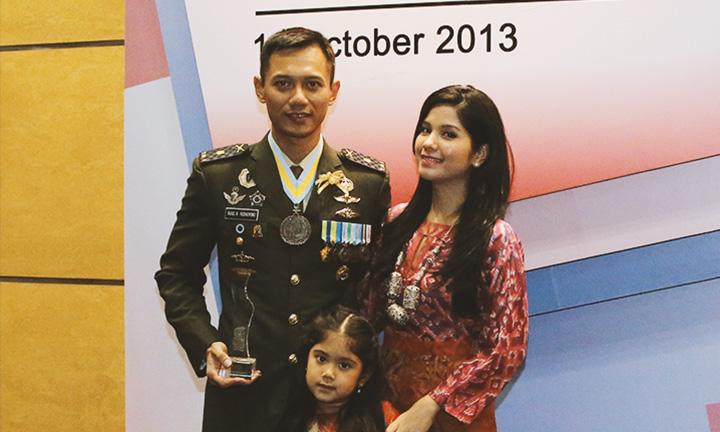 Dr Yudhoyono with his wife, Annisa Larasati Pohan, and daughter, Almira, at the Nanyang Alumni Awards ceremony in 2013.
Related story:
This article first appeared in issue 7 of U, the NTU alumni magazine.