Guardians of the wild
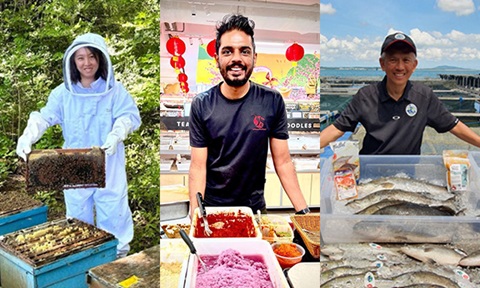
In a world of rising skylines, two alumnae have chosen a different horizon – one lined with forests, shorelines and wildlife. They have dedicated their careers to conservation, working not just to protect nature, but to reshape how people coexist with it.
Text: Junn Loh
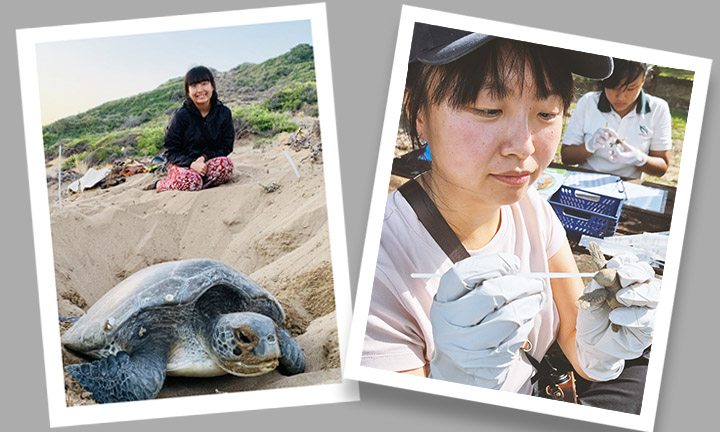 (Left) What began as a brief stint with a turtle conservation group in Northern Cyprus blossomed into a lifelong passion for Regine. (Right) Regine swabbing the eyes and mouth of a turtle hatchling to test for bacteria in its mucus.
Dr Regine Tiong spends her days by the sea, collecting samples from hawksbill turtle nests along East Coast Park and the Southern Islands.
Her goal is to understand and safeguard one of the world’s critically endangered marine species that quietly calls Singapore home.
Her interest in turtles began as an Environmental Earth Systems Science undergraduate during a research trip to Northern Cyprus, where she worked with a turtle conservation group.
There, she observed nesting turtles and learnt just how fragile their existence is.
Back home, Regine discovered that Singapore’s own beaches are secret nesting grounds for hawksbill turtles. For her final-year project, and later her PhD studies in NTU, she focused on studying their genetics. “We collect biological samples like unhatched eggs or dead hatchlings for DNA extraction,” she explains. “By analysing their genetic makeup, we can see how Singapore’s turtle populations are connected to others in the region. This helps us understand how best to protect them.”
“Only one in a thousand hatchlings makes it to adulthood,” she says. “When you see those tiny turtles crawling to the ocean, you realise how much they’re up against and how incredible it is that any of them make it.”
Protecting future nests
Regine’s research now plays a vital role in shaping Singapore’s coastal development plans, including the upcoming Long Island Project, a massive reclamation initiative that could affect turtle nesting sites.
“Our research provides evidence of how important these beaches are,” she says. “We’re working with the National Parks Board to relocate vulnerable nests from East Coast Park to safer hatcheries in the Southern Islands. Hopefully, we can even recommend new nesting sites as part of the Long Island Project.”
Regine, who earned her doctorate this year, credits much of her growth as a researcher to her mentor and PhD supervisor, Assoc Prof Kim Hie Lim, who has guided her through both successes and setbacks. “She’s nurturing and patient, yet always pushes me to think critically,” Regine shares. “When experiments don’t go as planned, she reminds me that every small step is progress.”
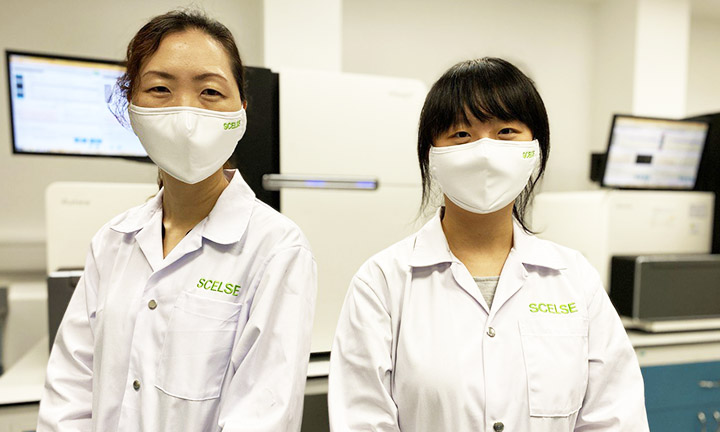 Regine (right) attributes her development as a researcher to the mentorship of Assoc Prof Kim Hie Lim (left).
“Conservation can feel like an uphill battle sometimes because space is limited,” she says. “But I see so many young people doing their part.”
She adds: “You don’t have to be a researcher to care. There are so many ways to contribute, like volunteering for beach clean-ups, joining turtle-monitoring programmes, or simply spending time in nature. The more we connect with nature, the more we’ll want to protect it.”
Coexisting with wildlife
In a small patch of forest near an industrial estate, alumna Karina Lim stands beneath a large tree in the sweltering afternoon heat, looking up at a struggling white-bellied sea eagle. The bird is caught in a branch, its leg twisted, and trapped high above the ground.
Reaching it takes hours and teamwork. With the help of a volunteer arborist and rescue experts, the woman and her team finally free the eagle and rush it to a veterinarian late at night. Days later, it is released back into the wild and reunited with its parents.
Karina's love for helping humans and wildlife thrive together grew at Earthlink NTU. She now works as a Senior Wildlife Coordinator at Singapore’s Animal Concerns Research and Education Society (ACRES).
"Seeing the eagle get well again, and reunited with its parents, is the kind of moment that keeps you going," she says.
Karina explains: “Conservation isn’t only about science or public awareness. It’s also about sociology. Many wildlife issues in urban spaces are really social issues.”
It is a point the 2024 sociology graduate explored deeply in her final-year project at NTU, which examined pigeon-feeding habits among elderly residents. “I found that many weren’t simply feeding birds. They were really seeking companionship,” she says. “It shows how addressing wildlife problems often means addressing human ones first.”
As a teenager, Karina volunteered at the Singapore Zoo, first as a conservation ambassador, then as a keeper. Those experiences helped her understand animals as sentient beings and appreciate the nuances of their care.
When she learnt about government-led wildlife-culling programmes in junior college, she launched a campaign promoting the understanding of urban wildlife and how people could live alongside them. This connected her with ACRES, where she found mentors who encouraged her to continue advocating for animals.
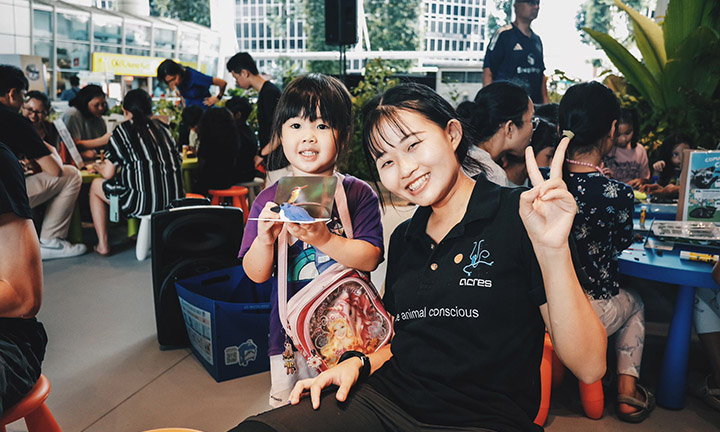 Education, Karina believes, is the bridge to appreciating and understanding wildlife in Singapore.
At NTU, Karina joined Earthlink NTU, the University’s flagship environmental club, and became the first director of its newly formed Human-Wildlife Coexistence portfolio, leading efforts to foster harmony between people and the wildlife that share the campus grounds.
Being part of Earthlink also brought her into contact with experienced conservationists such as Dr Shawn Lum, Senior Lecturer at NTU's Asian School of the Environment, and Assoc Prof Vilma D’Rozario, formerly of the National Institute of Education at NTU. “They were extremely supportive and taught me a lot about how to advocate effectively for wildlife,” Karina says.
“Their guidance helped me see that change doesn’t happen overnight. It takes consistent effort, good science and empathy.”
One such initiative, developed with their support, was NTU’s first wildlife coexistence guidebook, a practical resource for students and staff on how to interact safely and responsibly with animals on campus, from wild boars to snakes. “It was really about changing perspectives,” Karina explains. “Instead of seeing wildlife as pests, we wanted people to see them as neighbours.”
Armed with a portfolio of advocacy experiences after graduating from NTU, Karina joined ACRES full time. Apart from emergency rescue missions, she coordinates public outreach and represents ACRES in various working groups that handle issues such as management of otters and macaques in urban areas. These efforts, with NParks and other government agencies, have led to humane and sustainable approaches to human-wildlife coexistence.
Her day-to-day work can be mentally demanding. Not all rescues have happy endings, and policy advocacy can be an uphill task. Yet she remains undeterred.
“You learn to channel sadness into motivation. If you let emotions take over, you can’t work effectively. There’s always another animal that needs help.”
That discipline, she says, is balanced by hope. “Singapore aspires to become a ‘City in Nature’. In the course of my work, I’ve come to realise that people actually want greenery and biodiversity. It’s just that they don’t yet know how to deal with the wildlife that comes with it. This is where education comes in. We need to teach people to live alongside nature, not apart from it.”
This article first appeared in issue 7 of U, the NTU alumni magazine.