Homeschooled by mum
Three NTU mothers are swimming against the mainstream, choosing to homeschool their children, who have never spent a single day in a kindergarten or primary school uniform. How do they do it?
Text: Wong SY
Classroom of one
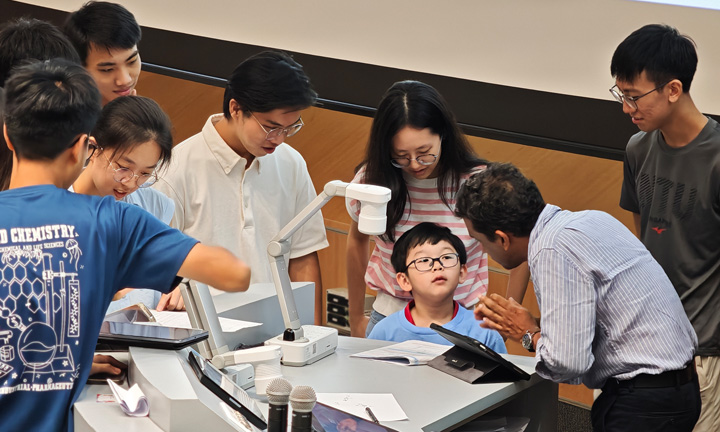 Theodore joining a foundational chemistry lecture at NTU as a guest of senior lecturer Dr Sumod Pullarkat. (Photo: Don Tan)
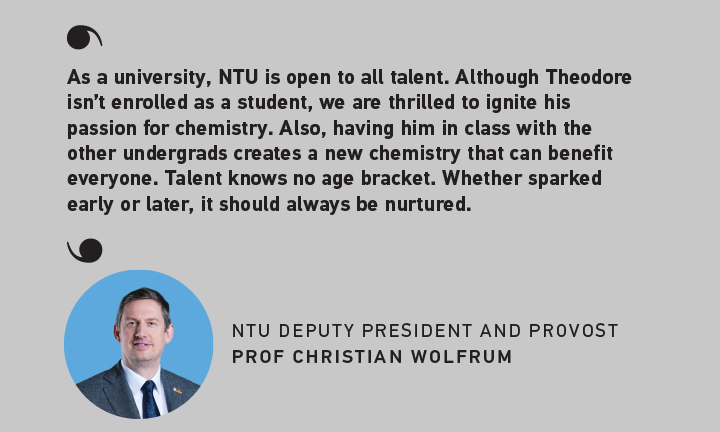
At a recent NTU lecture, a little bright spark posed questions to the chemistry professor that baffled the adult undergrads. Whiz kid Theodore Kwan, 7, does not belong to any gifted school programme. In fact, he does not even attend school. If Theodore was in a Primary One class, his classmates would not understand his questions. That’s why homeschooling is the only option for him.
Theodore is not alone. According to The Straits Times, about 50 children in Singapore are homeschooled each year, exempted from attending school under the Compulsory Education Act. Not all homeschooled kids have an IQ of 154 like Theodore. Parents educate their kids at home for various reasons, for example, to broaden their horizons beyond a fixed syllabus and to foster closer family ties.
Homeschooled children are typically urged to learn at their own pace. But taking it easy is not necessarily an obstacle to achievement. Singapore’s Olympic bronze medallist in kitefoiling, Maximilian Maeder, was homeschooled.
For Theodore, homeschooling seemed the natural route. “Sending him to school was never part of the plan, though family pressure prompted me to consider a few preschools. Ultimately, homeschooling was Theodore’s choice,” says his mum, Crystal Tang, a PhD student at NTU’s Lee Kong Chian School of Medicine who also teaches children's enrichment courses.
Crystal doesn’t need to worry about her seven-year-old’s intellectual development. With his high IQ and insatiable curiosity, he thrives academically. Crystal and her businessman husband rely on an informal network of homeschooling families for support. Theodore has his three-year-old sister, Tabitha, to keep him company at home.
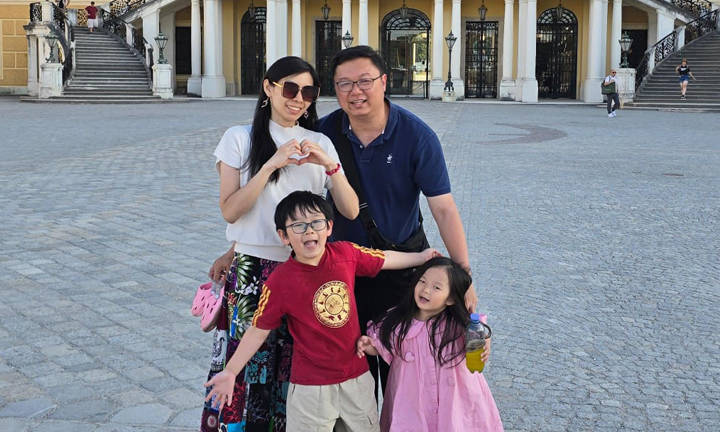 Crystal homeschools her two
children, Theodore and Tabitha. (Photo: Crystal Tang)
Crystal homeschools her two
children, Theodore and Tabitha. (Photo: Crystal Tang)
“Theodore mixes well with other kids in the homeschool community. He’s not socially awkward. By and large, he’s just an average, well-behaved boy,” says Crystal.
“He likes to engage me in intellectual debates. Sometimes, I feel Theodore is too smart for his own good, or rather, for my own good,” she jokes.
Theodore doesn’t argue for the sake of it. “He has high EQ and relates well to kids and adults,” Crystal says.
Theodore excels in the sciences. Learning languages is also a breeze. Earlier this year, he scored an A in IGCSE Chemistry, the equivalent of a GCE O Level exam. At some point, he should be at a higher institution of learning as an exceptionally gifted child. “A foreign education is expensive, and how can any parent bear to send a small kid to study abroad on their own?”
After completing her doctorate in medical research, Crystal hopes to pursue a medical degree to fulfil her childhood dream of becoming a doctor. But, like any devoted mother, her first priority is securing Theodore’s educational future.
When asked about the familiar nature-versus-nurture question, she says: “I don’t know. I don’t believe in the Mozart Effect – having your unborn child listen to classical music while in the womb to nourish his or her IQ. In fact, I ate all sorts of junk food when I was carrying Theodore,” Crystal quips.
For the mum of a cool kid, Crystal is really chill herself.
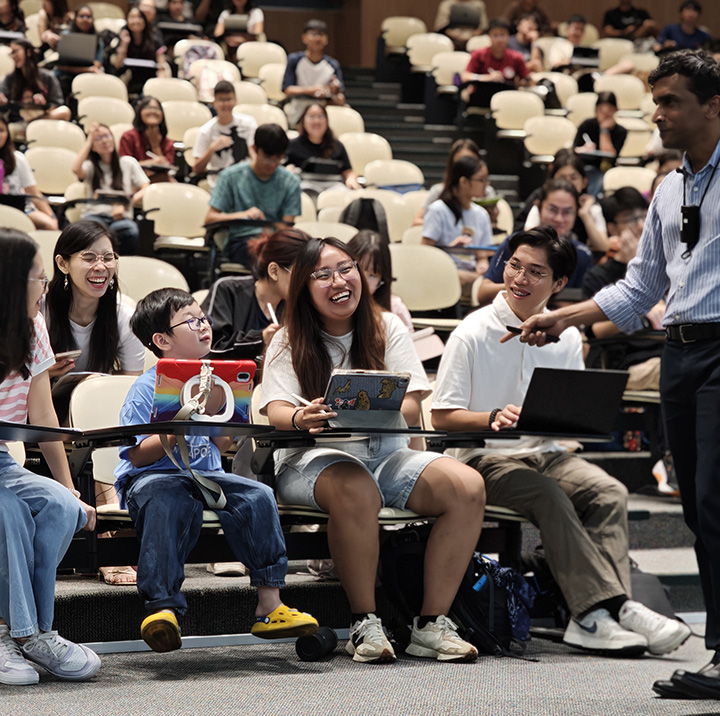 Watch Theodore sate his curiosity at an NTU chemistry lecture
Homeschooling 7 children
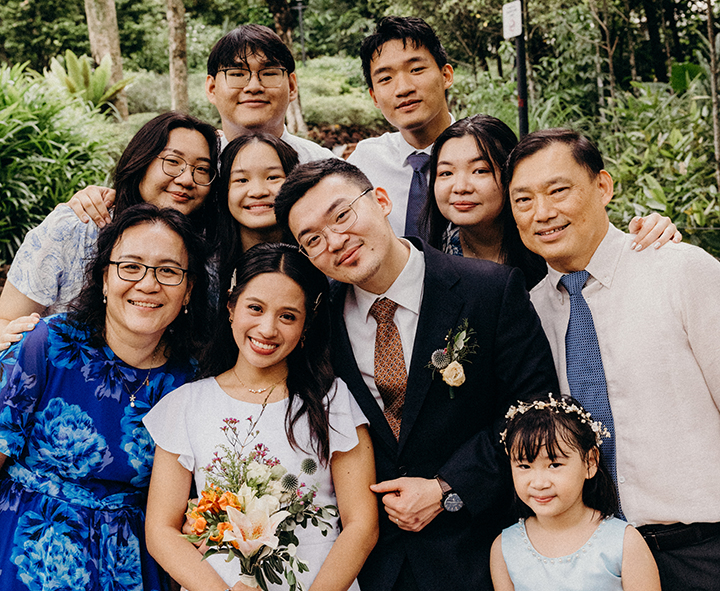 Sue (first row, far left) with
her husband and children
at the wedding of her
eldest son Asher (centre)
and daughter-in-law in
September this year. (Photo: Sue Ong)
Sue (first row, far left) with
her husband and children
at the wedding of her
eldest son Asher (centre)
and daughter-in-law in
September this year. (Photo: Sue Ong)
All seven of Sue Ong’s children have been homeschooled. The 1998 National Institute of Education (NIE) graduate manages this feat alongside her teacher husband.
“Homeschooling enables parents to help their children experience a holistic education, not just focus on scoring ‘A’s,” Sue explains. “The goal isn’t to produce all-rounders like schools expect of their top students, but to cater to the unique needs of each child. My kids have different talents and interests. Our duty is to help them find the way to maximise their potential.”
So far, her children, aged six to 25, have followed diverse paths. Her four oldest children have graduated from homeschooling to pursue their individual passions in architecture, pedagogy, biochemistry and cello studies, respectively. The three youngest are still homeschooling.
“My second child, who loves music, chose to study at NIE to become a teacher because she is passionate about teaching. She’s now a student conductor in the NTU Choir,” Sue says.
Her eldest son, Asher, exemplifies the unique appeal of homeschooling. His teen years as a homeschooler included a six-month road trip around the United States with his family and the publishing and marketing of a photo journal he created. He took the GCE O Level exams as a private candidate in two sittings to allow him time for these endeavours. He then graduated from Nanyang Polytechnic with a near-perfect score and earned a scholarship to study architecture in London at the Architectural Association.
“We did not aim for scholarships. When Asher got one, it was a bonus, not an expectation. We are proud of him because he did it his own way,” says Sue.
Family first
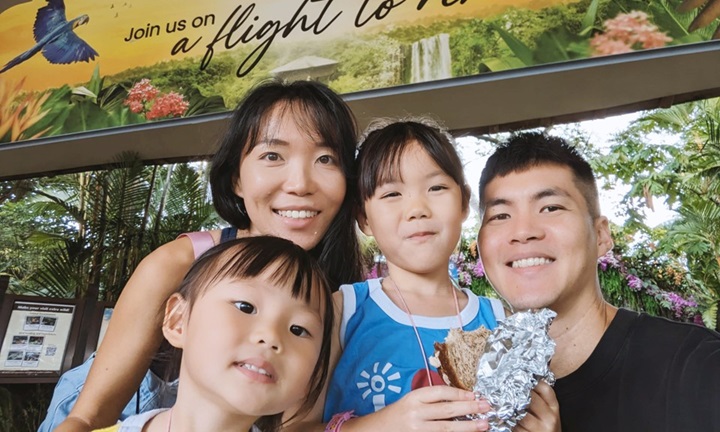 Jiamin and her husband
with their children on a
nature excursion. (Photo: Han Jiamin)
Jiamin and her husband
with their children on a
nature excursion. (Photo: Han Jiamin)
Nanyang Business School (NBS) alumna Han Jiamin ditched a high-flying career to teach her daughters, aged six and eight, full time. She loved her previous job. But she loves her family even more.
“I want to be with my kids at this fundamental stage of their growth to build their character and instil family values. I cherish every bonding moment at home with them,” says Jiamin. Bonding means morning hugs, storytelling and exchanging words of affirmation.
Her husband, an NTU art, design and media graduate who runs a media studio, has a flexible work schedule that allows him to spend mornings with the family. Their daughters aren’t missing out – the elder, once painfully shy in preschool, now happily socialises with other homeschooled kids.
Jiamin researched and spoke to homeschooling parents before embarking on her home education journey.
“I want to give my children the freedom to learn at their own pace in ways that suit their learning styles, as every child develops on their own timeline,” she explains. “I try to give them more space to enjoy childhood and discover their interests, strengths and sense of purpose.”
Her eight-year-old was curious about pregnancy and childbirth, so Jiamin guided her to research the topic and make a presentation to close family friends. Indeed, such a birds-and-the-bees project would not be in a typical Primary Two classroom.
Jiamin co-founded My Curious Child, an educational resource business, with a fellow NBS alumna. The initiative has been well received by young families eager to explore learning through stories and playbased activities that support parent-child bonding. Her family is active in a local homeschool community, taking part in festivities, science and maths fairs, and excursions to parks.
“I have never regretted giving up a well-paid job to teach my daughters at home and watch them grow,” Jiamin says. “I try to see life from a bigger perspective.”
Careful Deliberation
Dr Wong Hwei Ming (right), Assistant Centre Director (Education) at NTU’s Centre for Research in Pedagogy & Practice, advises parents to carefully weigh the benefits and challenges before embarking on homeschooling. | 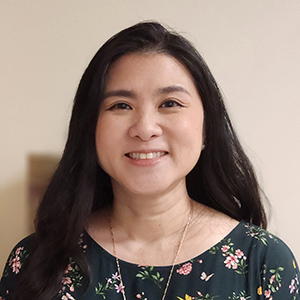 |
Preparation
- Parents must meet Ministry of Education (MOE) guidelines to be exempt from the Compulsory Education Act.
- They can use online resources for curriculum ideas and teaching methods, and seek guidance from MOE and homeschooling communities.
Benefits
- Flexibility to tailor learning to a child’s interests and pace, allowing in-depth exploration and alignment with family values and beliefs.
- Stronger bonding between parents and children.
Drawbacks
- Limited interaction, such as in classrooms, may affect social and communication skills.
- Learning quality depends on parents’ teaching ability.
- Learning gaps may lead to retaking exams, impacting self-esteem.
Overcoming Drawbacks
- Homeschoolers can join enrichment and community programmes. “These may not fully replicate school, but they provide settings that develop communication, teamwork and social skills,” says Dr Wong.
- Parents can use curriculum resources, workshops and homeschooling networks to meet national standards. Regular assessment helps track progress. “When parents focus on effort and growth over grades, children develop resilience and a positive attitude towards learning,” notes Dr Wong.
This article first appeared in issue 7 of U, the NTU alumni magazine.