AI is a multiplier, not a shortcut: an NTU alumnus on getting more out of it
Speaking at NTU's PACE Forward panel on the future of work, Eric Yim (NBS/1998) shares how AI rewards expertise, not just adoption, and that getting the most out of it starts with understanding people.
Text: Vivien Yap | Photos: NTU Academy for Professional and Continuing Education (NTU PACE), Eric Yim
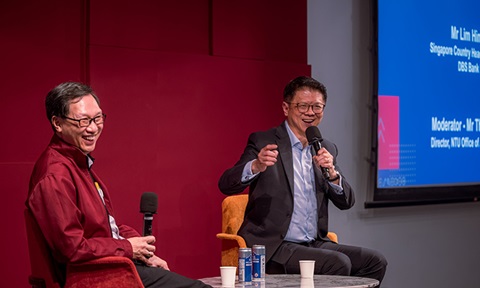
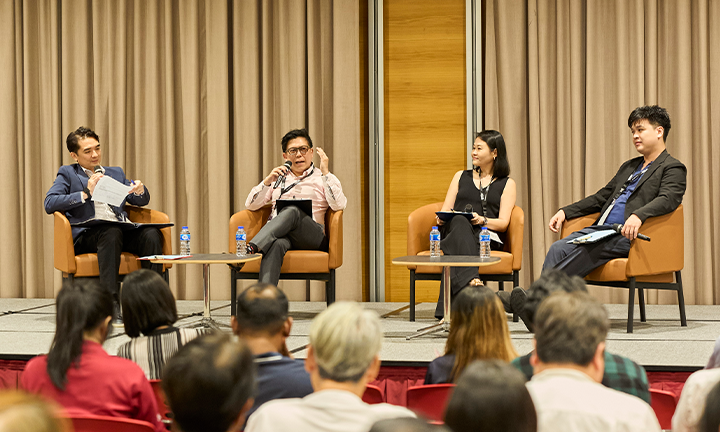 Eric (second from left) speaking on a panel at the PACE Forward x SG Innovate Tech Talk event on 13 July 2026
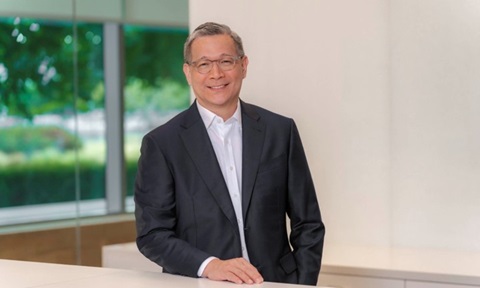
"Zero multiplied by any number is still zero." That’s how Eric Yim (NBS/1998) explains why AI rewards the people who already know what they're doing – not the people who are quickest to adopt it.
He graduated from Nanyang Business School in 1998 with a specialisation in financial analysis, but an elective on organisational behaviour sent him down a different path.
"I was very inspired by how the culture and workings of an organisation shape how its people behave and act in the workplace," he says.
That curiosity became a career. Over 20 years later, Eric works at the intersection of organisational development and AI adoption in the workplace.
A hard drive, then a second brain
Long before AI entered the workplace, Eric was building his own knowledge system the analogue way. "I kept a hard drive with about two decades of work in it. I put everything I thought about on a daily basis and everything I've built in it."
When the first versions of AI arrived, he brought the same instinct to ChatGPT.
"I first used AI as my own personal knowledge management system," he says. He has since built what he calls his second brain. Unlike the hard drive, which only archived data, it’s a responsive system that stores and builds on his existing knowledge.
A certificate in prompt engineering, drawn from his organisational development background, then shaped how he uses AI. "With AI, it's about asking good questions. Learning prompt engineering helped me to think like a system. In order to get a system to do something, you've got to think like it."
Why AI rewards experience
Eric's personal stance on AI usage in the workplace is a reframing of who benefits most from it. "AI is a multiplier," he said during the PACE Forward x SG Innovate Tech Talk event on 13 July.
To him, AI is most valuable to people who already have deep domain expertise to amplify, not necessarily those most comfortable with new technology.
His advice to individuals exploring AI at work goes back to basics: take stock of what you already know before you open the tool.
 | "Take time to appreciate your own expertise and translate them into heuristics and methods that you've taken years to make sense. When you are clear of your capabilities, AI tools can come in and help consolidate and expand on your expertise in meaningful and productive ways." |
In leading teams, Eric does not encourage using AI as merely an assistant or a functional tool. "If AI can be customised to the individual, don't just treat it like a digital assistant. Treat it like your chief of staff," he says, emphasising that shaping an AI agent to work at a higher level, rather than simply issuing it instructions, is what separates real amplification from surface-level efficiency.
The rawness of humans in action
Eric is candid about where AI can fall short, particularly as generated content becomes harder to distinguish from human work. As AI output grows more polished, he sees audiences swinging the other way.
"People like to see the rawness of humans in action," he says, predicting a return to unscripted, long-form communication as audiences grow wary of anything too polished.
That instinct guides his own use of the technology. For example, he avoids AI when writing sensitive emails. "It may not seem as polished, but it's just more sincere."
His guidance for professionals navigating AI adoption is less about which tool to choose and more a discipline of judgement: "The point that we should be striving towards is discerning the right time and place to use AI."
It is a philosophy that calls back to the organisational behaviour module he took as an NTU undergraduate: understanding people.
Know an NTU alumnus with a story worth telling? Write to us at u-alumnimag@ntu.edu.sg.