
NTU maintains a top-tier global position in materials science as it marks 35 years of the discipline
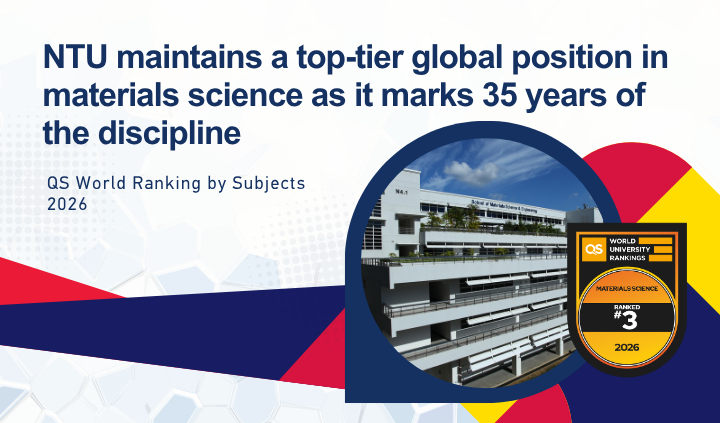
SINGAPORE — Nanyang Technological University, Singapore (NTU) has maintained its position among the world’s leading institutions in materials science, underpinned by strong research output, in the latest Quacquarelli Symonds (QS) World University Rankings by Subject 2026.
NTU has ranked among the top three globally in materials science over the past three years according to the independent comparative analysis of academic offerings by universities worldwide. The university’s performance is consistently supported by high research impact from the School of Materials Science and Engineering (MSE), reflecting the influence and quality of its scientific output in the field.
35 years of materials science at NTU
This year marks 35 years since the establishment of NTU’s School of Materials Science and Engineering, which has built a strong track record in research impact and global collaboration.
NTU MSE has maintained its position among the world’s leading materials science programmes and continues to demonstrate strong performance in research impact and global influence.
Its research output remains among the most highly cited worldwide, underscoring both the relevance and the application of its work to real-world challenges.
Bridging research and application
Research at NTU MSE is closely tied to industry needs, particularly in sectors where materials science plays a central role.
These include energy and the environment, advanced materials and manufacturing, health and medical technologies, and computational materials science, where research increasingly integrates artificial intelligence to accelerate discovery and design.
Within these areas, work ranges from semiconductors and next-generation electronics to sustainable materials, energy storage, biomaterials, and data-driven materials innovation.
Collaborations with research institutes and industry partners enable findings to be translated into practical applications and shape research directions.
Strong Graduate Outcomes and Industry Readiness
Graduates command competitive starting salaries within the industry range, reflecting both the relevance of their training and the demand for materials science expertise in high-growth sectors.
Based on the latest Graduate Employment data released by the Ministry of Education, Singapore, the majority of NTU MSE graduates secure employment upon graduation, with close to 80% entering the workforce and over 70% obtaining full-time permanent roles within 6 months from graduation , among the stronger outcomes in the discipline locally. Strong demand was seen across sectors, including advanced materials & emerging technologies, innovation & manufacturing, and semiconductors.
NTU MSE graduates are equipped with both strong technical foundations and the ability to apply their knowledge in real-world contexts.
Students benefit from:
- Industry-linked projects and internships
- Exposure to real-world challenges from global companies
- Opportunities to work across both research and applied settings
Latest Programme Developments
NTU MSE has introduced new postgraduate offerings and specialisations in response to industry demand.
From August 2026, the Master of Science in Materials Science and Engineering will include optional pathways in nanomaterials and sustainable materials.
A new Master of Science in Applied Materials Analytics has also been launched. The programme focuses on materials characterisation, diagnostics and failure analysis, reflecting growing demand in these areas.
Professor Ng Kee Woei, Chair of the School of Materials Science and Engineering, said the School would continue to focus on areas of growing relevance.
“Materials science is becoming increasingly important across sectors such as artificial intelligence, sustainability and advanced manufacturing. Our focus is on ensuring that both our research and training remain aligned with the latest developments.”
Looking Ahead
As NTU MSE enters its next phase, the School remains focused on strengthening its research excellence, deepening industry integration, expanding global collaborations, and advancing innovations that address emerging technological challenges — ensuring that its graduates remain relevant in a rapidly evolving global landscape.



-dr-kaarunya-sampathkumar.tmb-listing.jpg?sfvrsn=caf8aefd_2)