The Professor Who Made Heat Transfer Make Sense
 Assoc Professor Leong Kai Choong in the lab
Ask any MAE undergraduate to name the hardest module on the course list, and MA3003 Heat Transfer comes up more often than not. For 40 years, it was Assoc Professor Leong Kai Choong's job to change that reputation.
Not by making the subject easier, but by making it teachable.
He did not start out trying to reform anything. In the late 1980s, he was simply running small tutorial classes, watching students work through problems in real time.
That vantage point taught him more than any curriculum review could have.
"Conducting tutorial sessions in small classes then allowed me to understand the students' learning difficulties," he says.
Everything he built afterwards, the worked examples, the online modules and the restructured tutorials, traced back to what he saw in those early rooms.
The interest itself goes back further to his graduate studies in the United States, where he watched professors take intermediate and advanced heat and mass transfer and ground it in physics, thermodynamics and fluid mechanics without losing students along the way.
What struck him was how they tied the theory to their own research and to industry. It gave the material a reason to matter.
When encouragement was not enough
By the early 2010s, Professor Leong and his colleagues had run into a wall familiar to anyone who teaches a hard subject: students were not showing up prepared, tutorial attendance was slipping, and no amount of encouragement toward "active learning" moved the needle. Open-ended assignments had not fixed it either.
The push to actually do something came from an unlikely place, a chance conversation with an MAE graduate working in industry who had taken heat transfer under him.
Soon after, Professor Leong made class participation a graded component of the course. Students had to present in tutorials, offer alternative solutions, defend their reasoning in front of classmates.
However, graded participation alone would not work in a one-hour slot. He proposed something more disruptive: extending MA3003's tutorials to 1.5 hours, breaking from the standard format used across every other Year 2 and 3 courses in the School.
The School said yes. That was more than ten years ago. MA3003 is still the only course in MAE with the extended session.
"The tutors of the course have to work harder," he admits, "but the effort was worth it."
Bringing the outside world into the room
Professor Leong's research career runs through electronics cooling, thermal management of high heat flux electronic components, petrochemical processing, alternative refrigeration, and, in recent years, 3D-printed heat transfer devices engineered for higher energy efficiency.
None of it stayed on the page.
Years of industry experience before joining NTU, and consultancy work alongside it, gave him a steady supply of real-world examples to bring into lectures.
He was also candid with students about where their responsibility began and ended. "Engineers in the industry need to be equipped with good understanding of the concepts to troubleshoot and solve problems in-house," he says. "External consultants should only be engaged to solve higher level problems which require graduate level training and years of relevant experience."
This distinction shaped how he taught mathematical modelling in heat transfer. Students should work through the simple problems themselves first. Only then would they learn to recognise when a costly experimental rig or a high-performance computing bill was not actually necessary.
The project he feels most connected to, even now, is his last one: applying 3D printing to heat exchangers that exploit phase-change heat transfer for higher efficiency.
"I looked strict, but I was very kind"
Multiple Teacher-of-the-Year awards later, Professor Leong points to the same explanation every time: he made himself available. Students who came to his office expecting a stern professor often left saying the opposite.
One told him directly, "Although I looked strict in class, I was very kind in helping this student understand the course." It is a line he still remembers.
"It made my day then," he says.
Some of that empathy came from disclosure. He told struggling students that he had faced the same difficulties as an undergraduate himself, and watched the tension in the room ease.
Later in his career, he leaned further into the Socratic method, guiding students toward answers through questioning rather than handing solutions down from the front of the room.
A number of his heat transfer students went on to pursue doctoral degrees under his supervision, proof that at least some of them came out the other side not just passing the module but interested in it.
What he wants remembered
Forty years, more than 200 papers, and a teaching award collection to match. None of that is what Professor Leong leads with when asked what he hopes students carry forward.
"I hope that they will remember the importance of conducting themselves with integrity and humility," he says. "These, to me, are more important qualities than the mere mastery of technical knowledge."
And what is he most proud of, looking back across four decades at NTU? It wasn't the papers, nor the awards.
"I am most proud to see my former students succeed in their careers and live a happy and meaningful life." says Prof Leong.
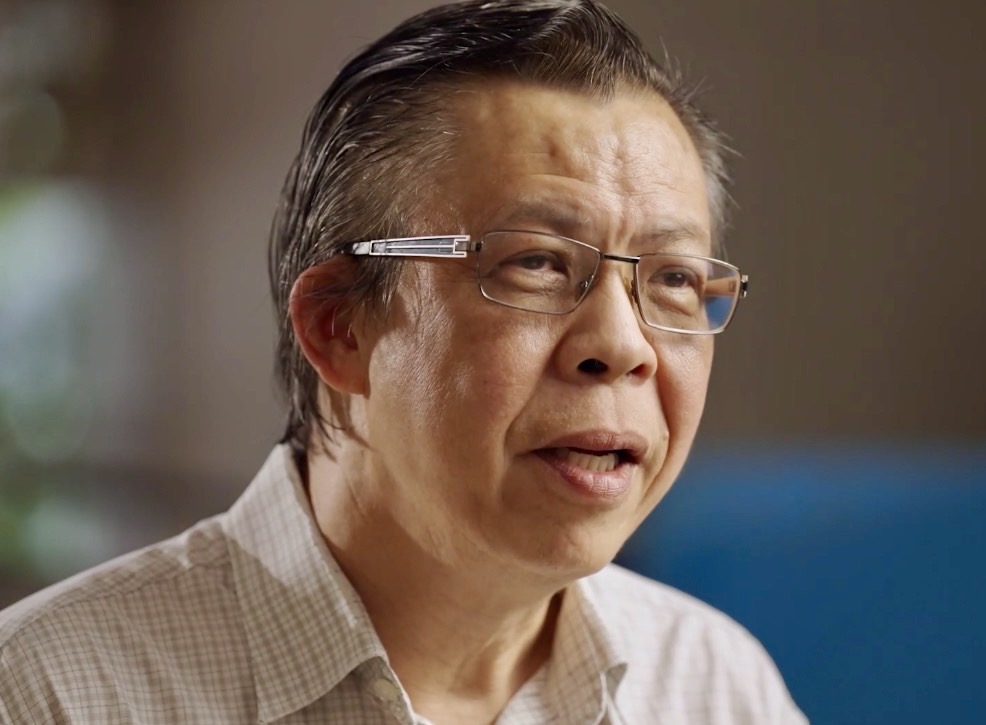 | The School of Mechanical and Aerospace Engineering at NTU extends its heartfelt gratitude to Assoc Professor Leong Kai Choong for his unwavering dedication, impactful research, and inspirational teaching over the years. |
About Assoc Professor Leong Kai ChoongDr. Leong Kai Choong worked as an engineer for some years before he embarked on an academic career with Nanyang Technological University (NTU) for the next 40 years. Besides teaching and research activities, he held administrative appointments as Vice-Dean (Academic) and Associate Chair (Academic) in the School of MAE from 2002 to 2008 and was concurrently Fellow of the Renaissance Engineering Programme from its inception in 2011 to 2024. Dr. Leong received the Ph.D. degree from the University of Queensland, the M.S.M.E. degree from the University of California, Los Angeles (UCLA) and the B.Eng.(Mech,) degree from the National University of Singapore. He is a Life Member of the Institution of Engineers, Singapore and a Registered Professional Mechanical Engineer in Singapore. In NTU, his research interests were in single- and two-phase heat transfer (boiling, condensation, solidification/melting), additive manufacturing (3-D Printing) of heat transfer devices, adsorption refrigeration and potable water generation. He was principal investigator of many funded research projects and is the author or coauthor of more than 200 journal and conference papers and 5 book chapters. Dr. Leong had the privilege of supervising many students for their Final Year Projects, master’s and Ph.D. degree theses. Many of these graduates are now working in the industry, research institutions and universities in Singapore or overseas. Though retired, Dr. Leong still teaches part-time in the School of MAE and contributes some of his time to serving the industry. |
By Kendra Kee and Karen Chai, NTU MAE Communications