Asst Prof Punit Kumar on the alloy that stays tough at −253°C
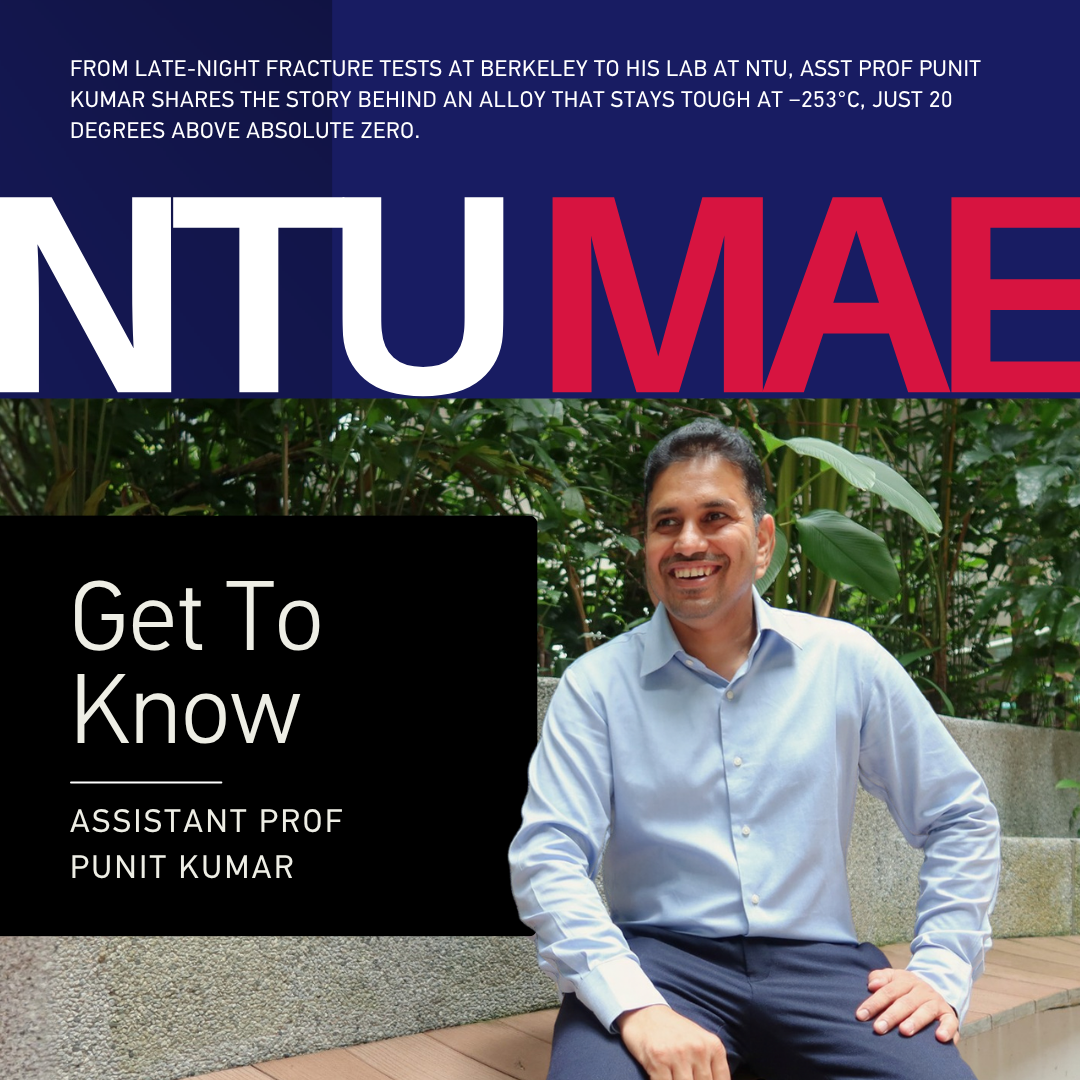
Asst Prof Punit Kumar, School of Mechanical and Aerospace Engineerin
Assistant Professor Punit Kumar joined NTU’s School of Mechanical and Aerospace Engineering in September 2025. He studies how materials deform and break, and how to make them tougher in extreme conditions.
Before NTU, he was a postdoctoral researcher in Professor Robert Ritchie’s group at the University of California, Berkeley, and Lawrence Berkeley National Laboratory.
His most recent work there, published in Nature, was a team effort led by Prof Ritchie with first author David Cook, then a PhD student at UC Berkeley and now an Assistant Professor at the University of Cambridge. The study shows how a metal alloy stays tough at −253°C, a temperature at which many metals turn brittle.
We spoke to him about the research, the experiments behind it and what he plans to build at NTU.
Get to know Asst Prof Punit Kumar
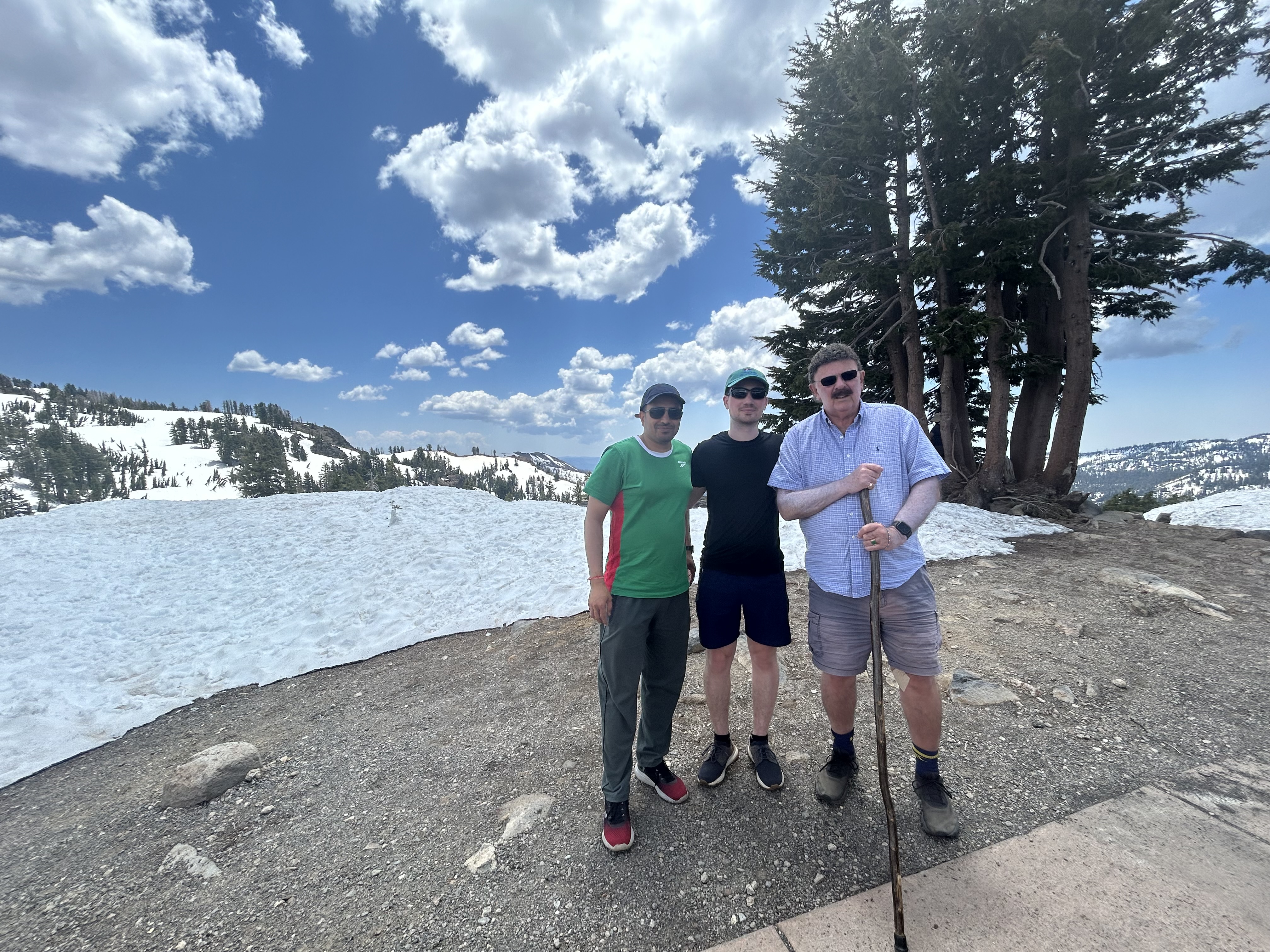 With David Cook and Prof Robert Ritchie in Lassen National Park, California. Photo: HaiYing Soon | Research: Structural Materials for Extreme Environments |
| PhD: Indian Institute of Science | |
| Postdoc: Nanyang Technological University, University of California, Berkeley | |
| Joined NTU MAE: September 2025 | |
| Off the clock: Poetry (he used to write in Hindi), cricket and tennis |
Coffee, tea or kopi-o kosong?
I’ve become a coffee person, but if masala chai is on offer, that wins every time!
Best thing you’ve eaten in Singapore so far?
Hard to pick just one! I like chicken xiao long bao from Din Tai Fung and country chicken biryani from Anjappar, and I’ve recently become a fan of biang biang chicken noodles from Koufu.
If you weren’t an engineer, you’d be…
I’ve wanted to be a scientist for as long as I can remember, so that’s a tough one! Perhaps I’d run a small organic farm. My grandfather used to bring home fresh vegetables and mangoes from our farm, and nothing has ever tasted better.
One book and one podcast you’d recommend
For a book, Surely You’re Joking, Mr. Feynman! by Richard Feynman. For a podcast, StarTalk with Neil deGrasse Tyson, especially the Cosmic Queries episodes.
The most extreme temperature you’ve personally experienced?
Probably around 45°C, cycling to tuition classes in the summer back in Bihar. Although I’ve burnt my hand a few times while cooking, so technically that might beat it!
You were at NTU before. What brought you back?
I first came to NTU as a postdoc in 2019 and stayed until 2021. Although much of that time was during COVID, I felt very safe in Singapore, and it was one of the most productive periods of my career. I also made some lifelong friends here.
When I was thinking about my next step after Berkeley, Singapore was naturally one of my first choices. Coming back felt familiar, both personally and professionally. What has surprised me most is how many talented new faculty members have joined NTU, and it feels like an exciting time to be here.
In simple terms, what is your research about?
I study how materials deform and break, and how we can make them more resistant to damage. This is especially important in extreme conditions, such as the intense heat inside a turbine or the large temperature changes experienced in aerospace applications.
In my group, we combine the design of new alloys with 3D printing and artificial intelligence to explore both what a material is made of and how it is manufactured. We then test how it behaves, particularly when it contains a crack. A material can be very strong but still break suddenly, so strength alone is not enough.
How did your earlier work lead to this Nature paper?
Our earlier study, published in Science in 2024, looked at how this alloy resisted fracture at high temperatures. The next question was what would happen at the other extreme, because many refractory alloys become very brittle at low temperatures.
To our surprise, its fracture resistance was similar at −253°C and −196°C. That led us to ask why, and understanding the combination of deformation mechanisms behind it became the basis of the Nature paper.
What particularly interested me was that we still saw kink bands at these very low temperatures. These are regions where the crystal bends or rotates as the material deforms. The alloy resisted a crack remarkably well even though its ductility, or ability to stretch, was limited, and that distinction is something I find fascinating.
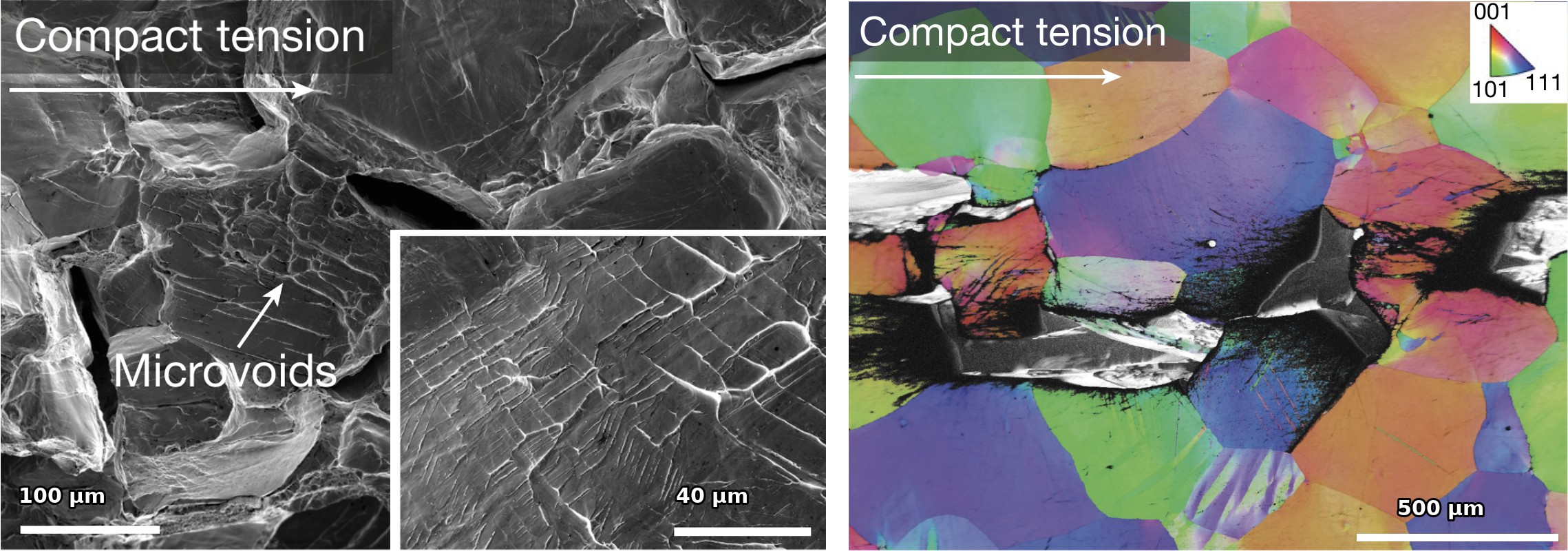 After being cracked at −253°C, the alloy shows fine bands of twinning in its crystal grains, one of the ways it holds together in extreme cold. Image adapted from Cook et al., Nature (2026), Fig. 2a,c, under CC BY 4.0.
How would you explain the main finding to a friend over kopi?
Some metals can handle tremendous heat but become brittle when they get very cold. We tested this alloy at −253°C, just 20 degrees above absolute zero, and found that it still resisted fracture remarkably well.
This material doesn’t stretch much before breaking, so you might expect a crack to grow easily through it. That wasn’t what we found. Defects form in the crystal near the crack, including kink bands, and these help the material deform locally and make it harder for the crack to grow.
That combination of heat resistance and resistance to cracking at very low temperatures could be useful in rocket engines, where some components face intense heat while others are exposed to extremely cold fuels. There’s still a lot to do before this alloy could be used in an engine, but the finding gives us ideas for designing materials that can handle those extremes.
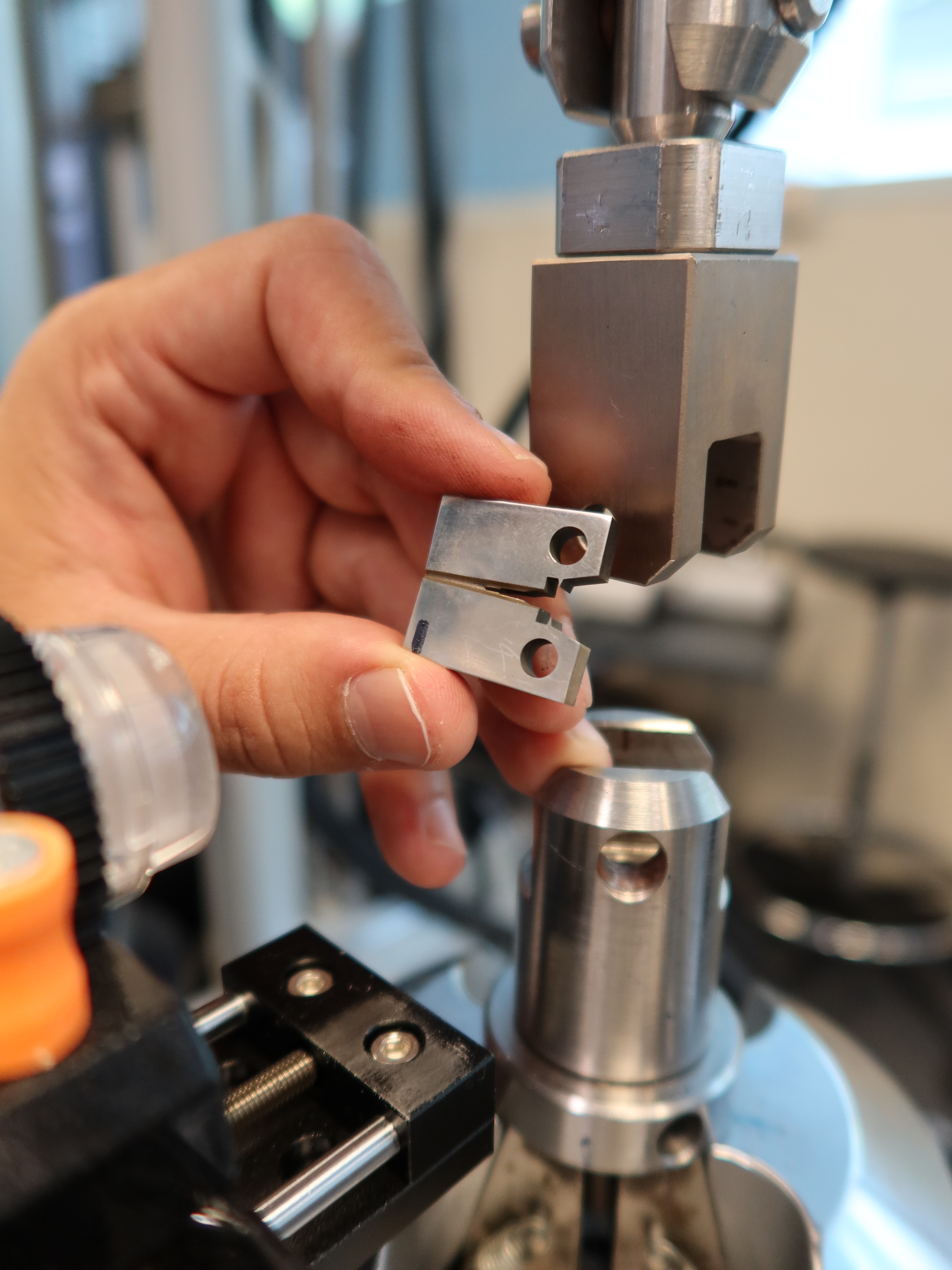 A test specimen after fracture testing. Photo: NTU
What do you remember most from running these experiments?
Our first fracture test on this alloy stands out. David and I started around 11am, thinking we would finish by lunch. The test kept going until four or five in the afternoon, so lunch never happened. When we finally saw the fracture resistance data, we couldn’t quite believe it, and we spent the next week checking and double-checking it.
The high-temperature tests brought a different set of problems. The pins we used to pull the specimen apart had to survive the same extreme conditions as the alloy, and they sometimes became stuck to the specimen or evaporated during testing. We ended up taking the whole fixture to the machinists after each test to have the pins cut out. They used to laugh when they saw the two of us coming, and by the end of the project we had become good friends.
For the low-temperature tests, we needed a container to hold a liquid-nitrogen bath. We bought two or three expensive polymer containers online, and one cracked during a test and spilled some liquid nitrogen. Eventually, we went to Target and cut down an ordinary plastic water container, which worked remarkably well. In our setup, the wall thickness mattered much more than we had expected. It was a good reminder that solving an experimental problem doesn’t always mean buying something more expensive.
What was it like working with David Cook and Prof Ritchie?
Working with David was wonderful. As a postdoc, you feel very lucky to work alongside a PhD student as brilliant as him. Rob’s experimental team was just the two of us, so we spent a lot of time together running tests. Some nights we were the last people to leave Building 62, and David even got a sofa bed so he could rest in the lab when sessions ran late.
I learnt so much from Rob about how materials fail. What stayed with me most was his curiosity. Despite everything he has achieved, including membership of both the US National Academy of Engineering and the National Academy of Sciences, he was always eager to hear about the next result.
Sometimes we would finish testing around 10pm, and Rob would be waiting for our call to find out what we had seen. After more than 50 years of research, he still had that excitement. I hope I can hold on to mine in the same way.
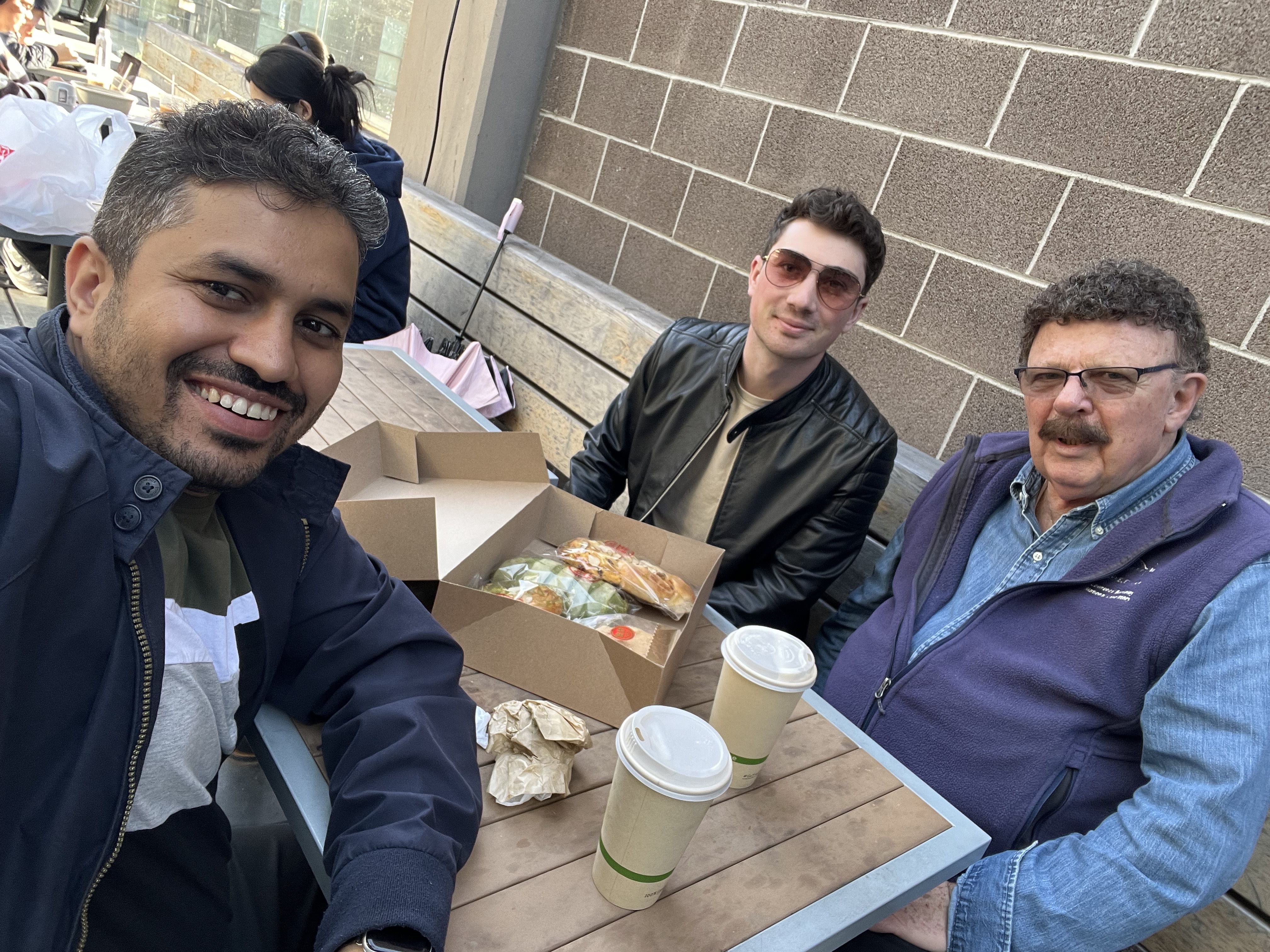 Asst Prof Kumar (left), David Cook and Prof Robert Ritchie celebrate their Science paper over coffee near UC Berkeley. Photo: Asst Prof Punit Kumar
“Punit was a postdoc in my group for several years and was spectacular in what he achieved, co-authoring Science and Nature papers and bringing 3D-printed alloys into our repertoire. He interacted especially well with my graduate student David Cook, and they were the most successful team that I have worked with for decades.
Punit wasn’t simply a great experimentalist and a first-rate researcher. Apart from flooding my lab a couple of times (!), he was also a wonderful writer, which is a rare trait among researchers these days. He is sorely missed here at Berkeley,” said Professor Robert Ritchie, UC Berkeley and Lawrence Berkeley National Laboratory.
Your Science study drew wide attention. Did any reaction surprise you?
Yes, a couple. One was seeing a news article on India Today about the work. I hadn’t expected it to get that kind of attention back home, so that was a lovely surprise.
The other was a LinkedIn message from the CTO of an aerospace company in the US. He asked who was making our samples, whether anyone was producing the alloy commercially and whether it could be 3D printed. He ended by saying, “Obviously you realise that industrial quantities of this metal alloy can usher in a new era in daily space transportation. So thank you for making history!”
We were focused on understanding why the material behaved the way it did, and he was already imagining what it could mean for space transportation. There is still a lot of work to do before it can be used in an actual component, but receiving a message like that was very encouraging.
Where do you see your research going at NTU?
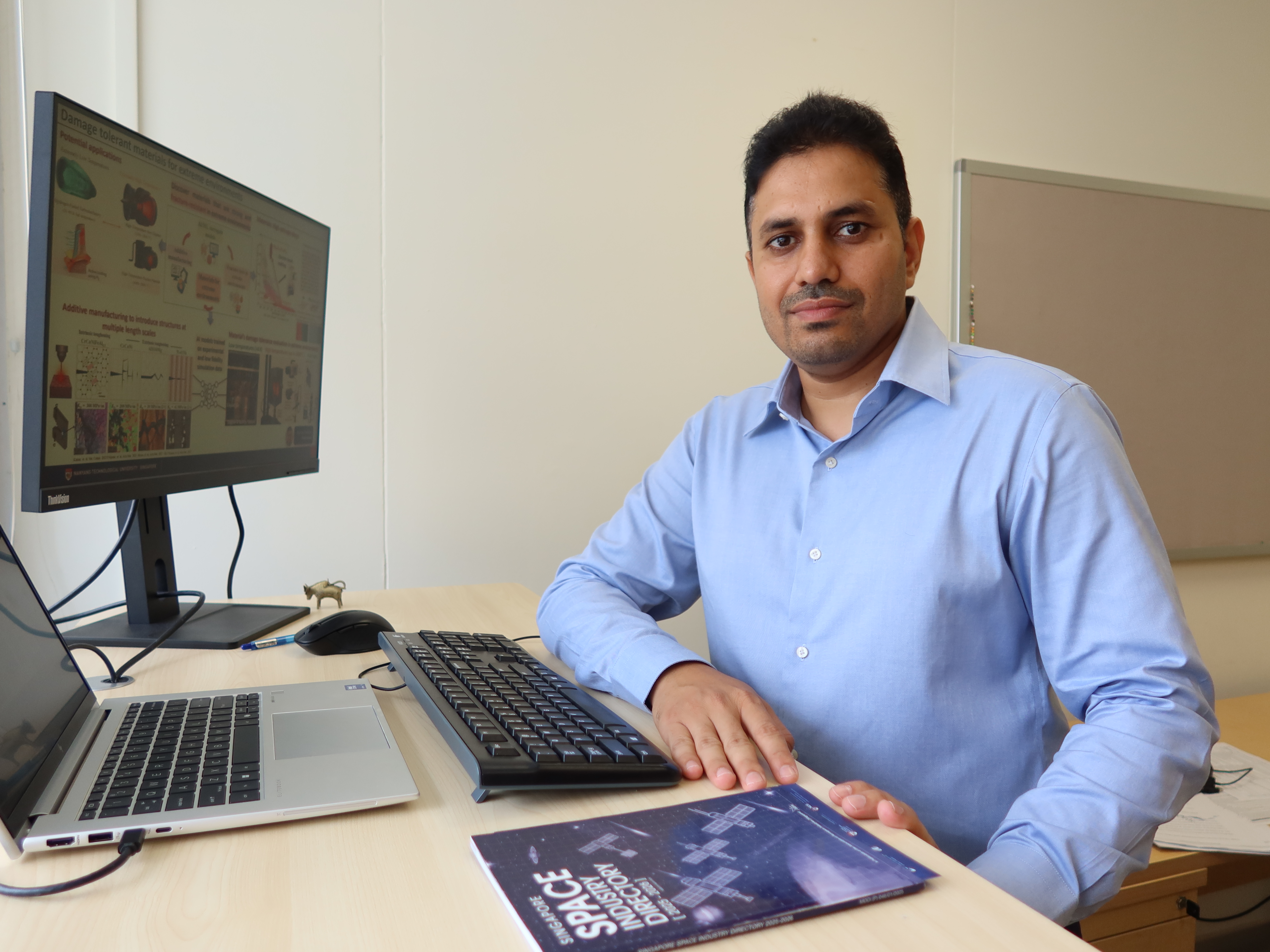 Asst Prof Kumar in his office at NTU. Photo: NTU
Kink bands also occur in materials as different as rocks and ice, which makes me curious about what we can learn from this mechanism. At NTU, I want to explore whether we can design less expensive alloys that use the same mechanism to resist fracture.
I also want to bring manufacturing, service performance and qualification into the alloy design process from the start. Often, when we select promising compositions and microstructures, we lack data on how they will perform under repeated loading or long exposure to extreme conditions. Those questions are addressed later, when finding a problem can mean delays and costly changes.
By generating these data faster through 3D printing, testing in extreme environments, multiscale simulations and AI, we can identify damage-tolerant materials earlier and shorten the development cycle. Ultimately, I want to develop materials that make aerospace, nuclear and other energy systems safer, more reliable and more efficient.
About the research
The research was published in Nature under the title “Competing mechanisms toughen bcc binary and medium-entropy alloys at 20 K.” It was principally supported by the US Department of Energy, Office of Science, Basic Energy Sciences, through the Damage-Tolerance in Structural Materials programme at Lawrence Berkeley National Laboratory. Asst Prof Kumar acknowledges support from the Nanyang Technological University Startup Grant. https://doi.org/10.1038/s41586-026-11065-7
The earlier related study was published in Science in 2024 under the title “Kink bands promote exceptional fracture resistance in a NbTaTiHf refractory medium-entropy alloy.” https://doi.org/10.1126/science.adn2428
About the researcher
Assistant Professor Punit Kumar joined Nanyang Technological University in September 2025 and holds an appointment in the School of Mechanical and Aerospace Engineering. He earned his PhD from the Indian Institute of Science, followed by postdoctoral work at NTU and at the University of California, Berkeley, and Lawrence Berkeley National Laboratory. His research focuses on structural materials for extreme environments, bringing together alloy design, additive manufacturing, fracture mechanics and AI. He is a recipient of the National Research Foundation Fellowship and was named in MIT Technology Review Asia Pacific’s 35 Innovators Under 35. Learn more about his lab.
By Karen Chai, NTU MAE Communications