How Nature’s Design Is Shaping Tougher Ceramics
NTU researchers have found that the structure inside a seashell can teach engineers how to build ceramics that resist cracking and remain stable at high temperatures, without relying on polymeric or glassy soft interlayers.
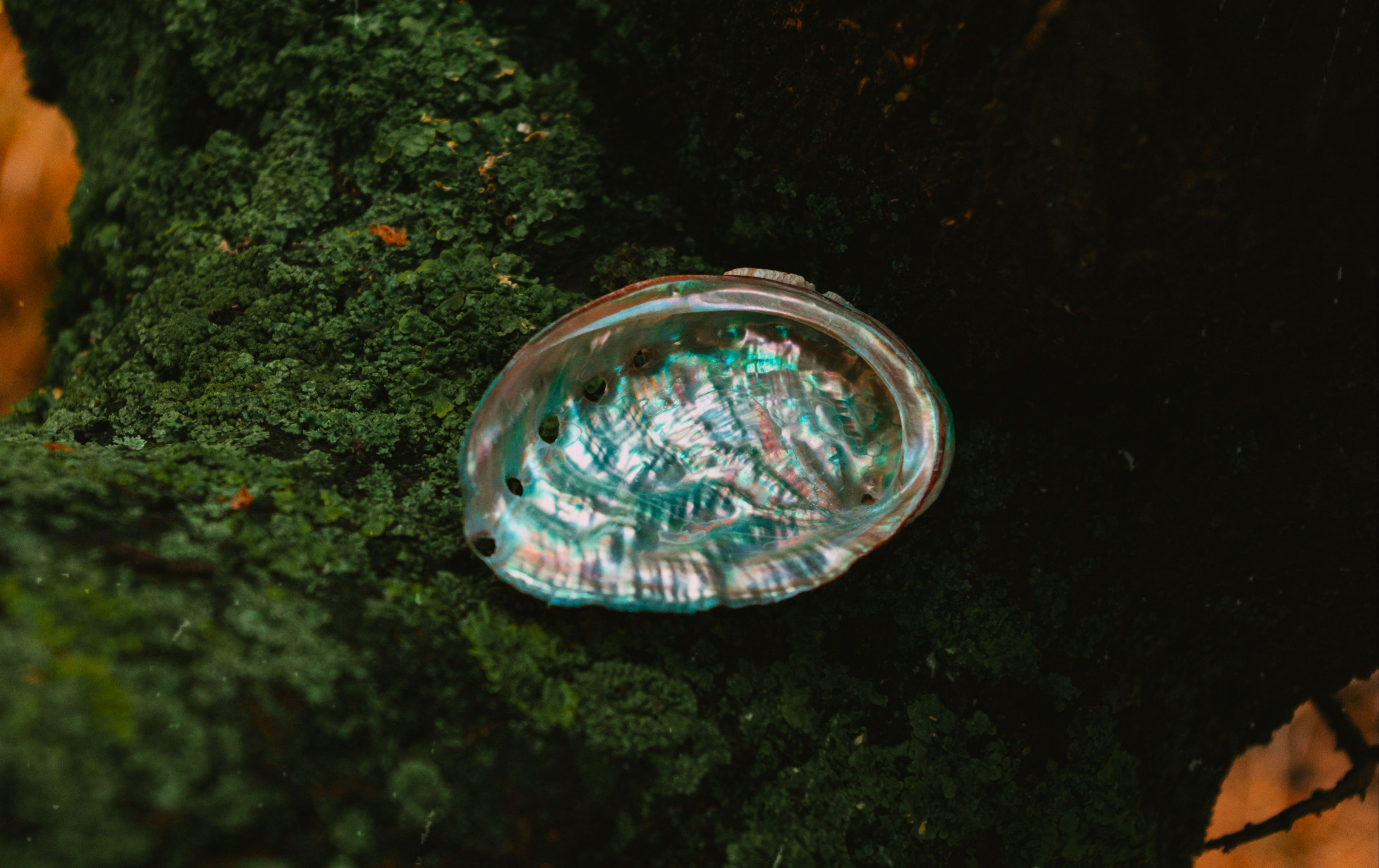 Nacre, the inner lining of an abalone shell, has inspired a new approach to designing tougher ceramics.
Photo: Dagmara Dombrovska / Pexels
Nature has long solved problems that engineers are still working on.
Elephant skin regulates heat without any mechanical system. Seashells resist cracking despite being made almost entirely of mineral. Bamboo bends under loads that would snap most rigid materials.
Engineers call this approach bioinspiration: learning from nature’s designs and adapting their underlying ideas to create better materials.
Associate Prof Hortense Le Ferrand has built her research around this principle. At NTU’s School of Mechanical and Aerospace Engineering, her group has developed building tiles inspired by elephant skin for thermal management, and sustainable composites drawn from fungal growth structures.
Her current work turns the same lens on ceramics.
A material with a known weakness
Ceramics are known to be strong and hard, but those same qualities also make them brittle.
The properties that allow ceramics to withstand heat and resist chemical damage also make them prone to cracking under load.
Once cracking begins, the material gives way quickly.
What nature does differently
Researchers had been looking to nature for a better way, and one of the most studied examples is nacre, the inner lining of an abalone shell.
Nacre is made mostly of minerals, yet it handles cracking far better than most man-made ceramics.
Its mineral platelets (bricks) are stacked in layers and held together by a soft interface that forces any crack to slow down and change direction rather than run straight through.
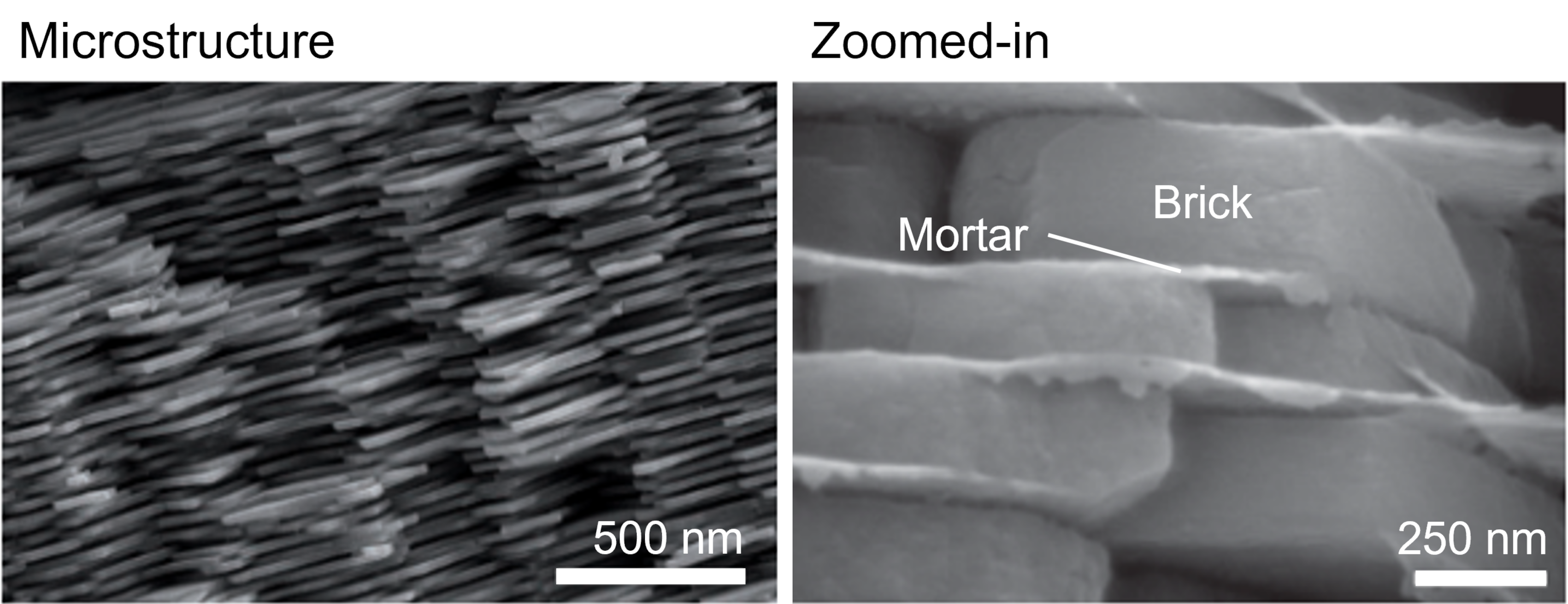 A microscope image of nacre showing its layered brick-and-mortar hierarchical structure (left) and a zoomed-in view (right), where thin mineral platelets (bricks) are held together by soft interfaces that redirect cracks. Source: https://doi.org/10.1038/nmat3915
For years, researchers borrowed from this design to make tougher ceramics, with promising results.
The soft interface helped manage cracks, but it could not survive high heat, or even moisture that is needed before it could be used safely for applications in adverse environments such as the human body implant.
Prof Le Ferrand and her group started asking whether that soft interface was strictly necessary at all.
The researchers behind the work
Leading the experimental work was Dr Rohit Pratyush Behera, first author of the study. He began the research during his PhD in Prof Le Ferrand’s group and continued developing it as a postdoctoral researcher at NTU.
“I was trying to solve a very old problem in structural ceramics,” Dr Behera says. “They are extremely strong, hard, and chemically inert, but once a crack starts, they usually fail suddenly.”
During his postdoctoral work at NTU, Dr Behera proposed using zirconia specifically at the interfaces between the alumina microplatelets. Working with Prof Le Ferrand, he developed this idea into the fully ceramic structure studied in the paper.
Natural nacre also contains tiny mineral connectors between its microplatelets or bricks, called nanobridges, which most research had treated as a secondary detail in controlling crack path.
Prof Le Ferrand’s team went a step further by asking how their width and how much of the interface they covered could be used to control the path of a crack without relying on a soft layer.
“We believed we can still have the mechanisms that make nacre tough,” Prof Le Ferrand says, referring to the way cracks are forced to follow a longer, more energy-consuming path through the material. “Carefully designed mineral bridges make this possible.”
What kept Dr Behera on the project through his PhD and into a postdoc was the possibility of changing failure behaviour from inside the material itself, not by adding a soft layer, but by designing the mineral bridges so that cracks are forced to slow down and change direction before the material fails.
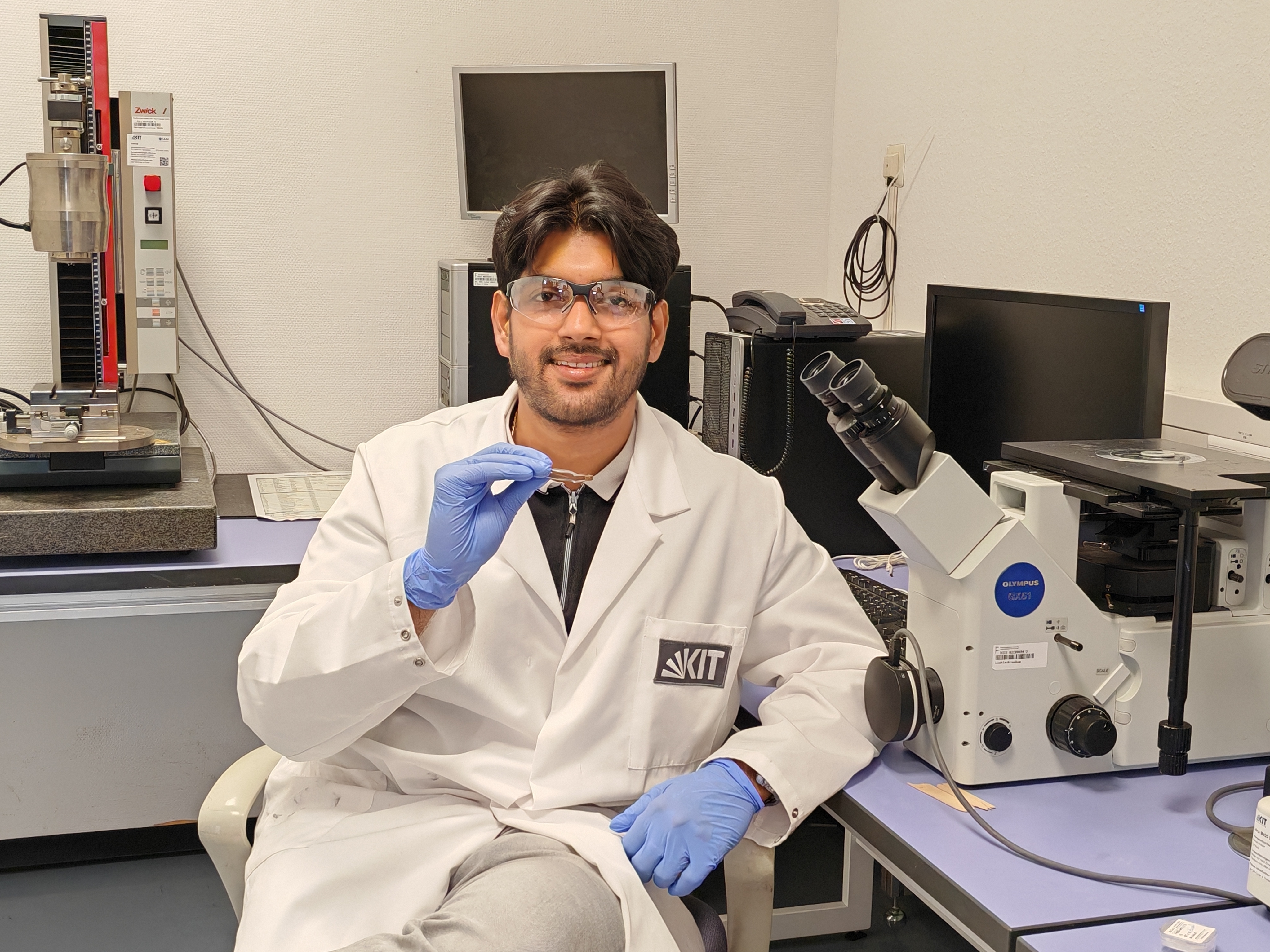 Dr Rohit Pratyush Behera, first author and lead researcher on the study. He is now a postdoctoral research associate at the Karlsruhe Institute of Technology (KIT) in Germany, where he continues his work on bioinspired designs for toughening ceramics.
Programming how a ceramic cracks
The team found that two variables were especially important in governing how a crack moved through the material: how much of the interface between platelets was covered by mineral bridges, and how wide each bridge was.
Too few bridges and the platelets separated too easily, with cracks moving along the interface without much resistance.
Too many and the interface locked up, pushing cracks straight through the ceramic rather than along it.
Prof Le Ferrand describes the balance in plain terms. “If the connection is too loose, it opens too easily. If it is completely fused, it may tear suddenly. But if it is connected in a controlled way, it can resist opening while absorbing energy step by step.”
The team mapped this relationship as a design tool: a guide that tells researchers which combination of bridge coverage and width produces the most controlled crack behaviour.
“It felt like the material was finally telling us the rule behind its behaviour,” Dr Behera says. “That was when the design map became more than a theoretical figure.”
 The design map developed by the team links nanobridge coverage and width to crack behaviour, identifying a mixed-mode window where toughness peaks.
Building it in the lab
The fabrication process is called magnetically assisted slip casting.
Tiny ceramic platelets, coated to respond to magnetic field, are suspended in a liquid mixture and poured into a mould while a rotating field aligns them. As the liquid drains away, the structure locks into place before being fired at high temperature.
The process takes time to learn. Slurry consistency, drying rate, and how gently the mould is handled all affect the final result.
Early samples cracked during drying, warped, or showed misaligned layers under the microscope.
“Getting this material to work was less like following a recipe and more like learning a language,” Dr Behera says. “Over time, the slurry, the green body, the sintered sample, and even the fracture surface started giving clues. The work was about listening to those clues carefully enough to know what to change next.”
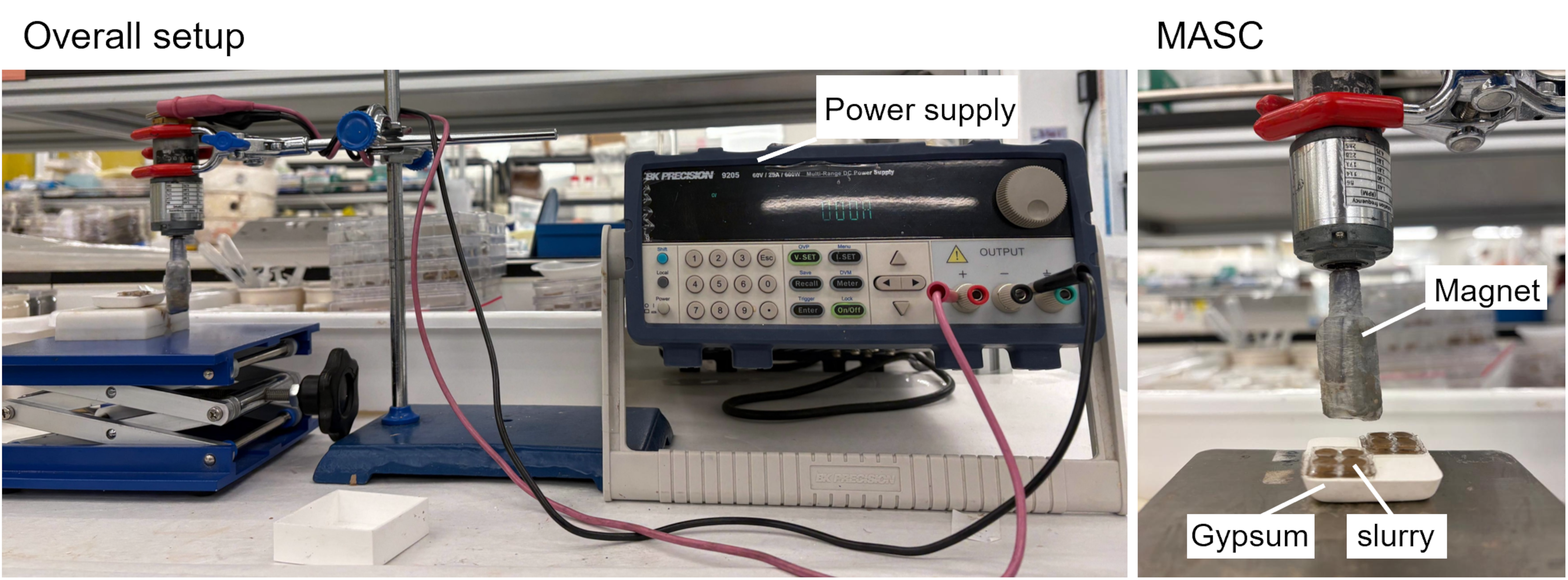 The magnetically assisted slip casting process uses a rotating magnetic field to align ceramic platelets during casting, allowing precise control of the internal microstructure.
What the material can do
The optimised material reached a fracture toughness of 13.9 MPa m0.5, roughly twice that of natural nacre and more than twice that of dental zirconia used in current implants.
The material remained mechanically stable in tests up to 500 degrees Celsius and showed limited changes in shape even when heated to 1,300 degrees Celsius.
It also dissipated more vibration energy than most dense ceramics. The researchers attribute this mainly to tiny frictional movements where the zirconia bridges meet the alumina platelets, rather than to any added soft material.
In laboratory tests, cells involved in bone formation attached to and multiplied on the ceramic over seven days, without any added polymer coating. This is an encouraging early sign that the material is compatible with cells, although further biological and clinical testing would be needed before any medical use.
The zirconia bridges also provided a smaller, additional toughening effect. Near a crack, some of the zirconia changed its crystal structure under stress, helping to shield the crack tip and making it harder for the crack to spread.
The combination was not fully expected.
“I expected the interface design to improve toughness,” Dr Behera says, “but I did not initially expect the same structure to also show such clear damping and stability. The interface was doing more than one job.”
Proving the concept: the shape of a tooth
To test whether the design could be translated into a complex shape, the team formed the ceramic into a tooth-like construct using a mould based on a human molar.
A tooth was a natural proof of concept. It is a structure that already solves the same engineering problem: the outer enamel is stiff and hard to resist surface contact, while the inner dentin is tougher and more energy-absorbing to prevent cracks from spreading.
Using the same ceramic ingredients, but arranging their internal microstructure differently in each region, the team created a gradual change in mechanical properties inspired by the contrast between enamel and dentin in human tooth.
“Most of the work before that point was microscopic,” Dr Behera says. “So when the material finally took the shape of a tooth and still retained the internal architecture, it felt like the project had crossed an important line. It was no longer only a set of bars tested in the lab; it had become a real, recognisable object.”
The construct is not only a dental implant. It is also a demonstration that the design principle can be translated into a complex, application-relevant shape.
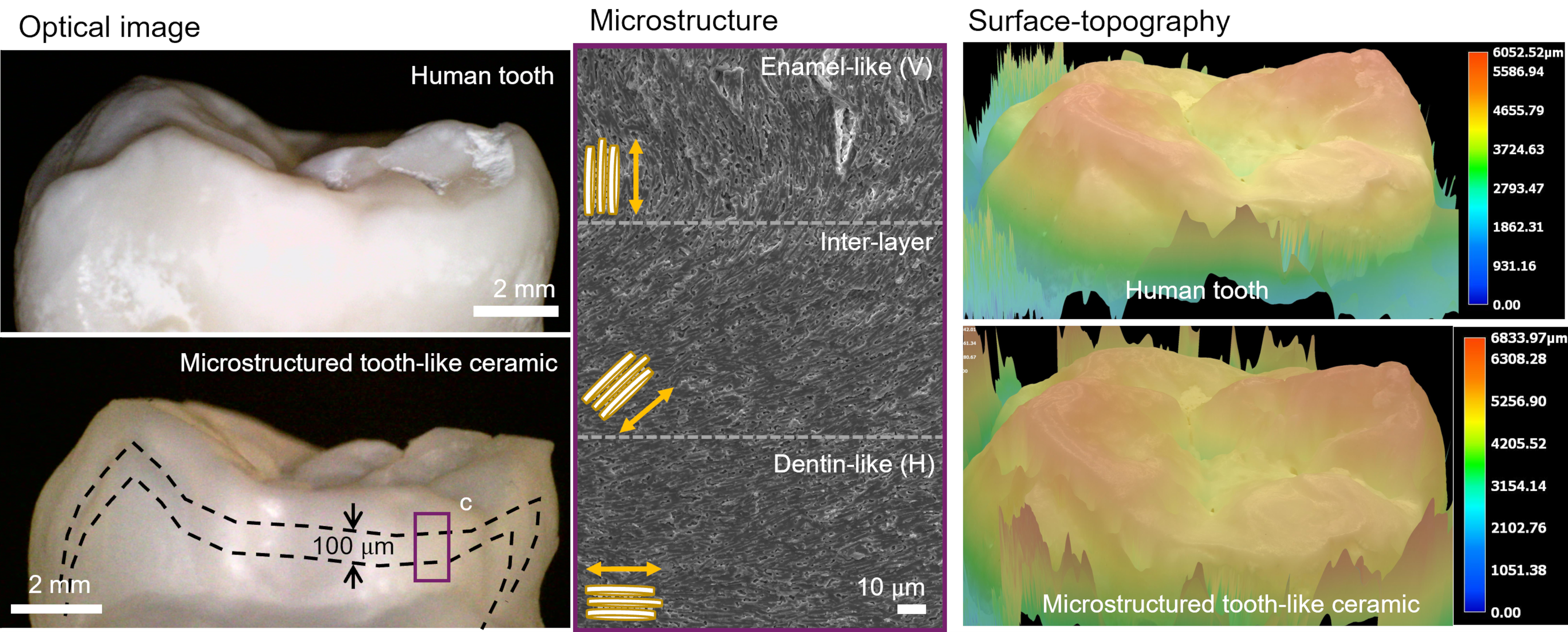 The tooth-shaped ceramic construct creates an enamel–dentin-inspired change in mechanical properties, demonstrating that the team’s design framework can be applied to a complex shape.
A framework other researchers can use
The design map developed by the team is not limited to the materials used in this study.
Any research group working with platelet-based or layered brittle ceramics can apply the same logic and design approach to a different material system, tuning bridge coverage and width to programme crack behaviour rather than relying on trial and error.
“The project had moved beyond making a beautiful bioinspired structure,” Dr Behera says. “We were beginning to understand how to program the way a ceramic fails.”
For Prof Le Ferrand, the work is still continuing. “We are still working on the concept,” she says, “and have an even more high-performing material under cooking.”
The research was published in Advanced Functional Materials under the title “Fracture-mechanics design of mineral-bridged interfaces enables damage-tolerant, high-temperature bioinspired ceramics” and was supported by the Ministry of Education of Singapore under award T2EP50122-0021.
About the researchers
| Associate Professor Hortense Le Ferrand holds a joint appointment in the School of Mechanical and Aerospace Engineering and the School of Materials Science and Engineering at NTU Singapore. Her research group develops bioinspired and sustainable materials, drawing on structural principles found in natural systems to engineer high-performance composites and ceramics. |  |
| Dr Rohit Pratyush Behera completed his PhD at NTU in 2023, stayed on as a postdoctoral research fellow to continue developing the work, and has since moved to the Karlsruhe Institute of Technology (KIT) in Germany, where he is currently a postdoctoral research associate continuing to follow design principles from nature and add more mechanisms for toughening ceramics. |  |
| Dr Zezhou He was a researcher in Prof Le Ferrand’s group at NTU, where his work focused on interfaces in bioinspired ceramics and composites. He contributed to the computational and analytical aspects of the study. |  |
| Professor Huajian Gao is a Xinghua Distinguished University Professor and Director of the Mechano-X Institute at Tsinghua University, China. A leading figure in applied mechanics, his research centres on the mechanical properties and behaviours of materials in both engineering and biological systems. He is a fellow of the Royal Society and a member of the National Academy of Sciences and National Academy of Engineering in the United States. |  |
References
R. P. Behera, Z. He, C. Y. Chia, H. Gao, and H. Le Ferrand, “ Fracture-Mechanics Design of Mineral-Bridged Interfaces Enables Damage-Tolerant, High-Temperature Bioinspired Ceramics.” Advanced Functional Materials (2026): e75738. https://doi.org/10.1002/adfm.75738
Bouville, F., Maire, E., Meille, S. et al. Strong, tough and stiff bioinspired ceramics from brittle constituents. Nature Materials 13, 508–514 (2014). https://doi.org/10.1038/nmat3915
By Karen Chai, NTU MAE Communications