A Robot That Learns Its Own Behaviour
NTU researchers have developed a single stiffness-based, data-driven control method that a soft robot learns from its own movement, then applies across four different tasks and transfers to a mechanically different robot.
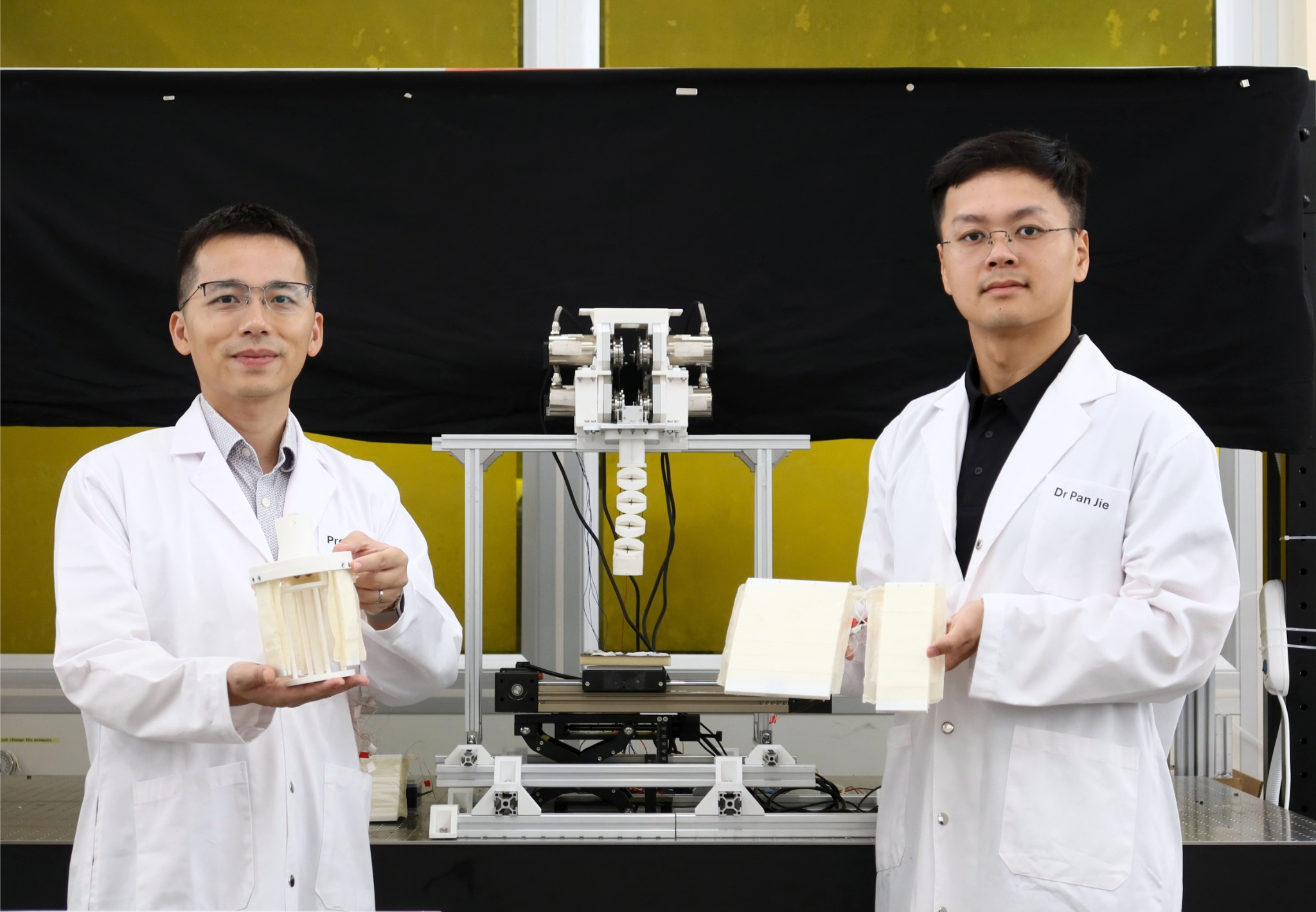 Associate Professor Wang Yifan (left) and Dr Pan Jie (right) with the antagonistic soft robot developed at NTU MAE.
Soft robots have come a long way. Built from flexible, compliant materials rather than rigid metal, they are already being developed as surgical tools that bend through the body, wearable gloves that help a weak hand grip, and grippers that handle delicate or irregular objects a rigid machine would damage.
Their appeal is that they are gentle and adaptable. They can bend around what they touch and work safely alongside people.
However, that same flexibility makes them hard to control. A soft robot can be difficult to move precisely, and it may sag or lose its shape under load.
The deeper problem is how such a robot is controlled in the first place. Usually, an engineer has to study a specific robot in detail and hand-build a control system for it. Change the robot, and much of that work starts again.
A team at NTU has taken a different route. Instead of being programmed by hand, the robot learns how it moves on its own, from a few minutes of its own motion. The same method can then be carried from one robot to another, rather than being rebuilt each time.
How opposing muscles inspired the design
To be useful, a soft robot needs to be soft at some moments and firm at others. One design makes this possible, and it is borrowed from the body.
In your arm, muscles work in opposing pairs. Your biceps and triceps pull against each other. Tense one and your arm bends. Tense both together and your arm stiffens and holds steady, even though it has not moved.
A soft robot can be built the same way, with two opposing parts that work against each other. This is called antagonistic actuation.
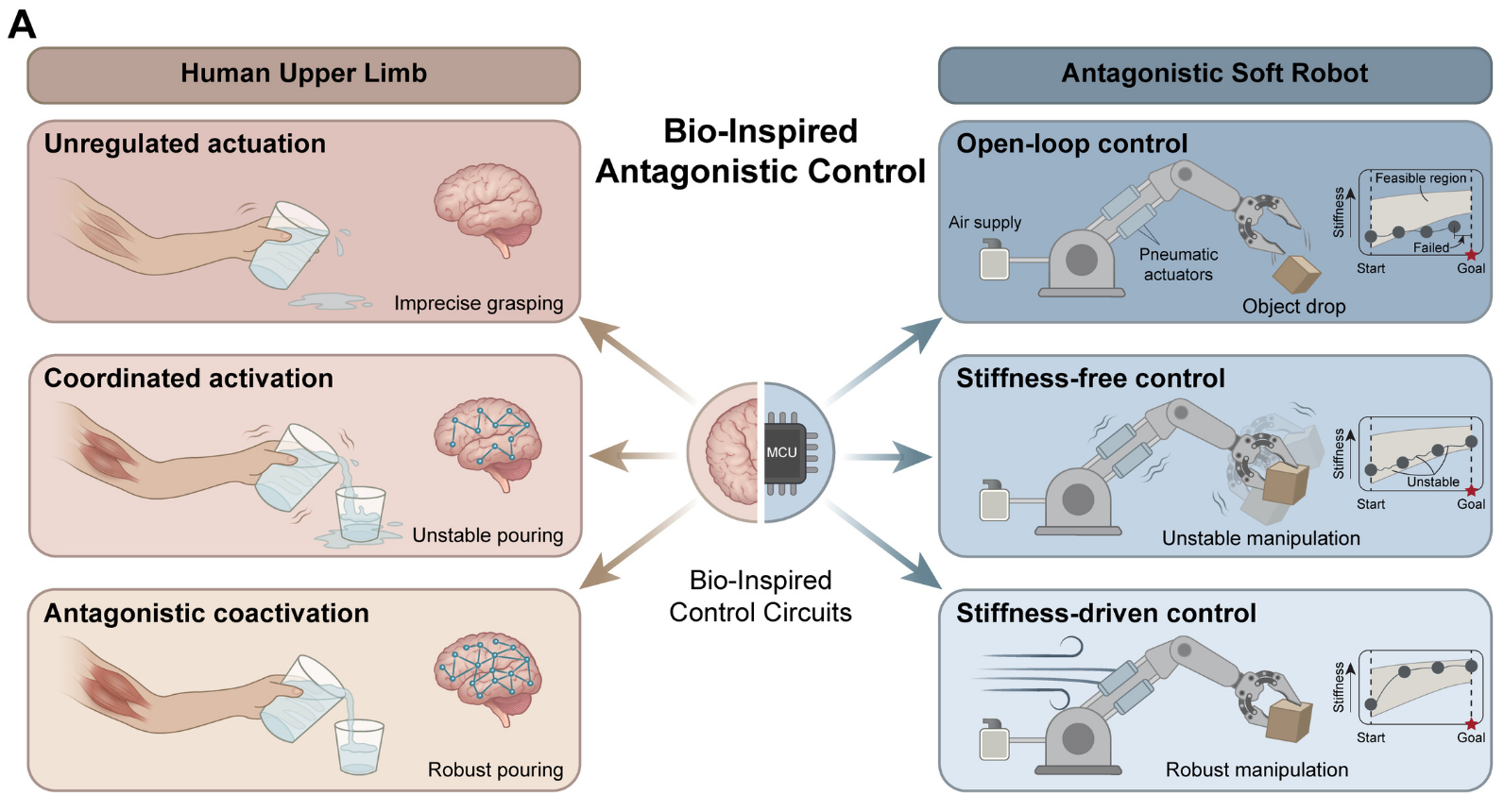 How antagonistic actuation works: driving the two sides against each other controls where the robot bends, while driving both together controls how stiff it is, letting the robot set its position and its stiffness independently.
It gives the robot two independent controls. Driving one side against the other sets where the robot bends. Driving both sides together sets how stiff it is. The robot can hold the same shape softly or firmly, depending on what the task needs.
This is what makes the design powerful. But it also makes the robot hard to control, because the system now has to manage movement and stiffness at the same time.
To do that accurately, engineers have usually had to take one of two demanding routes. They could build a detailed mathematical model of exactly how that one robot bends and flexes, which is slow and painstaking for something soft. Or they could fit it with sensors that constantly measure how stiff it is as it moves, which is hard to do reliably.
Both share the same weakness. They are built for one specific robot. Change the design, and the work largely starts again.
“Hand-built models are closely tied to a robot’s geometry, materials and actuation mechanism,” said Dr Pan Jie, a Research Fellow at NTU’s School of Mechanical and Aerospace Engineering (MAE) and co-first author of the study. “Even small changes can alter the robot’s behaviour, requiring the model and controller to be rebuilt.”
Letting the robot learn itself
A team at NTU MAE, led by Associate Professor Wang Yifan, took a different approach. Instead of handing the robot a model of how it works, they let the robot learn how it moves on its own.
The robot is put through a few minutes of simple movements. As it moves, it records how each of its actions changes its shape. From this, it works out its own behaviour, without anyone building a model for it by hand.
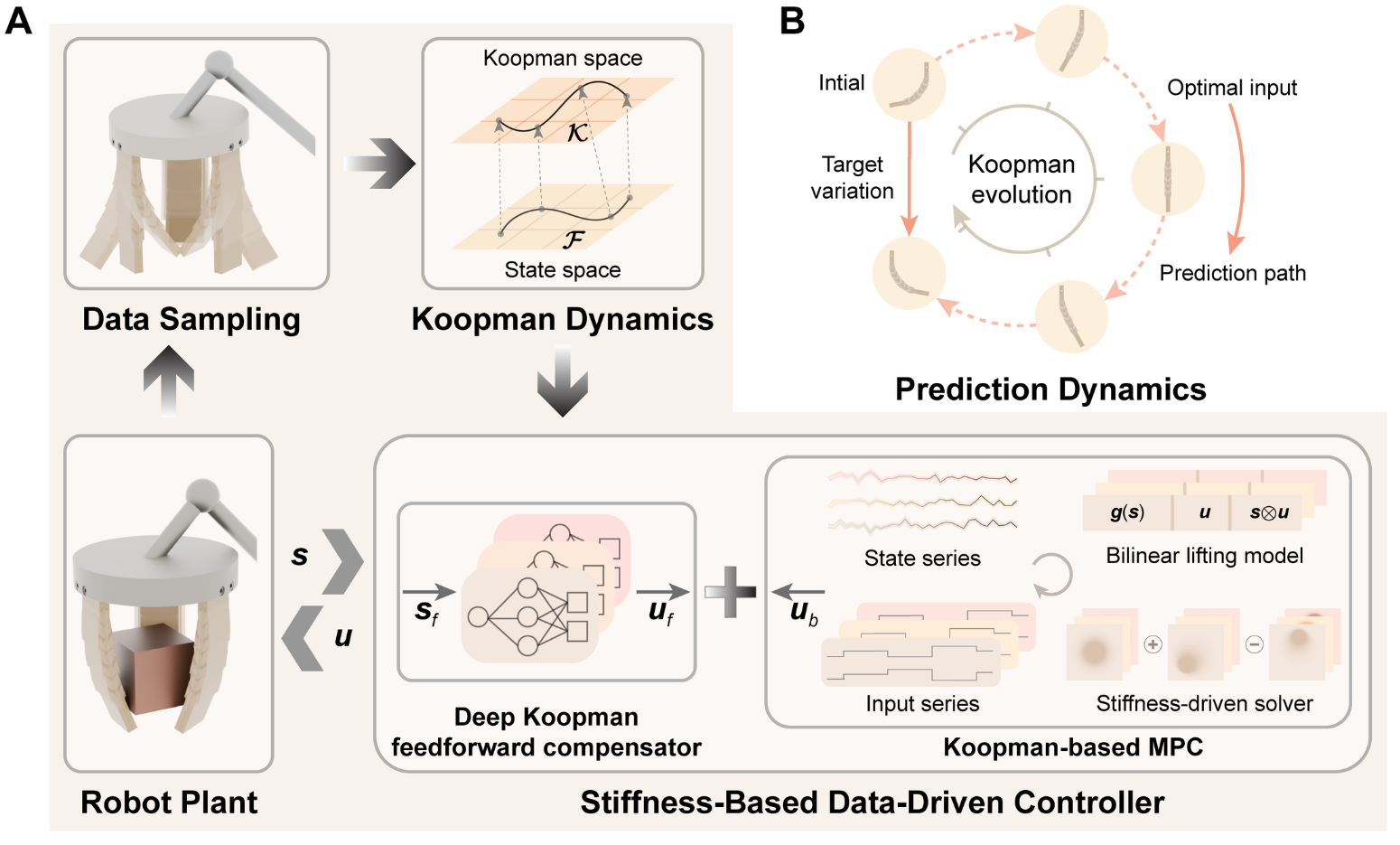 The robot learns how it moves from a few minutes of its own motion, and uses this to control both its position and its stiffness.
The whole process takes under eight minutes. The result is a controller that can guide the robot accurately, and that was learned rather than hand-crafted.
Just as importantly, the same method can regulate the robot’s stiffness. Drawing on the muscle concept, the controller does not only decide where the robot should bend. It also decides how firm the robot should be when it gets there.
“Bending determines where the robot goes; stiffness determines what it can do when it gets there,” Dr Pan explained.
That single ability, controlling shape and firmness together, turns out to be surprisingly powerful.
One robot, many jobs
To show how far the idea could stretch, the team gave the same self-taught robot four very different jobs. It was not rebuilt or reprogrammed for each one. It was simply given a new goal.
As a gripper, it could pinch a soft silicone ring without squashing it, then firm up to lift a hard object securely. The same hand could be gentle or strong, depending on what it held.
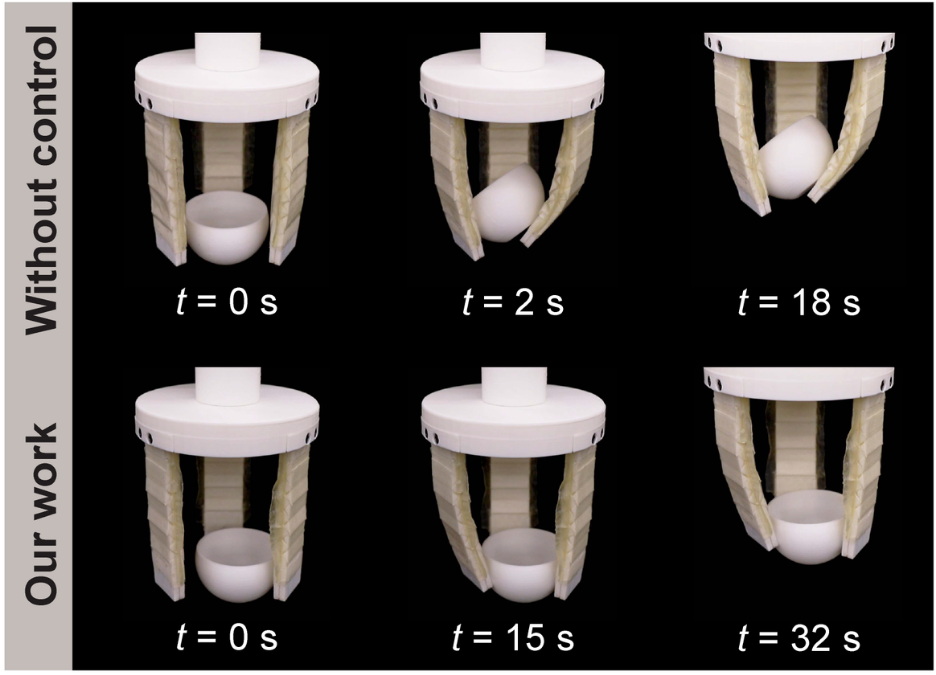 As a gripper, the robot lifts a light, delicate object without tipping it over.
As a sensor, it could feel how soft an object was by pressing against it and noticing how much it had to give way, then sort objects from soft to hard.
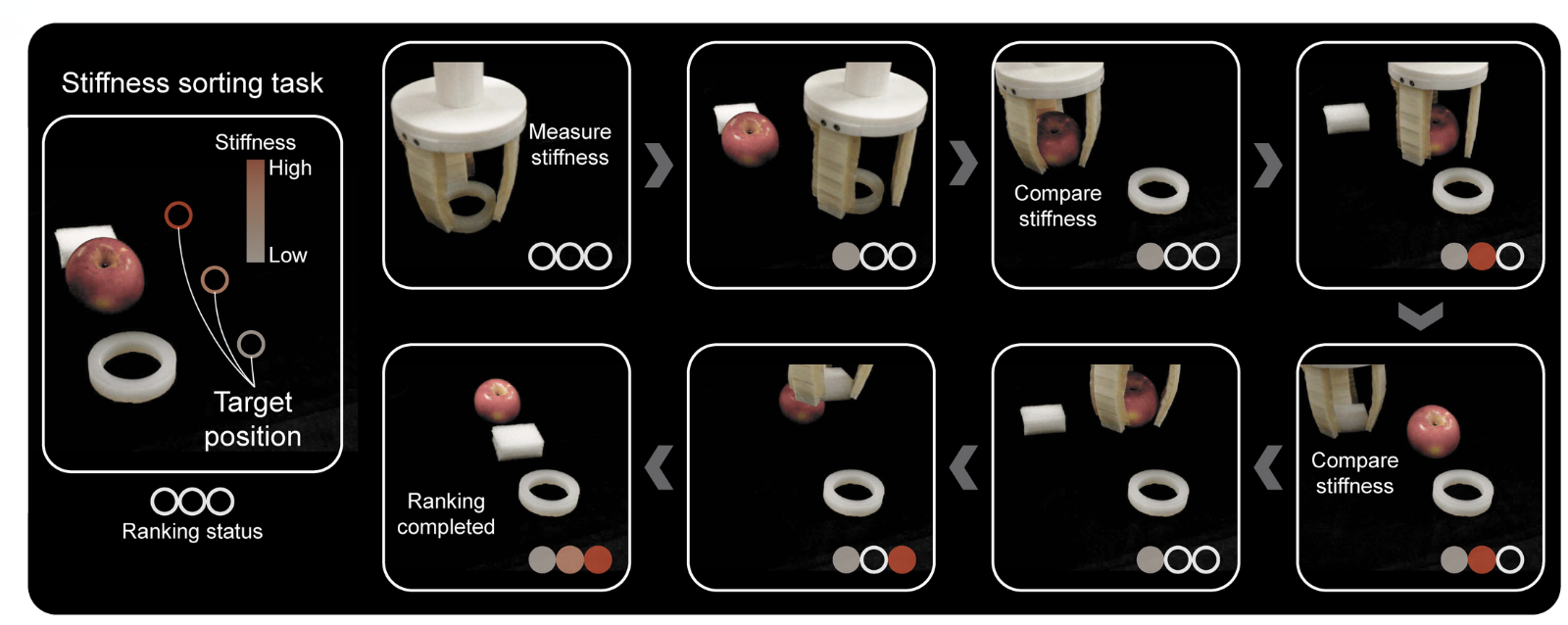 As a sensor, the robot feels how soft each object is and sorts them from soft to hard.
As a pump, it could scoop up liquid and lift it upwards against gravity, something it could not do without careful control.
Lastly, in the most demanding test, two of the robots formed a bridge. They stayed flat and firm enough for a toy car to drive across, then arched upward to let a boat pass beneath, before flattening again.
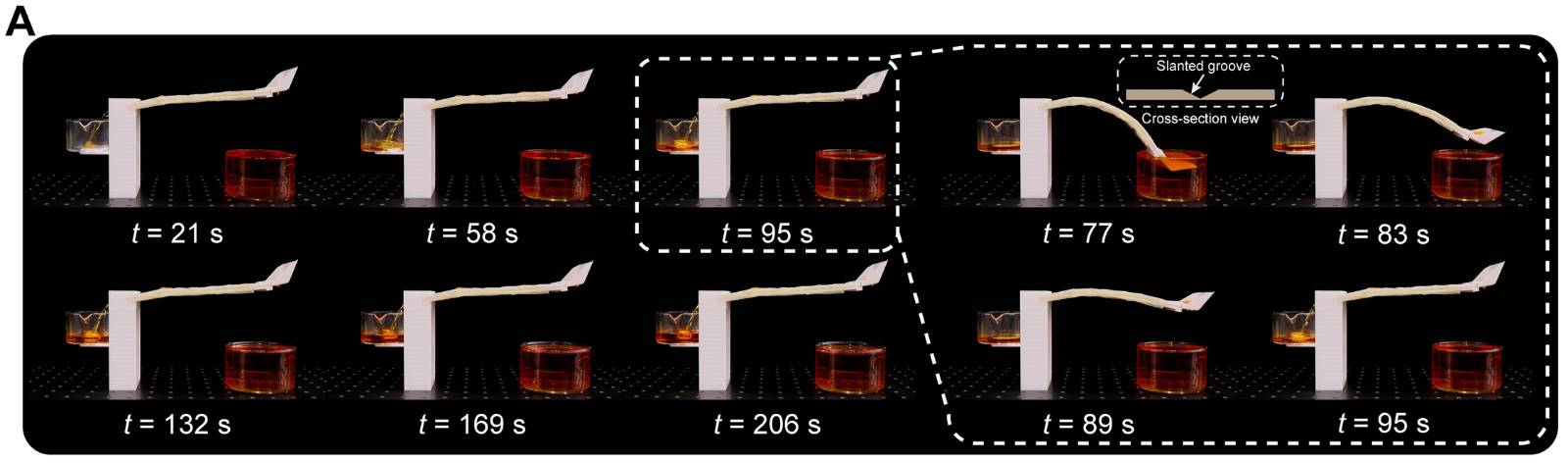
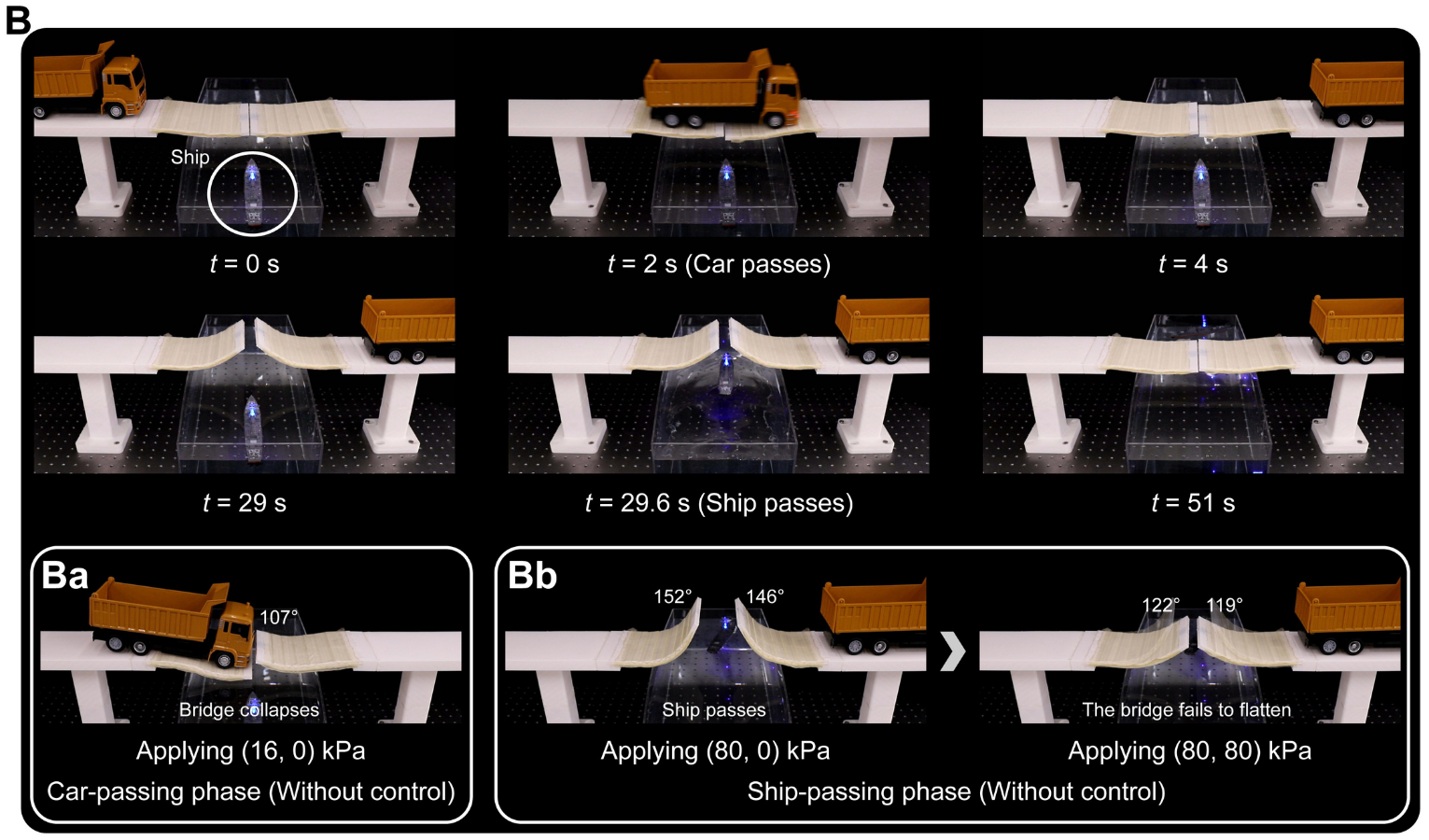 (A) Liquid pump: A slanted groove introduced into the robot enables liquid transport against gravity.
(B) Reconfigurable bridge: Two antagonistic soft robots form an adaptive bridge.
“The reconfigurable bridge was especially striking,” said Dr Pan. “Without proper control, the bridge either sagged under the car or failed to return to a usable flat state.”
The bridge made the point clearly. Simply changing shape is not enough. To hold a load, reshape, and hold again, a robot has to manage its movement and its firmness at the same time.
The real test: a completely different robot
The four jobs were impressive, but they shared one thing. They all used the same kind of robot, one driven by air.
The team wanted to know whether their method was tied to that particular design, or whether it was something more general.
To find out, they tried it on a completely different machine: a robot moved by pulling cables, more like tendons than air-filled chambers.
It worked. The method did need some adjusting for the new design, but the core idea carried over. The cable-driven robot could be controlled accurately too, and it held up even under added weight and when pushed through thick silicone oil.
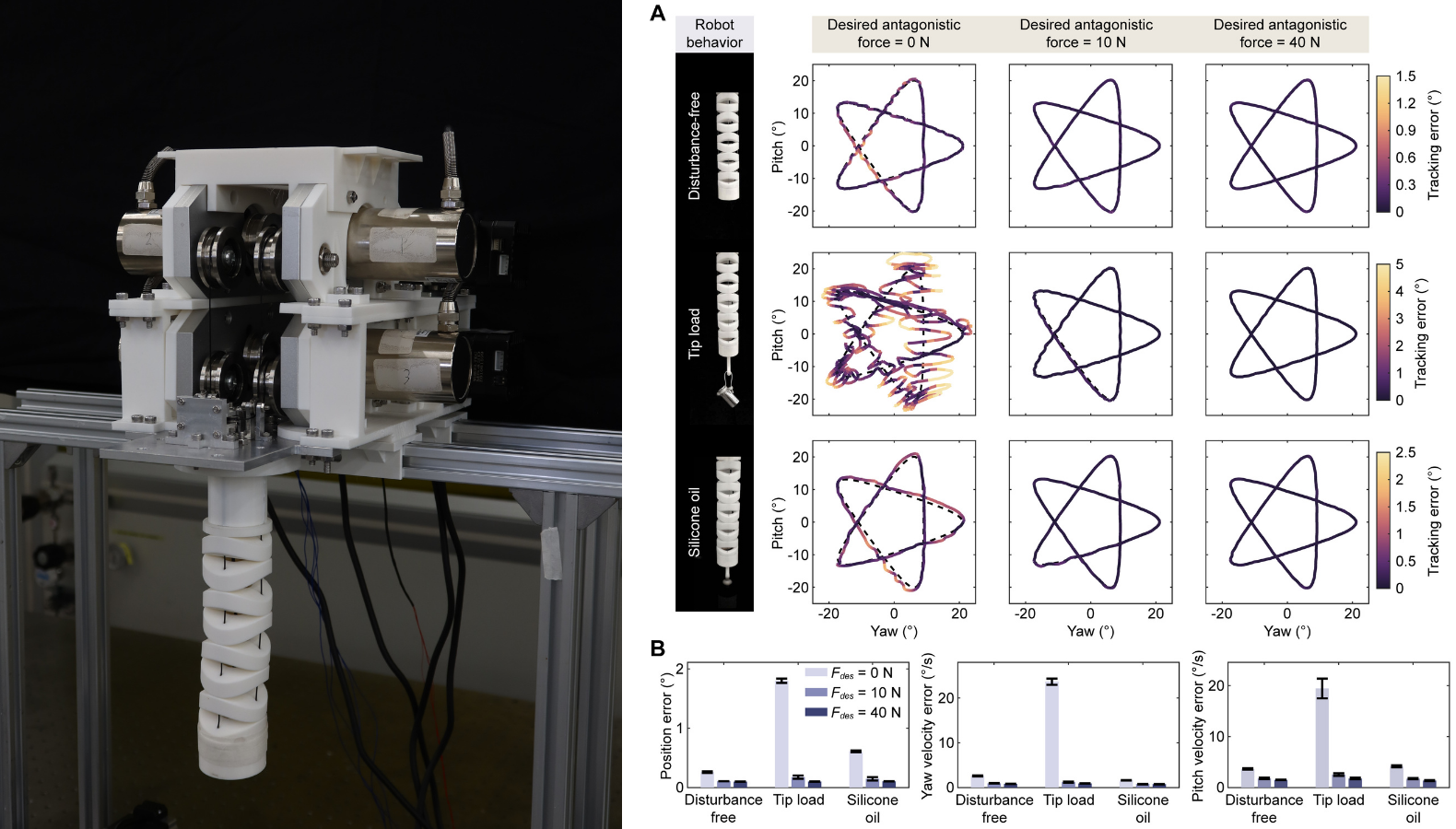 The same control method applied to a very different robot, one moved by pulling cables rather than air. It kept the robot on track even under added weight and in thick silicone oil, showing the approach is not tied to a single robot design.
“Applying the framework there showed that the central idea is not tied to one type of robot,” said Dr Pan.
Demonstrating the method on a mechanically different robot is important because it shows the approach is not tied to one design. A method that works on a single robot could be a one-off; showing it on two robots that work in different ways is evidence that it can transfer more broadly.
Why it matters
Today, controlling an antagonistic soft robot usually means building a new control system for each design, so the effort rarely carries over from one robot to the next. Because the NTU team's robot learns from its own movement, the same method can move with it to the next machine.
That points to a wider shift. Rather than each robot depending on a control system built by hand, robots could learn their own behaviour and carry that ability across different tasks and designs, adapting as they go.
It would make soft robots easier to build and quicker to adjust to the changing, real-world settings where they are most useful, from the operating room to the home.
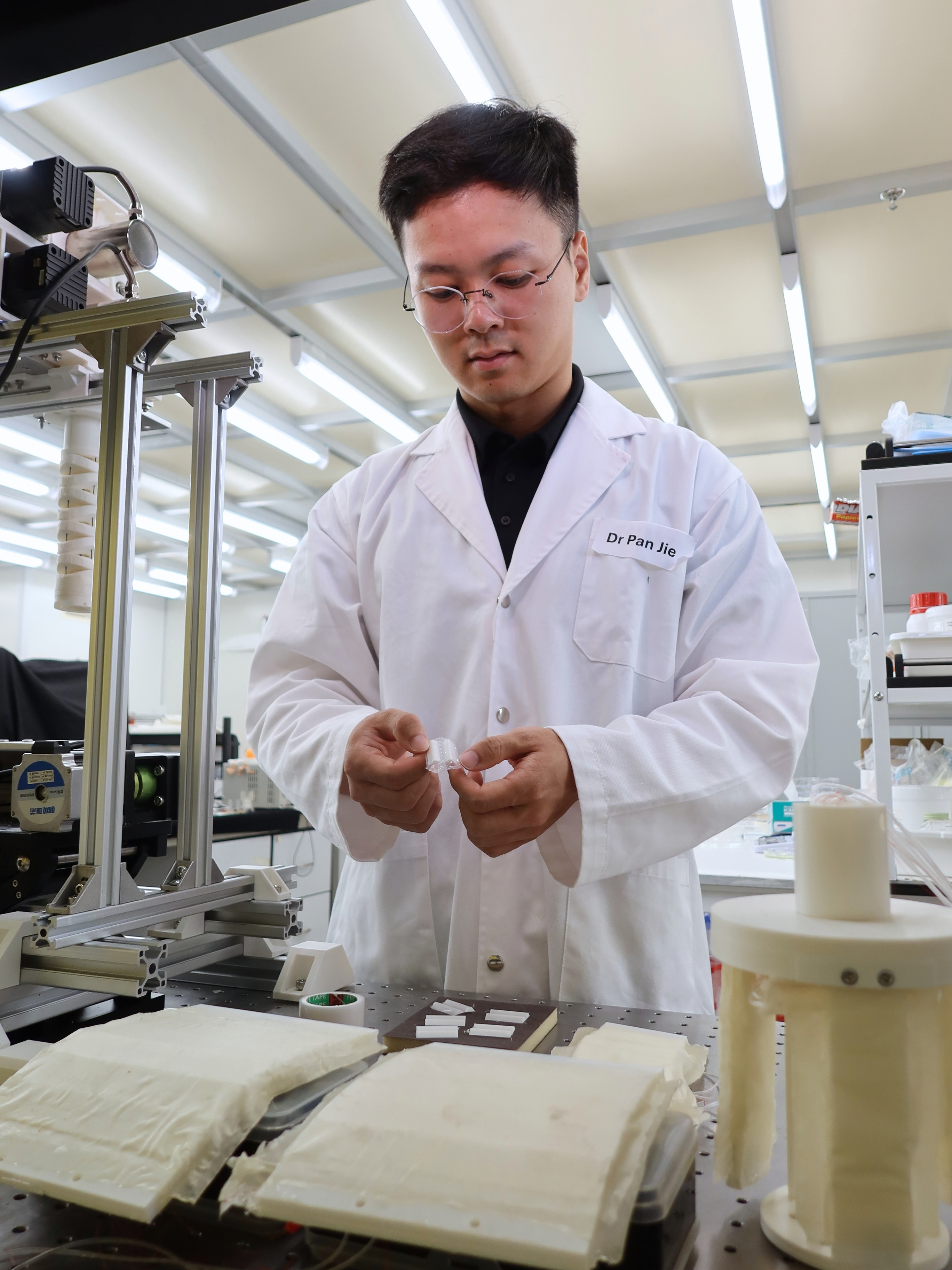 Dr Pan inspecting the 3D-printed parts that form the robot's gripper fingers. Their layered, scale-like surfaces let each finger bend and stiffen on demand.
For Dr Pan, the deeper change is in how we think about stiffness. A robot no longer has to be either soft or firm by design.
Now it can decide, moment to moment, to be gentle when gentleness is needed and firm when the task calls for it.
"The most important change is to treat stiffness as an active part of intelligence, rather than a fixed mechanical property," he said.
About the research
The research was published in Science Advances under the title “Muscle coactivation-inspired stiffness-driven control strategy for antagonistic soft robots” and was supported by the Ministry of Education of Singapore under awards MOE-T2EP50123-0015 (Tier 2) and RG146/24 (Tier 1).
About the researchers
Associate Professor Wang Yifan is the Principal Investigator of the Robotic Materials Group in the School of Mechanical and Aerospace Engineering at NTU. His research spans human–robot interaction, assistive and wearable robotics, intelligent robotic materials and structures, and bioinspired intelligence and control. By integrating sensing, learning, control and physical design, his group develops embodied, human-centred robotic systems that can adapt to people and changing environments. He received his PhD from the University of Chicago and conducted postdoctoral research at Caltech before joining NTU. |  |
Dr Pan Jie is a Research Fellow in the School of Mechanical and Aerospace Engineering at NTU Singapore. He received his PhD from Peking University, China. His research focuses on data-driven modelling and control of bioinspired, underwater and soft robots. He co-led the project, methodology, experiments, software development, data analysis and manuscript preparation for this study. |  |
Dr Chen Tianyu completed his PhD in Mechanical Engineering at NTU in 2025 and has since moved to the Bristol Robotics Laboratory at the University of Bristol, UK, where he is a research associate. His research focuses on the computational design, modelling and fabrication of soft robotic structures with programmable shape and stiffness. He co-led the project, methodology, experiments, data analysis and manuscript preparation for this study. |  |
By Kendra Kee and Karen Chai, NTU MAE Communications