
MASTER OF ARTS IN DIGITAL HUMANITIES

- Specially curated course offerings that focus on the two-way relationship between the digital and the humanities
- Flexibility in curriculum planning, ensuring that you can shape a learning pathway that is best suited for your personal career objectives
- Uniquely Asian perspectives that increase your flexibility to adapt and face global changes in the volatile job market
- A well-balanced education that prepares you for a career within and beyond the arts and cultural industries
- Vibrant intellectual exchanges that draw on NTU’s resources as a leading technological university and expertise from across the College of Humanities, Arts and Social Sciences
- Strong support and meaningful connections beyond the classroom. For more details, refer to the NTU Student Life page.
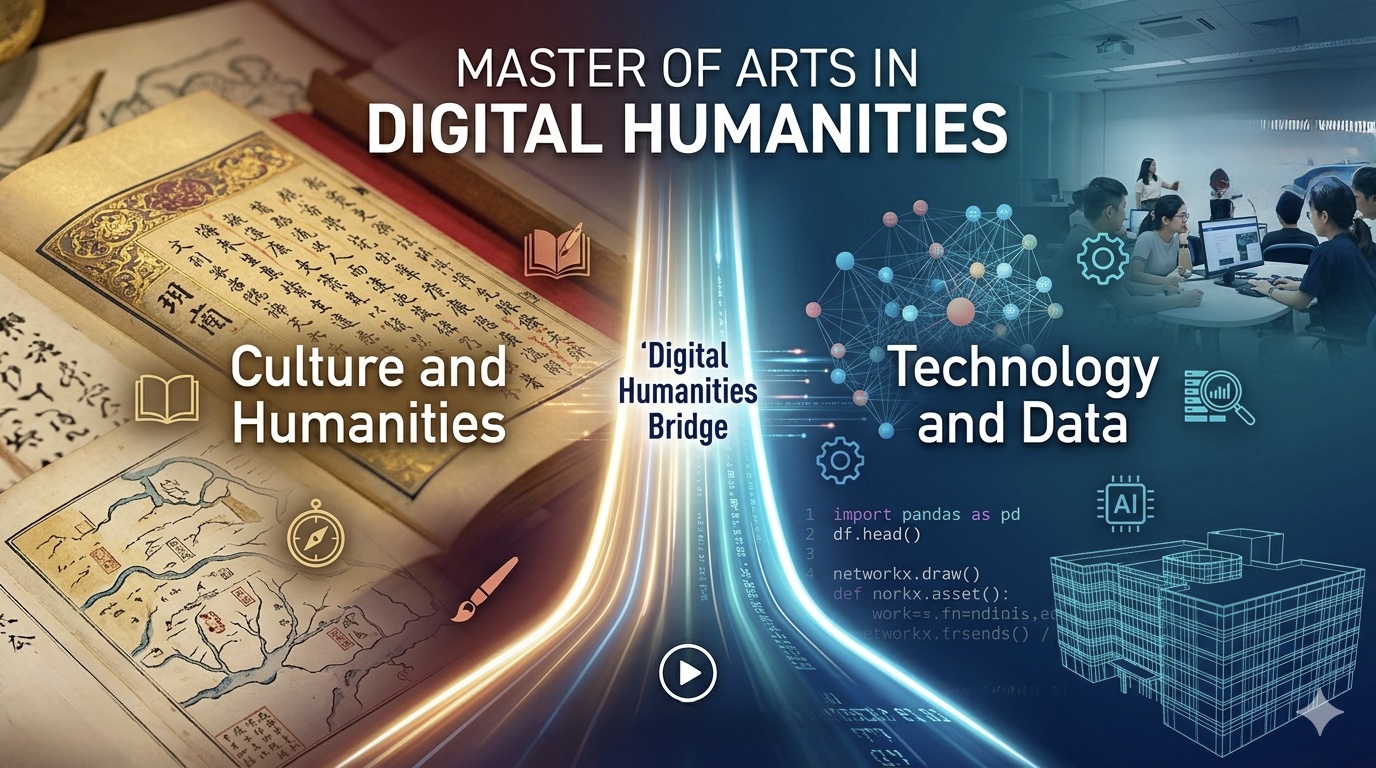
DIGITAL HUMANITIES, WHAT IS IT? As a fast-growing, interdisciplinary field of study that is gaining traction worldwide, Digital Humanities brings together the best of "digital" and the "humanities" by using using digital tools and data-driven methods to address human and social concerns, and tackling technological challenges through the lenses of the humanities, arts and social sciences. In today’s workforce, employers value individuals who combine technical expertise in areas like AI and data analysis with human-centred qualities such as empathy, creativity, and ethical reasoning to create technology that better serves people and society. |
PROGRAMME INFORMATION

- A good bachelor's degree in any discipline
- Good communication skills (written and spoken English)
- International applicants whose medium of instruction is not English at the tertiary level, the English language proficiency requirement is
- an IELTs score of 7, or
- minimum TOEFL score of 577 (paper-based), 233 (computer-based), or 100 (Internet-based).
- International applicants who have Bachelor's degrees from universities (must be at least 3 years of study) where English is the medium of instruction, TOEFL or IELTS results are not needed. However, documentary evidence must be provided for such cases. No prior course work or training in Digital Humanities is required.
Note: Meeting these criteria does not guarantee admission, as selection is competitive.
For details on the application process, please refer to the Coursework Programmes Admission Guide.
Mode and Duration:
Full-Time: 1 Year (2 Semesters)
Part-Time: 2 Years (4 Semesters)

UNIQUE FEATURES
- Interdisciplinary edge—carefully curated courses to broaden and deepen your knowledge of the “digital” and “humanities”
- Flexibility—choice of electives for designing a learning pathway that best aligns with your personal career objectives
- Uniquely Asian perspectives that increase your flexibility to adapt and face global changes in the volatile job market
- Career-ready training—knowledge and skills that are applicable to a broad range of industries
- Dynamic learning environment—access to leading expertise and research within the College of Humanities, Arts and Social Sciences
- Strong networks & support—mentorships, collaborations and lifelong connections beyond the classroom at Nanyang Technological University
PROGRAMME STRUCTURE
Compulsory Core 2 courses (6 AUs) | |
| Electives (24 AUs) | |
| Track 1: Full Coursework 8 courses (24 AUs) option of completing HD6997 Digital Humanities Project (3 AUs) | Track 2: Dissertation 6 courses (18 AUs) + Dissertation (6 AUs) |
Project
COURSES
1) Compulsory Core Courses 6 AUs
All students must complete both core courses to establish foundational knowledge in digital humanities.
HD6001 Foundations of Digital Humanities (3 AUs)
This course explores the historical and contemporary foundations of the humanities, focusing on influential thinkers who have shaped the field. It examines traditional inquiry methods in areas like philosophy, literature and history while addressing their evolution in the digital era. The transformative impact of digital technologies—such as AI, data visualisation, and text analytics—on humanities research is a central theme. Students will critically assess how digital tools are reshaping humanities research practices, pedagogy and public engagement.
HD6002 AI Ethics and Governance (3 AUs)
This course investigates AI concepts and analyses the potential risks and challenges associated with its use, including issues like bias, privacy, security and societal disruptions. It examines core principles and ethical frameworks for the responsible creation and deployment of AI systems. Additionally, the course will cover current and emerging regulations, standards and best practices for AI governance. Students will engage in discussions on AI's broader societal impacts, including implications for employment, human rights and decision-making.
2) Elective Courses 24 AUs
Apart from the project and dissertation, courses within this category cover a range of topics important to the Digital Humanities and are organized into two themes. In the Digital Methods theme, courses comprise computational methods for analysing and presenting digital data. They also include methods for understanding digital environments. In the Digital Society theme, courses focus on the social and cultural impact that arise from investigating digital data and/or digital environments. Courses also include specific domains or areas of interest studied by digital humanities scholars.
Digital Methods
HD6003 Applications of AI in Digital Humanities: Tools, Techniques and Projects (3 AUs)
This course examines the use AI in the digital humanities, emphasising tools and techniques that enhance analysis, interpretation and research. Students will be introduced to machine learning algorithms and concepts and processes for the analysis of large datasets. Natural language processing (NLP) for text analysis and machine learning applications to various humanistic datasets will also be covered. The course also introduces the role of generative AI in creating and analysing digital content, highlighting its potential for innovation, as well as the ethical challenges it presents.
HD6004 Digital Methodologies in Digital Humanities (3 AUs)
This course provides an applied introduction to research methods in Digital Humanities, combining traditional and digital approaches to studying people, societies and cultures. Topics include thematic, spatial and network analysis, with students engaging in hands-on exercises with diverse datasets and research collections. Emphasis is placed on critically evaluating digital humanities projects, allowing students to develop a nuanced understanding of their strengths, limitations and ethical considerations while gaining practical analytical experience.
HD6010 Programming for the Digital Humanities (3 AUs)
This course introduces programming fundamentals, with a focus on Python, a widely used programming language. Participants will learn to design, code, test and debug Python programmes while building a strong foundation in programming logic and best practices.
HD6011 Data Curation, Organisation and Preservation (3 AUs)
This course covers the principles of data lifecycle management, focusing on key concepts such as types of data, data architectures, metadata standards and best practices for archiving and preserving digital information.
HD6012 AI and Machine Learning for Social Data (3 AUs)
This course introduces students to core machine learning techniques and their implementation in Python, providing the skills needed to extract insights from diverse types of social and linguistic data for knowledge-building and decision-making.
HD6013 Texts to Tags to Data to Graphs (3 AUs)
This course provides experience using digital tools to construct your own corpus of tagged texts. Students will learn how to perform GIS visualisations and storytelling, before converting them into social network graphs for detailed analyses.
HD6014 AI in Interpretive Digital Research (3 AUs)
This course teaches students how to leverage generative pre-trained transformers (GPTs) such as ChatGPT, Claude or Gemini in the process of conducting qualitative research, addressing discrepancies between data quantity and detailed qualitative insights.
HD6015 Bringing Digital Humanities Projects to the Public through Transmedia Storytelling (3 AUs)
This course focuses on using multimodal digital storytelling techniques to transform data and research into engaging narratives that connect diverse audiences with digital humanities projects.
HD6016 Digital Ethnography: Methods and Applications (3 AUs)
This course introduces students to methodologies for studying online environments, communities and virtual worlds, emphasising the unique characteristics and dynamics of digital spaces.
Digital Society
HD6020 Sustainable Development in the Age of AI (3 AUs)
This course investigates the types and roles of information and communications technology, and digital innovations in advancing social, economic and environmental sustainability.
HD6021 Democracy in the Digital Age: Tools, Truths and Tactics (3 AUs)
This course explores the intersection of digital technologies, politics and democracy, examining how digital tools are transforming political campaigns, governance, and citizen engagement.
HD6022 Digital Knowledge Infrastructure: Tensions and Opportunities (3 AUs)
This course examines how advanced telecommunications and digital technology create powerful knowledge access systems while potentially fragmenting understanding into incommensurable knowledge universes.
HD6023 Culture and the Transformative Effects of AI (3 AUs)
This course explores the transformative potential of artificial intelligence in influencing and reshaping cultural landscapes, examining AI's impact on existing traditions and practices.
HD6024 Visual Integrity and Ethics for Digital Scholarship (3 AUs)
This course explores ethical challenges associated with digital tools in humanities, focusing on ethics, visual integrity and implications of generative AI in scholarly work.
HD6025 Digital Humanities in Global Asia: Critical Perspectives (3 AUs)
This course offers comprehensive exploration of digital humanities in Asia, emphasising regional perspectives and the transformative impact of digital technologies on Asian societies.
HD6026 AI, Robots and Humans (3 AUs)
This course examines the role of robots in society and evolving human-robot interaction dynamics, adopting a human-centred perspective on societal transformation.
HD6027 Communities, Platforms and Power (3 AUs)
This course examines digital platform dynamics and their impact on communities, focusing on how power is distributed, contested and exercised online.
TI6502 AI, ChatGPT and Machine Translation (3 AUs)
This interdisciplinary course explores the intersection of artificial intelligence, natural language processing, and translation studies.
HL6211 Writing & Editing for Digital Media (3 AUs)
This course focuses on developing professional writing and editing skills specifically tailored for digital platforms and media environments.
HL6212 Technology, Artificial Intelligence & Electronic Publishing (3 AUs)
This course examines the evolving landscape of electronic publishing and how AI and emerging technologies are transforming content creation and distribution.
HD6997 Digital Humanities Project (3 AUs)
- Faculty member from CoHASS schools
- Co-supervision with industry partner and faculty member
This project provides hands-on experience in designing and implementing digital humanities projects, allowing students to apply theoretical knowledge to real-world contexts. Students work with a faculty member through the entire project lifecycle, from conceptualisation to execution.
CAREER PROSPECTS
Graduates of Digital Humanities programmes worldwide have carved out exciting and impactful careers across sectors. With the unique skillset from our MA, you will be well equipped to pursue opportunities in industries such as business, finance, media, education, cultural heritage, social services, and technology.
Possible career paths include but are not limited to the following:
- Project Management & Business Consultancy
- Digital Content Marketing & Strategy
- Publishing, Media & Digital Storytelling
- Cultural Heritage & Archival Preservation
- UX, Learning Technologies & E-commerce Design
- Journalism & News Publishing
- Community Development & Social Innovation
Regardless of your career path, with a Digital Humanities Master's degree, you'll stand out as a professional who can step confidently into a technologically fluent and socially conscious workforce.
FEE INFORMATION
| Description | All Students (Singaporean Citizen, Singapore Permanent Resident and International Students) |
| Application Fee | $50 inclusive of GST |
| Deposit Fee | $5,000 Deposit fee can be used to offset the first tuition fee payment |
| Tuition Fee | $47,612 inclusive of GST |
| Miscellaneous Fee | Please access the link here for miscellaneous fee payable for all students. |
| Payment Schedule | Tuition fees will be collected on a Semester basis. Full-time students will be billed per semester over a period of one year, whereas part-time students will be billed per semester over a period of two years. |
| Note | Fees shown here are applicable to AY2026 intake only. All Singapore Citizens (SC) and Singapore Permanent Residents (SPR) are eligible for a S$5,000 tuition fee subsidy. *Additional fee subsidy of up to S$10,000 is available for qualifying needy SC/SPR students. All NTU alumni are eligible for a 10% tuition fee subsidy. *Terms & conditions apply |
- University reserves the right to revise its fees every academic year without notice.
- Students are advised to check back for the latest fee details.
- All fees listed are in Singapore dollars (S$).
| Withdrawal of Candidature | Request for withdrawal from a programme of study must be submitted to the School formally in writing. |
| Refund Policy | Request for refund must be made in writing and subjected to approval. In the event that a student wishes to withdraw from the programme, the application fee and deposit fee are non-refundable/non-transferable. |
Students who withdraw from the programme within 2 weeks after course commencement shall not be liable for the payment of tuition and miscellaneous fees.
Students who withdraw 2 or more weeks after course commencement shall be liable for the full tuition and miscellaneous fees.
MORE INFORMATION
Can I use SkillsFuture credits to fund my MA in Digital Humanities?
SkillsFuture Credit can be utilised for this programme. Please refer to the SkillsFuture Credits Website for more details.
SkillsFuture Fellowships
The SkillsFuture Fellowships are for Singapore Citizens with at least 10 years of working experience in the same, or related, industries or job functions. The award is worth S$10,000 and further details, eligibility, terms and conditions are available in the following link: https://www.skillsfuture.gov.sg/fellowships.
Why study at NTU CoHASS? What is your HASS Advantage?
In particular, joining our Master of Arts in Digital Humanities programme allows you to benefit from the research, knowledge and expertise generated from the following centres and schools within CoHASS for a well-rounded education:
- Digital Humanities Research Cluster
- Centre for Liberal Arts and Social Sciences (CLASS)
- NTU Centre for Contemporary Art Singapore
- Schools within CoHASS—School of Art, Design and Media, School of Humanities, School of Social Sciences, and the Wee Kim Wee School of Communication and Information
What are the benefits of studying an MA in Digital Humanities? What are the career prospects?
Possible career paths for Digital Humanities graduates include but are not limited to the following:
- Project management
- Business development and consultancy
- Digital content marketing
- Cultural heritage preservation
- Publishing
- Digital media and marketing
- News reporting
- Digital storytelling
- Learning technology designing
- Content strategy
- Business or user experience designing
- Community development
- E-commerce, and more
Our Master of Arts in Digital Humanities programme also prepares graduates for an academic career, should you wish to pursue Digital Humanities work as a research scientist or further your studies in Digital Humanities as a Ph.D. candidate.
What is the learning environment like?
- develop a safe and cohesive learning environment that supports meaningful interactions and in-depth discussions between you and your fellow students
- encourage you to ask questions, share ideas and take an active approach in your Digital Humanities learning journey
- guide you towards critical thinking, problem solving and the application of evidence-based learning strategies to actual global challenges that our faculty are solving, and
- promote lasting friendships and strong networks between students, faculty and staff.
Can I get research experience with the MA in Digital Humanities?
How are applications reviewed and when will outcomes be released?
Applications are reviewed on a rolling basis and may be assessed in batches throughout the admissions cycle. As each application progresses through the review stages, applicants may be contacted for additional information, receive status updates, or be notified of the outcome.
Depending on the information provided in an application, when it was submitted, and the total number of applications received, review and notification times can range between two to four months.
We advise submitting your application as soon as feasible for you. As review timelines can vary, we appreciate your patience while the process is ongoing. Applicants may check their application status at any time via the application portal: https://apps.ntu.edu.sg/COAL/
CONTACT US
For Enquiries:
Email to hass-pgc@ntu.edu.sg