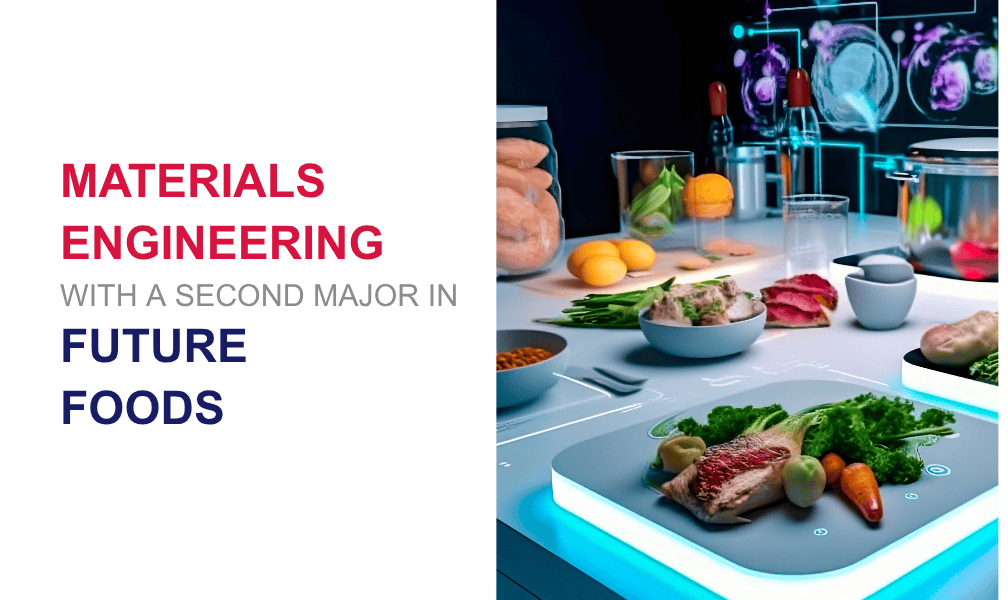
Shape the future of food with MSE — where materials science meets nutrition, sustainability, and innovation in our Second Major in Future Foods.
For students in the Bachelor of Engineering in Materials Engineering, the second major provides a distinct advantage: the ability to connect food innovation with materials science. MSE students learn to analyse materials at the micro- and nanoscale, understand environmental degradation of plastics, and explore sustainable development in water, agriculture, aquaculture, and materials innovation. By mastering materials analysis, eco-friendly innovations, and sustainability solutions, students are uniquely positioned to drive advances in:
- Smart and sustainable food packaging
- Eco-friendly materials for food systems and agriculture
- Future-ready technologies integrating food science and materials engineering
Graduates emerge with interdisciplinary training that equips them to shape the next wave of innovation at the intersection of food technology, materials science, and sustainability.
a) It is designed as a Second Major focuses on the broadening in learning and has been welcomed by the food industry.
Students must declare Track 1 or 2 by Year 2 Semester 1, after which a selection process will confirm their placement.
| Track 1 | Track 2 |
| Students will do a 1-semester exchange in Wageningen and complete all 5 FF electives at WUR as part of their FF requirement and one NTU elective course from Track 2. | Students will complete all their FF requirements with NTU courses. |
Certificate awarded upon completion of courses Second Major in Future Foods (Food Science and Technology) Signed by NTU & WUR | Certificate awarded upon completion of courses Second Major in Future Foods Signed by NTU |
Requirements for Second Major in Future Foods (FF)
- 5 Compulsory courses (15 AUs)
- 5 Second Major Electives (15 AUs) according to Track 1 OR Track 2
| 5 Compulsory courses (15 AUs) | ||
| Course Code and Name | Offering School-Prog | AUs |
| CH5220 Food Standard - Food Safety & Risk Assessment | CCEB-CBE | 3 |
| CH5222 Future Foods - Introduction to Advanced Meat Alternatives | CCEB-CBE | 3 |
| CH5210 Food Process Technologies and New Production Systems | CCEB-CBE | 3 |
| CH5211 Data Analytics in Food Systems | CCEB-CBE | 3 |
| CM5101 Food Chemistry & Nutrition | CCEB-CHEM | 3 |
| 5 Second Major Electives (15 AUs) | |||||
Track 1 Global Immersion / Exchange Programme in WUR | Track 2** Courses offered in NTU | ||||
| Course Code and Name | Offering School-Prog | AUs | Course Code and Name | Offering School-Prog | AUs |
| CH5200 Food Microbiology | WUR SBS-BS | 3 | AAQ10A Principles of Nutrition | NIE-NSSE | 3 |
| CH5201 Food Chemistry | WUR CCEB-CHEM | 3 | AB0603 Social Entrepreneurship | NBS-AB | 4 |
| CH5202 Food Physics | WUR CCEB-CHEM | 3 | BS4010 Synthetic Biology | SBS-BS | 3 |
| CH5205 Food Preservation Processes | WUR CCEB-CBE | 3 | BS4015 Plant Biotechnology | SBS-BS | 3 |
| CH5206 Food Quality Management | WUR CCEB-CBE | 3 | CH4303 Bioseparation | CCEB-CBE | 3 |
| One NTU Course from Track 2* | NTU | 3/4 | CH4306 Bioanalytical Techniques | CCEB-CBE | 3 |
| CH5221 Food Industry Seminar Series | CCEB-CBE | 3 | |||
| CH4013 Current Topics in Analytical Chemistry | CCEB-CHEM | 3 | |||
| CS4311 Promoting Sustainability | WKWSCI-CS | 4 | |||
| EM5109 Environmental Issues and Sustainability | CEE-EM | 3 | |||
| ES5006 Environmental Sustainability | ASE-ES | 3 | |||
| MS3014 Analysis of Materials | MSE-MS | 3 | |||
| MS4664 Environmental Sustainability and Materials | MSE-MS | 3 | |||
| MS4665 Sustainable Development in Water Agriculture and Aquaculture | MSE-MS | 2 | |||
| MS4666 Environmental Degradation of Plastics | MSE-MS | 1 | |||
*MS3014 Analysis of Materials MSE-MS
- You may choose any courses from the list offered by the various schools, as long as a minimum of 15 AUs is mapped. These courses should be planned without clashing with your core MSE curriculum, to ensure you complete all MSE AU requirements within the four-year programme.
- Courses highlighted in bold can be double-counted towards both the second major and core MSE requirements.
Graduates will gain interdisciplinary exposure that can open pathways into roles at the forefront of sustainable food technology and materials innovation, including:
- Food safety and quality management
- Alternative protein R&D
- Smart and sustainable food packaging
- Food process engineering and advanced production systems
- Environmental and agricultural sustainability
- Research and development in materials for food applications
71c552b9-56d0-4df7-a4b1-8ea31da180b9.png?sfvrsn=71e9d4da_3)