When the Map Doesn't Exist, You Draw One

For Dr Tang Xiaoli, a PhD was never about finding the right answers. It was about learning to ask questions that nobody had solved before.
Her fascination with computing began with a simple observation: how did shopping apps seem to know exactly what she wanted? That curiosity led her into recommender systems and, eventually, a deeper question about how artificial intelligence could learn from data without compromising people's privacy. It was this pursuit that brought her to NTU's College of Computing & Data Science (CCDS), where she began working with Associate Professor Han Yu on federated learning – an emerging field that allows organisations to train AI models collaboratively without sharing sensitive data.
As her research evolved, so did the complexity of the problems she wanted to solve. Rather than assuming organisations would willingly contribute data and computing resources, Xiaoli explored how incentives, market mechanisms and AI could work together to make collaborative learning not only privacy-preserving, but also economically sustainable. Her work brought together machine learning, auction theory, game theory and multi-agent decision-making to tackle problems with no established playbook.
That was precisely what drew her to research.
"There was no clear roadmap to follow," she says. "Many ideas that looked good at first simply did not work."
The early days of her PhD tested that resolve. Her first paper was not accepted until her third semester. Experiments failed. Research questions had to be redesigned. Papers went through multiple rounds of rejection and revision. At times, she questioned whether she was cut out for research at all.
Instead of chasing quick breakthroughs, Xiaoli changed her focus.
"Instead of worrying too much about the final result, I focused on understanding why an idea had failed and what I could improve next."
That mindset transformed the way she approached research. Every failed experiment became useful data. Every rejection became an opportunity to sharpen an idea. Looking back, the acceptance of her first paper marked more than an academic milestone – it was the moment she realised that meaningful research often advances slowly, built through persistence rather than sudden flashes of inspiration.
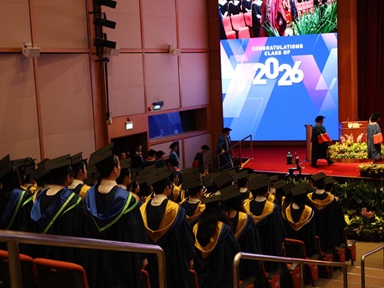
That perseverance culminated in one of NTU's highest academic honours – the NTU PhD Medal of Honour. Yet when Xiaoli learnt she had received the award, her first reaction was disbelief. Having applied simply to "give it a try", the recognition arrived at a pivotal moment as she prepared to enter the academic job market, reaffirming that years of persistence had been worthwhile.
Throughout that journey, she never saw research as a solitary pursuit. Daily conversations with her family kept her grounded through both successes and setbacks, while her supervisor and labmates challenged her thinking, helped untangle difficult problems and reminded her that even the most challenging questions are easier to tackle together.
Today, Xiaoli hopes to extend her research beyond data to the future exchange and coordination of AI models and intelligent agents, helping build AI ecosystems where organisations can collaborate securely while preserving privacy, autonomy and trust.
For students beginning their own journeys, her advice is refreshingly simple.
"Don't worry too much about having everything figured out from the beginning. Stay curious, try different things, and give yourself time to discover what you truly enjoy."
Because in research, as in life, there is rarely a map waiting to be followed.
Sometimes, you have to draw it yourself.